
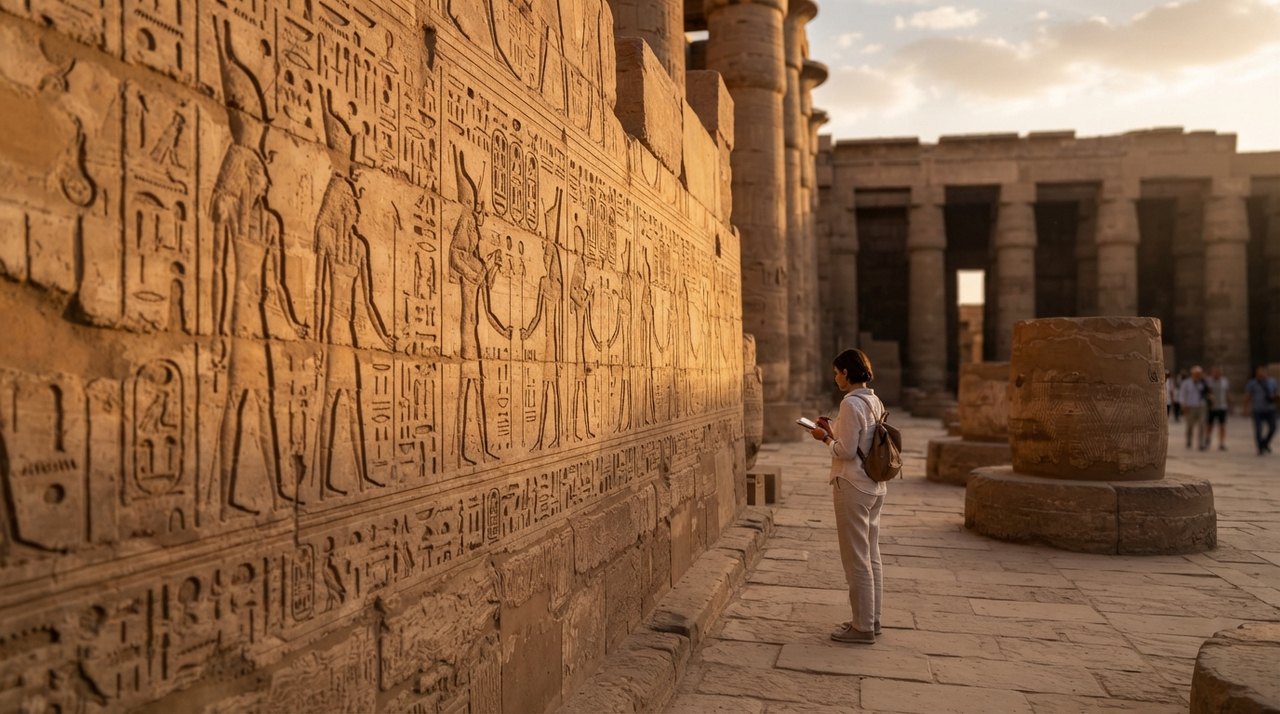
Ancient Kemet vs. Ancient Egypt: Understanding the Difference
Imagine standing on the Nile's banks at dawn, the sun gilding the rich, dark soil that cradles pyramid shadows. This fertile strip, vital to one of humanity's oldest civilizations, held a name whispered in ancient tongues: Kemet. Not Egypt—that came later, carried on Greek winds. Kemet (km.t) is the term the ancient Egyptians used for their land, meaning "the black land" of nutrient-rich silt. Egypt derives from the Greek Aigyptos, likely echoing the temple of Ptah at Memphis (Hwt-ka-Ptah). Today, invoking Kemet often signals an Afrocentric lens on African history or the vibrant Kemetic spirituality movement, reconstructing ancient wisdom. It's the same storied place, viewed through distinct prisms: one historical, one reclaimed.
What the Ancient Name Actually Was
In hieroglyphs, Kemet appears as km.t, a word etched across millennia. Linguistic evidence from sources like the Gardiner sign list and James Allen's Middle Egyptian deciphers it as denoting the black, alluvial soil deposited by the Nile floods—contrasting Deshret, the "red land" of arid deserts. E.A. Wallis Budge's Hieroglyphic Dictionary, though dated, catalogs these usages from pyramid texts to temple walls.
Linguistic Evidence and Historical Timeline
From the Old Kingdom (c. 2686–2181 BCE), when pharaohs like Khufu built Giza's wonders, to the Late Period (c. 664–332 BCE), Egyptians self-identified their realm as Kemet. Inscriptions on stelae and papyri, analyzed by scholars like Jan Assmann, reinforce this: the fertile valley was km.t, a cosmic gift sustaining sacred cycles.
This naming wasn't abstract; it rooted identity in the land's life-giving pulse. Deshret flanked it, embodying chaos tamed by Ma'at's order.
How the Greeks Renamed It—and Why 'Egypt' Stuck
Alexander's conquest in 332 BCE ushered Greek influence. Herodotus and Ptolemaic scribes dubbed the land Aigyptos, possibly from Ai-gyptos (House of the Ka of Ptah). This exogenous name endured through Roman, Byzantine, and Islamic eras, embedding in Western scholarship as "Ancient Egypt."
Colonial-era Egyptology, from Champollion's Rosetta breakthrough to modern academia, perpetuated it. Yet, as African history reframings emerged, Kemet resurfaced—not as replacement, but reclamation.
Modern Revival: Kemet in Afrocentric Scholarship and Kemetic Spirituality
Key Thinkers and Interpretations
Scholars like Cheikh Anta Diop, Theophile Obenga, and Molefi Asante championed Kemet to highlight Nile Valley contributions to world civilization, countering Eurocentric narratives. Diop's works interpret linguistic and cultural ties across Africa, framing Kemet as a cornerstone of continental heritage—distinct from Budge or Allen's philological focus.
Kemetic Spirituality Today
Contemporary Kemetic spirituality reconstructs practices like Netjeru veneration, heka rituals, and Nile-honoring festivals. Communities blend archaeological evidence with intuitive revival, diverging from academic Egyptology's caution. It's a living bridge to ancestral wisdom, emphasizing personal transformation over textual purity.
Why the Distinction Matters for African History
Using Kemet centers the civilization's self-perception, enriching African history discourse. It invites nuanced views: historical nomenclature versus modern empowerment, evidence versus ethos.
Frequently Asked Questions
Is Kemet More Correct Than Egypt?
Neither is inherently "more correct"—Kemet is endogenous, Egypt exogenously adopted. Context guides choice: Kemet for indigenous framing, Egypt for global scholarship.
Did Ancient Egyptians Call Themselves Kemetians?
They said "remet en Kemet" (people of Kemet), not a singular ethnic label. Identity flowed from land and divine order.
Is Kemetic Spirituality Ancient or Modern Reconstruction?
Primarily modern, drawing from ancient texts and artifacts while adapting to today—much like revivalist traditions worldwide.
What's the Relationship to African History?
Kemet anchors Nile Valley innovations in broader African narratives, fostering pride without erasing complexities.
As the Nile endures, so do these names—echoes of soil, scholarship, and spirit. Distinguishing Kemet from Ancient Egypt unveils layers of heritage, inviting deeper inquiry.
Join discussions and explore primary sources in Aetheria via The Guide as our current way to discuss, and Nile valley traditions for source surfaces.