
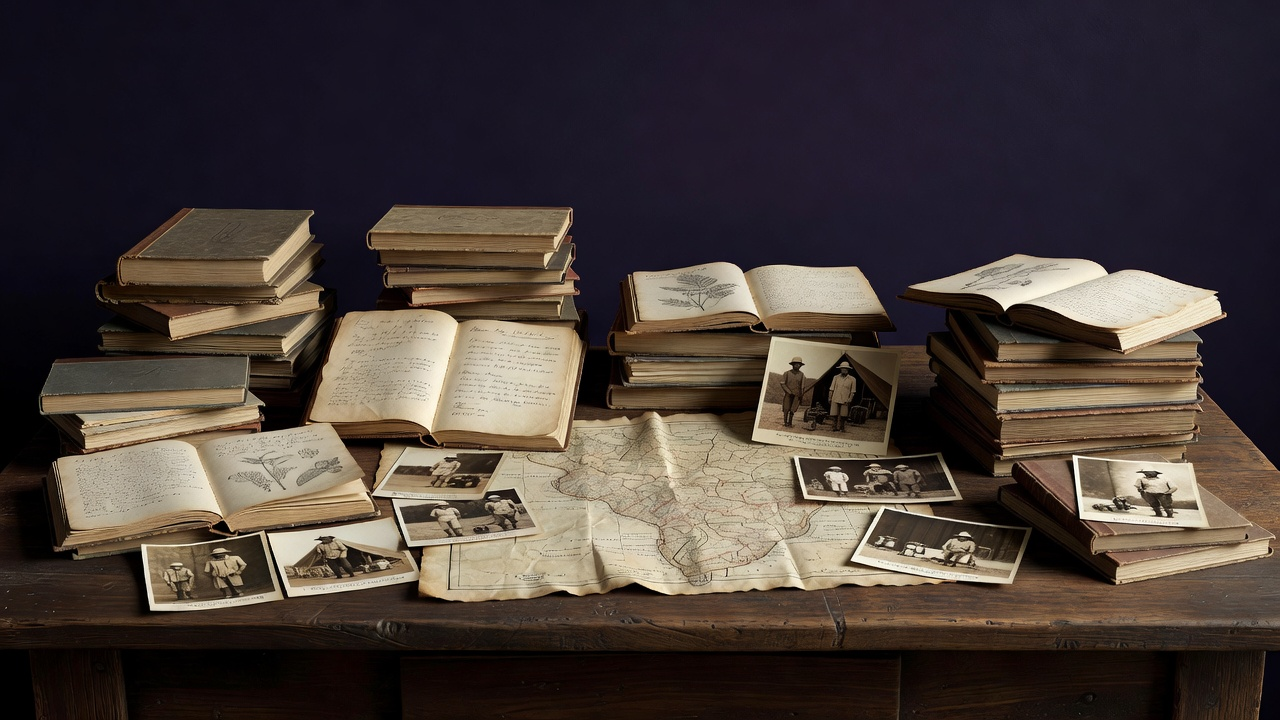
Anthropology's Colonial Legacy: A History from Armchair Theories to Decolonial Ethics and Community Authority
Picture a dimly lit study in Victorian London, 1871. Edward Burnett Tylor, Oxford's inaugural professor of anthropology, pores over travelers' tales and missionary reports. From his armchair, he sketches the evolution of human culture—from "savagery" to "civilization." It's a tidy ladder, with Europeans at the pinnacle. This scene captures the history of anthropology's origins, intertwined with empire's shadow. Why revisit this past? Because understanding anthropology's colonial roots isn't just academic housekeeping; it's essential for open inquiry today. It reveals how power shapes knowledge, urging us to question: Who speaks for whom? In an era of global crises, grasping the discipline's trajectory—from armchair speculation to decolonial ethics—equips thoughtful readers to engage its insights responsibly, bridging to fields like archaeology and history.
Anthropology emerged not in sterile labs but amid conquests, its methods forged in the fires of colonialism and anthropology. Early theories justified expansion; later fieldwork humanized the "other"; critiques now demand reciprocity. This journey illuminates research ethics, positionality, and community authority, challenging us to distinguish raw observation from laden interpretation.
The Armchair Era: Antiquarianism and 19th-Century Evolutionary Schemes
Anthropology's prehistory lies in antiquarianism—gentlemen scholars collecting curios from ancient ruins and distant lands. By the mid-19th century, it professionalized amid Europe's scramble for colonies. Context: Industrial Revolution fueled nationalism; Darwin's evolution inspired cultural parallels. Tylor and Lewis Henry Morgan championed unilineal evolution, positing societies progress through stages: savagery, barbarism, civilization.
Function: These theories ordered a chaotic world, legitimizing colonial rule. "Primitive" peoples were living fossils, ripe for uplift—or exploitation. Institutions like the British Museum amassed artifacts, often plundered, forming archives that still dominate today.
Limits surfaced quickly. Armchair anthropology relied on biased secondhand accounts from traders and missionaries, ignoring context. Classifications reduced diverse cultures to stereotypes, embedding racial hierarchies. Colonial legacies? Funding from imperial coffers; museums stuffed with unprovenanced bones and totems; knowledge extracted without consent.
Echoes in Modern Archives
Today, these collections spark repatriation debates. Consider Australian Aboriginal remains in Oxford—returned only after decades of advocacy. This era teaches positionality: scholars' Eurocentric lenses distorted data, a caution for cross-disciplinary bridges to archaeology, where similar biases interpret ancient civilizations.
The Fieldwork Revolution: Malinowski, Mead, and Participant Observation's Promise—and Pitfalls
Dawn of the 20th century: Bronisław Malinowski shipwrecks on the Trobriand Islands (1915-1918), notebook in hand. Exiled by World War I, he births intensive fieldwork—living among people, learning languages, observing daily life. His Argonauts of the Western Pacific (1922) details kula exchange rings, humanizing Melanesians beyond stereotypes.
Margaret Mead follows to Samoa (1925), exploring adolescence in Coming of Age in Samoa. Context: Post-WWI disillusionment; Boasian particularism rejects evolutionism, emphasizing cultural relativism. Function: Fieldwork yielded rich ethnographies, distinguishing observation (daily routines) from interpretation (cultural meanings), influencing policy from education to colonial administration.
Yet limitations abounded. Malinowski, a Polish exile in British territory, navigated colonial oversight; his functionalism explained societies as harmonious, glossing exploitation. Mead's work faced critiques for over-romanticizing, as Derek Freeman later argued with counterevidence from longitudinal studies. Colonial ties persisted: expeditions funded by governments, knowledge funneled to rulers.
Ethics in the Tent: Early Seeds of Reciprocity
No formal consent protocols existed; reciprocity was ad hoc—gifts exchanged, but power imbalances endured. Positionality emerged implicitly: researchers' outsider status shaped findings. Bridges to history appear in ethnohistory, blending fieldwork with archives for fuller narratives.
Mid-20th Century: Structuralism, Thick Description, and Cold War Contexts
Post-WWII, anthropology splits: Claude Lévi-Strauss's structuralism decodes myths as universal mind-patterns, from Brazil's Amazon to French salons. In the U.S., Clifford Geertz's "thick description" (1960s) layers symbols—Balinese cockfights as microcosms of status.
Context: Decolonization waves; Cold War pits West vs. East, anthropology aids development projects. Function: Theories abstracted from fieldwork, distinguishing community knowledge (local narratives) from imposed theory. Structuralism universalized; interpretive anthropology celebrated diversity.
Limits: Detached intellectuality ignored politics. Lévi-Strauss romanticized "untouched" tribes amid logging; Geertz's hermeneutics privileged elite texts. Colonial legacies lingered: U.S. funding via foundations tied to CIA; classifications informed counterinsurgency.
Counterevidence: Talal Asad's 1973 critique highlighted anthropology's complicity in domination. Ethics evolved—positionality formalized in introspective accounts.
The Reflexive and Decolonial Turn: Critiques from the Margins
1980s crisis: James Clifford and George Marcus's Writing Culture (1986) exposes ethnographies as authored fictions. Reflexivity demands: Reveal your position. Decolonial anthropology surges, led by scholars like Faye V. Harrison, critiquing Eurocentrism.
Context: Independence movements; postmodernism; indigenous rights. Function: Shifts authority to communities—collaborative ethnographies, co-authored works. Distinguishes theory (Western constructs) from community knowledge (oral histories, resurgence).
Research ethics transform: Informed consent mandatory; reciprocity means returning data, materials. NAGPRA (1990) mandates U.S. repatriation; global protocols demand benefit-sharing. Colonial legacies confronted: Archives digitized for source communities; museums deaccession.
Voices of Community Authority Today
Indigenous anthropologists like Audra Simpson (Mohawk) assert sovereignty in research; projects like the Native American Graves Protection Act empower tribes. Counterevidence: Not all decolonial efforts succeed—power asymmetries persist. Modern reception: Anthropology informs climate justice, linking to ancient civilizations' resilience studies.
Unpacking Colonial Legacies: Funding, Archives, and Repatriation
- Funding: Early grants from colonial offices; today, diversifying sources reduces bias.
- Archives: Western vaults hold non-Western stories—digital returns foster equity.
- Classification: Racial typologies debunked, yet haunt DNA studies.
- Museum Collecting: Benin Bronzes' saga exemplifies ethics debates.
These threads weave through eras, demanding positionality—acknowledging researchers' privileges—and community authority.
Cross-Disciplinary Bridges: Archaeology, History, and Beyond
Anthropology's history of anthropology intersects archaeology in material culture analysis—colonial digs parallel armchair raids. With history, ethnohistory reconstructs pasts; ancient civilizations gain nuance via ethnographic analogies, sans evolutionist pitfalls. Ethical reciprocity strengthens these bonds.
Toward Ethical Futures: A Reflective Next Step
Anthropology's arc—from Tylor's armchair to community-led praxis—mirrors humanity's quest for understanding amid inequality. Decolonial anthropology isn't erasure; it's amplification. For readers: Dive into a local archive, question a museum label, support indigenous scholars. History matters because it frees inquiry—position yourself, reciprocate knowledge, honor community authority. The next ethnography? Perhaps yours, ethically forged.
In tracing shadows, we illuminate paths forward.