
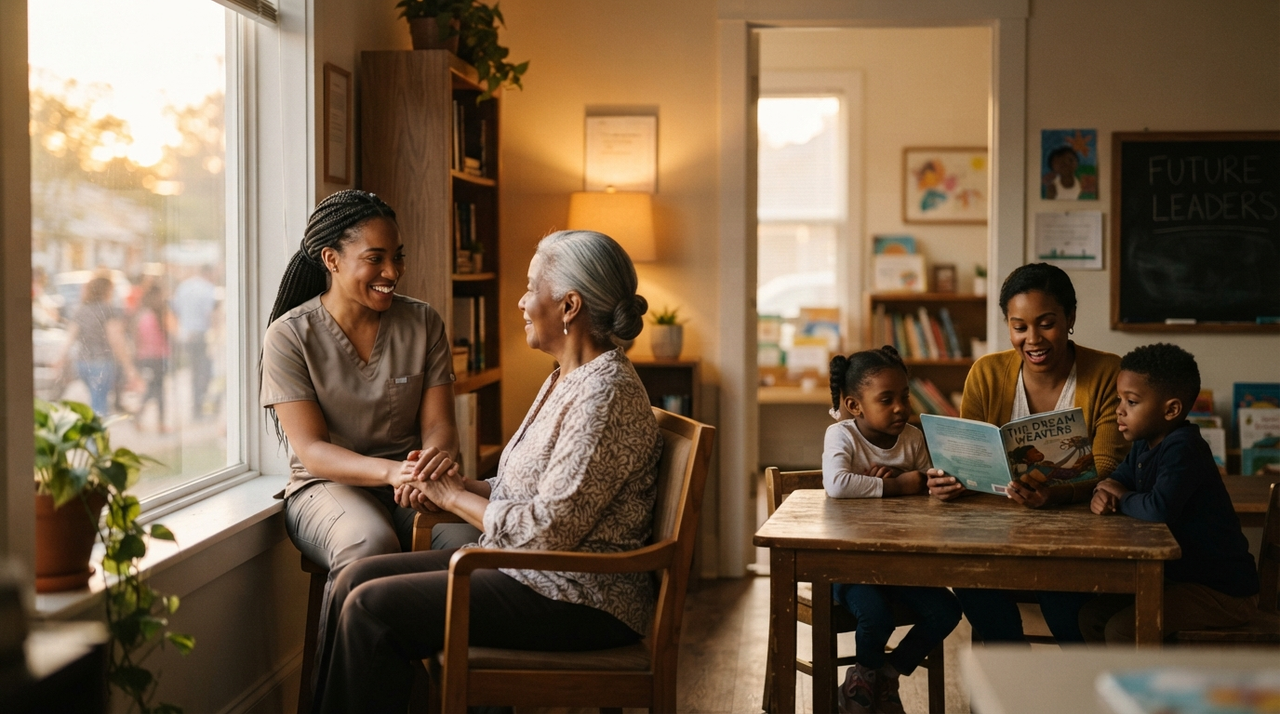
Care Infrastructure: Forging Human Futures in Households, Clinics, and Schools Beyond Tech Hype
A nurse steadies a patient's trembling hand in a crowded clinic ward. Flour dusts the air of a household kitchen as hands knead dough for the evening meal. Chalk scrapes across a blackboard in a sunlit classroom, drawing young minds toward tomorrow. These rooms pulse with the quiet labor that shapes human futures. Not algorithms or screens, but flesh and care.
Here lies the essence of care infrastructure: the foundational work of feeding bodies, mending wounds, imparting knowledge, and honoring the dead. Water carried to the thirsty. Meals prepared amid exhaustion. Lessons repeated until they stick. Burials conducted with reverence. This infrastructure sustains life across generations, forging community futures through everyday acts of social reproduction.
Defining Care Infrastructure in the Future of Care
Care infrastructure extends beyond pipes and wires. It encompasses the human systems that reproduce society: households as sites of nurturing and repair, clinics as hubs of healing, schools as forges of capability. These spaces demand ongoing investment in people over technology. Tools aid the work, from sturdy pots to stethoscopes, yet they never supplant the skill of the hand that holds them.
In conversations about the future of care, gadget narratives often eclipse this reality. Visions of automated companions promise efficiency, but they sidestep the burnout of unpaid household labor, the exclusions from clinical doors, the fatigue of teachers grading stacks of papers. True futures emerge when we center people over technology, recognizing care as the bedrock of education and medicine.
Historical Echoes: Communities Investing in Shared Care
Granaries as Lifelines in the Inca Empire
The Inca built qollqas, vast storehouses dotting Andean landscapes. These granaries held surpluses of corn and potatoes, distributed during droughts or wars. Communities treated them as public trusts, guardians of food security that ensured survival and continuity. Care here meant collective foresight, not individual hoarding.
Medieval Hospitals and Monastic Schools
In medieval Paris, the H��tel-Dieu served as a hospital where sisters tended the sick around the clock. Adjoining monastic schools taught reading and trades, preparing orphans and paupers for lives beyond charity. These institutions wove care into the social fabric, prioritizing communal thriving over private gain.
One-Room Schoolhouses in Rural America
Nineteenth-century one-room schoolhouses dotted American frontiers. A single teacher managed all ages, blending lessons with practical skills like mending clothes or planting seeds. These schools embodied care infrastructure, equipping youth for uncertain tomorrows through patient, adaptive teaching.
What Tech Hype Overlooks in Households, Clinics, and Schools
Gadget stories dazzle with seamless futures, yet they conceal the shadows: the invisible toil of household production that underpins economies, the clinic queues where the undocumented wait unseen, the schoolrooms where overworked educators face empty budgets. Unpaid household labor fuels growth but invites burnout. Education and medicine falter without addressing who performs the unglamorous tasks and who receives the care.
Links ripple outward. Robust care infrastructure bolsters health by easing family burdens, enriches education through stable homes, stabilizes economics via sustained labor forces, nurtures relationships in shared vulnerability, and grounds ethics in mutual obligation. Nonhuman life enters too: gardens in households, therapy animals in clinics, nature studies in schools.
Envisioning Plural Futures: An Invitation to Inquiry
Futures multiply through choices, not inevitabilities. Trends like aging populations signal rising care needs. Scenarios of decentralized clinics or cooperative schools offer paths. Forecasts hinge on governance: who funds the kitchens, staffs the wards? Speculation invites fiction, yet community choice anchors reality. Human agency persists amid uncertainty, favoring justice and care.
Of any proposed future, ask: Who tends the granaries, the beds, the chalkboards? Who remains outside the circle of care?
These questions reveal the true measure of progress. In households, clinics, and schools, we forge paths where people matter most.