
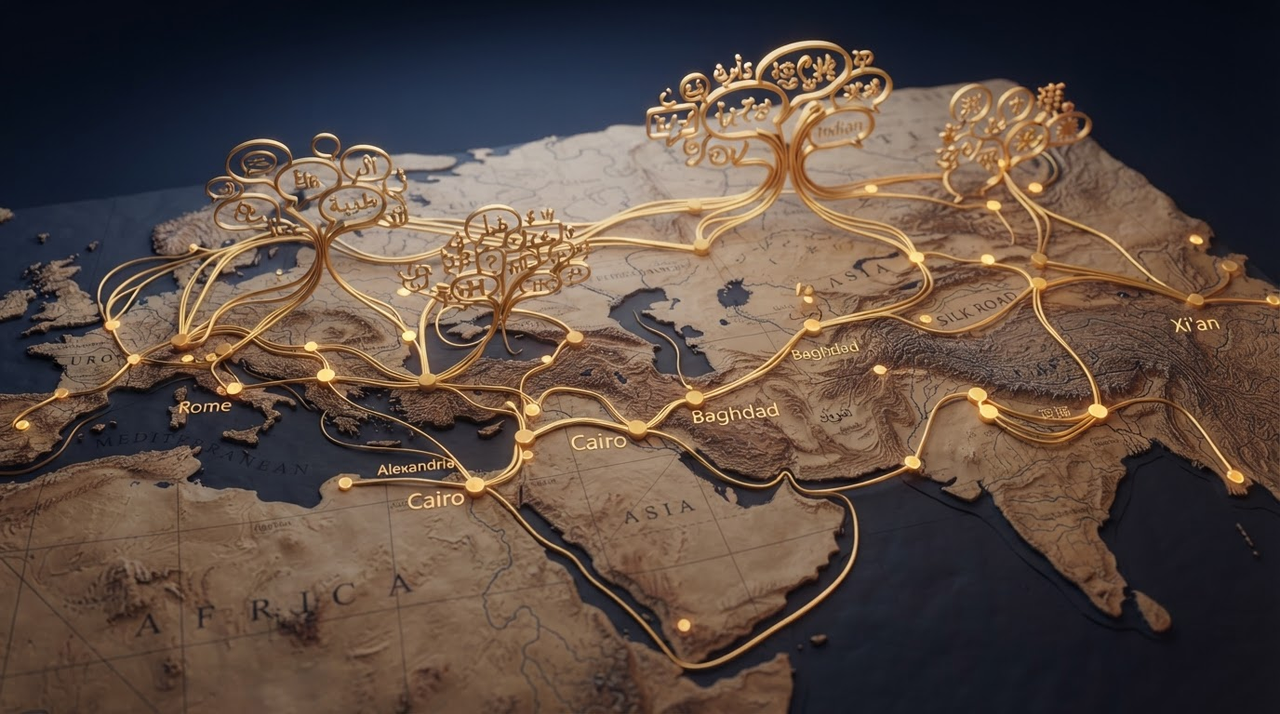
Language Contact as Social History: Pidgins, Creoles, Trade Routes, and Migration Linguistics
Imagine a bustling medieval port in Venice, where Venetian merchants haggle with Arab traders over spices, their words twisting into a makeshift blend of Italian, Arabic, and Greek. This wasn't chaos—it was language contact in action, etching social history into the very fabric of speech. From ancient Silk Road caravans to colonial plantations, human movement has forged linguistic hybrids that reveal tales of trade, migration, and power. For students of language history and cultural contact, these aren't mere curiosities; they're windows into anthropology and ancient civilizations, where tongues collide to map humanity's restless journey.
The Mechanics of Language Contact: Borrowing and Code-Switching
Language contact begins subtly, often through borrowing—words slipping across borders like contraband goods. English, for instance, absorbed thousands of terms during the Norman Conquest of 1066, turning "beef" from French boef into a staple while Old English speakers herded the cows. This isn't invasion by lexicon; it's pragmatic adaptation, driven by conquerors, traders, or neighbors.
Deeper interactions spawn code-switching, where speakers fluidly alternate languages mid-sentence. In modern Mexico City markets, vendors might pitch "¡Compre estos tacos frescos, very delicious!"—a nod to tourists that mirrors ancient bazaars. Such shifts highlight internal diversity within speech communities, challenging folk myths of "pure" languages frozen in time. Scholars see these as dynamic evidence of social networks, not dilution.
Pidgins and Creoles: Born of Necessity in Trade and Colonization
Pidgins as Trade Languages of the Margins
Pidgins emerge when groups with no common tongue forge a stripped-down trade language for bare essentials. Chinook Jargon, born in the 19th-century Pacific Northwest fur trade, mashed Chinook, Nootka, French, and English into phrases like klahowya (hello) and potlatch (gift-giving feast). Used by indigenous traders, Russian explorers, and Americans, it mapped economic alliances across rugged coasts.
Nigerian Pidgin, thriving in Lagos ports today, echoes West African slave trade routes, blending English with Yoruba, Igbo, and Edo for market banter and survival.
Creoles: When Pidgins Take Root in New Worlds
Creoles evolve when pidgins become mother tongues for communities, expanding grammars and vocabularies. Haitian Creole arose on 18th-century French Saint-Domingue plantations, fusing French with West African languages like Fon and Kikongo. Enslaved workers transformed overseers' commands into a vibrant system, complete with tenses and idioms, now spoken by over 10 million.
Jamaican Patois, rooted in British colonial sugar fields, weaves English with Akan and Twi, its rhythms pulsing in reggae lyrics—a testament to resilience amid forced migration.
Trade Routes and Migration Linguistics: Echoes of Empires
Migration linguistics traces how mass movements reshape speech. Swahili, a Bantu-based trade language along East Africa's Swahili Coast from the 8th century, incorporated Arabic loanwords via Indian Ocean dhows laden with ivory and gold. From Zanzibar to Kilwa, it linked Persians, Indians, and Africans, its script preserving tales of monsoon voyages.
Ancient Mesopotamia offers older proof: Akkadian served as a lingua franca for Sumerians, Hittites, and Egyptians around 2000 BCE, its cuneiform tablets logging diplomatic barters and wars. Roman legions, too, spread Latin borrowings into Celtic tongues, seeding Romance languages.
- Ports like Lisbon and Batavia accelerated contact during the Age of Sail, birthing pidgins amid spice hunts.
- Diasporas, from Romani travelers across Eurasia to Chinese coolies in 19th-century California, layered substrates onto host languages.
Scholarly Insights vs. Folk Purity Myths: An Anthropological Lens
Folk claims decry creoles as "broken" talk, lamenting lost purity. Linguists counter with evidence: these forms thrive with complexity rivaling any "standard." Anthropology reveals language contact as social glue, binding diverse groups in ports and frontiers. History and ancient civilizations unlock further doors—think Silk Road Sogdian as a medieval pivot language.
Communities boast internal diversity: urban Swahili speakers code-switch with ethnic dialects, mirroring global patterns. This mosaic underscores humanity's hybrid nature, inviting Aetheria linguistics explorers to probe deeper.
Why It Matters: Tracing Humanity's Shared Story
Language contact isn't relic—it's alive in global cities, fueling innovation. Pidgins evolve into creoles; borrowings seed revolutions. For students, it's a portal to anthropology's beating heart: how trade routes, migrations, and conquests scripted our tongues. What hidden pidgin lurks in your family's history? Dive in—the universe of words awaits your inquiry.