
Reciprocity, Redistribution, Long-Distance Trade: Coexisting Practices in Ancient Economic Anthropology
Three Paths for One Handful of Barley
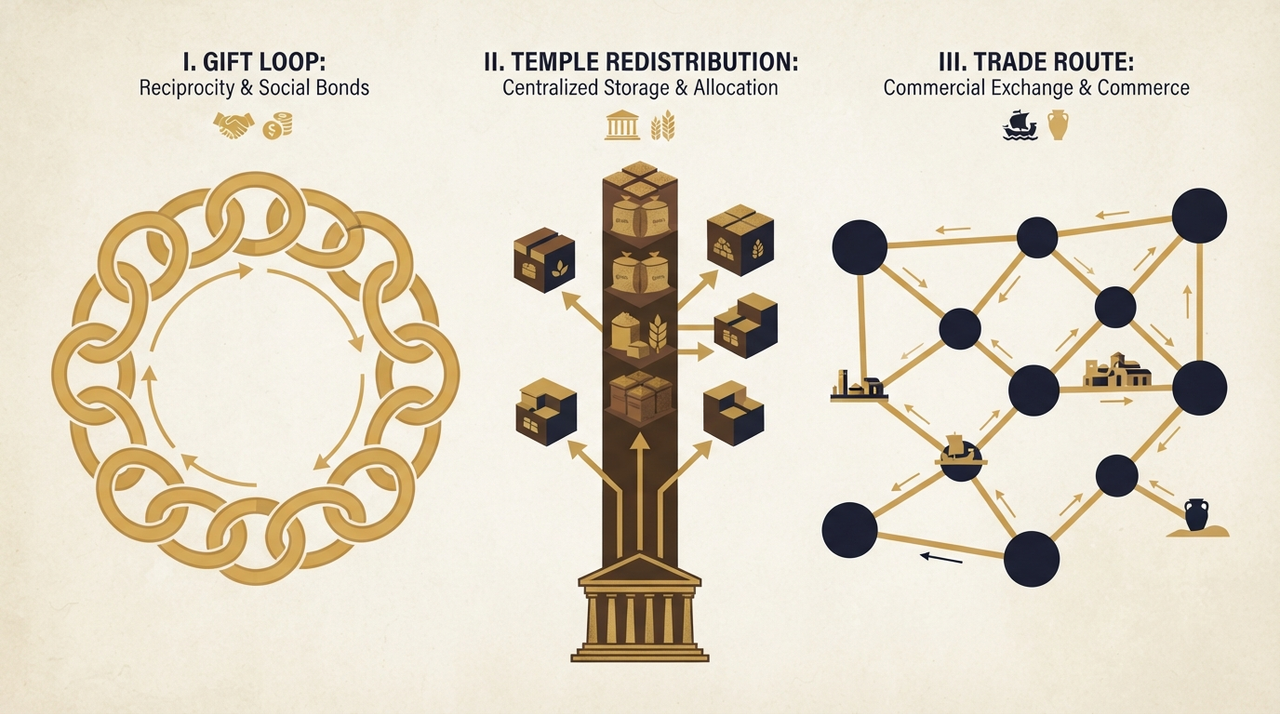
Imagine a single handful of barley in a Mesopotamian village around 2000 BCE. A farmer shares it with his kin after the harvest, fulfilling a spoken obligation from last season's drought. The next month, he carries a sack to the local temple granary, where priests record the delivery before allotting rations back to workers, including his family. Later that year, a merchant exchanges barley stores for copper tools brought along caravan routes from distant mountains. These movements happened among overlapping people, in the same fields and forums. They represent reciprocity, redistribution, and long-distance trade. None evolved into the others. Each thrived under distinct rules, institutions, and powers.
Economic anthropology invites us to track goods and obligations like this barley: through households, temples, palaces, and trade routes. Not as a unified "market," but as coexisting practices. Reciprocity binds kin and neighbors with delayed returns. Redistribution centers on temples or palaces that collect and re-allot. Long-distance trade deploys merchants with contracts across regions. Understanding these distinctions reveals how ancient societies organized flows without money-dominated markets or state capitalism.
Reciprocity: Named Ties Among Households
Reciprocity names specific obligations between ritual partners, neighbors, or kin. A farmer lends seed to his brother's household, expecting grain at harvest. These exchanges balance over time, enforced by social shame or oaths, not courts. Cuneiform letters from Old Babylonian villages show brothers swapping oxen or cloth, tracking debts in family ledgers. Unlike anonymous sales, reciprocity embeds care and subsistence within ongoing relations. It sustains households amid ecological limits, like irregular rains, without formal markets.
This practice differs from gift exchange in its routine, balanced form. It keeps informal flows visible, distinct from temple collections or caravan deals.
Redistribution: Temples and Palaces as Hubs
In southern Mesopotamia during the Ur III period (2100-2000 BCE), temples like those at Umma gathered barley from dependent lands. Scribes tallied deliveries on clay tablets, then issued allotments: rations for plowmen, weavers, and herders. Laborers received barley, emmer, and fish oil weekly, supporting thousands. Palaces in the north, like Mari, did the same with wool and silver.
Across the Andes, Inka storehouses, or qollqas, held maize and quinoa collected via labor tax from provinces. Rulers redistributed these during famines or feasts, tying subjects to Cusco's authority. These systems relied on coercion and record-keeping, not profit. Redistribution funnels goods centrally for stability, contrasting merchant ventures.
Long-Distance Trade: Assyrian Caravan Firms at Kanesh
At Kanesh in central Anatolia, around 1900 BCE, Assyrian family firms ran long-distance trade. Tablets from their trading colony detail contracts for tin and textiles hauled from Mesopotamia. Merchants advanced silver to partners, shared risks, and haggled prices with local Anatolians. A father dispatched sons with donkeys, instructing them via letters: sell high, buy low, avoid palace tolls.
This trade differed from redistribution. Palaces at Kanesh took tolls but did not organize caravans. Merchants used private contracts and family trust, bearing losses from bandits or bad deals. Goods moved for gain across ancient trade routes, intersecting but not merging with temple allotments.
Silver in One City, Under Three Rules
In Kanesh itself, silver circulated diversely. A trader gifted it to his ritual partner for a vow fulfilled (reciprocity). The palace allotted it as labor payment (redistribution). He bartered it for lapis from Afghan caravans (long-distance trade). Tablets capture these shifts: same metal, different ledgers, powers, and contexts. No single "economy" unified them.
What Sources Show and Hide
Cuneiform archives preserve elite views: scribes noted temple hauls, merchants their deals. Household reciprocity appears in letters, but unwritten exchanges wither. Sources favor visible coercion over quiet care.
Scholarly Debates: Beyond Polanyi's Stages
Karl Polanyi saw reciprocity, redistribution, and markets as successive forms, with trade marking modernity. The substantivist debate he sparked pitted embedded exchanges against formalist market models. Critics note these practices coexisted, as at Kanesh. No linear path from gift to trade. Instead, institutions like family firms or temple estates enabled each.
Connections and Inquiry
These practices link to Relationships door's gift ties, Business shelf's firm risks, History's routes, Politics' coercion, and Environment's limits. Unequal access persisted: elites controlled redistribution, merchants trade.
Next time you read a tablet or chronicle, classify its movement: reciprocity's kin debt, redistribution's allotment, or trade's contract? What room held it? Who enforced the rule? Such questions uncover ancient worlds without projecting our markets.