
Unlocking the Anthropology Door: Exploring Human Variation, Meaning, and Ethics in Aetheria's Cosmic Library
Imagine stepping into Aetheria's cosmic library, where shelves stretch into infinity, each volume whispering tales of human lives woven across time and space. Amid the glow of starlit tomes, one door beckons: the Anthropology Door. It doesn't promise tidy answers or grand theories. Instead, it invites students of existence to confront the central question of our humanity—how do we vary, and what meanings do we craft from those variations? In this cornerstone piece for the Aetheria Journal, we open that door with open inquiry, protecting the journey as we explore human variation and meaning without slipping into outdated hierarchies.
What the Anthropology Door Actually Holds
Behind the Anthropology Door lies no dusty archive of relics, but a living inquiry into the rich tapestry of human ways of being. Anthropology studies human variation and meaning across the full spectrum: bodies shaped by ecology and migration, languages that encode worldviews, kinship systems that redefine family, rituals that mark life's passages, economies that balance reciprocity and exchange, and adaptations to diverse environments. Here, biological and cultural threads intertwine yet remain distinct—genes influence traits, but culture amplifies, reshapes, and transcends them.
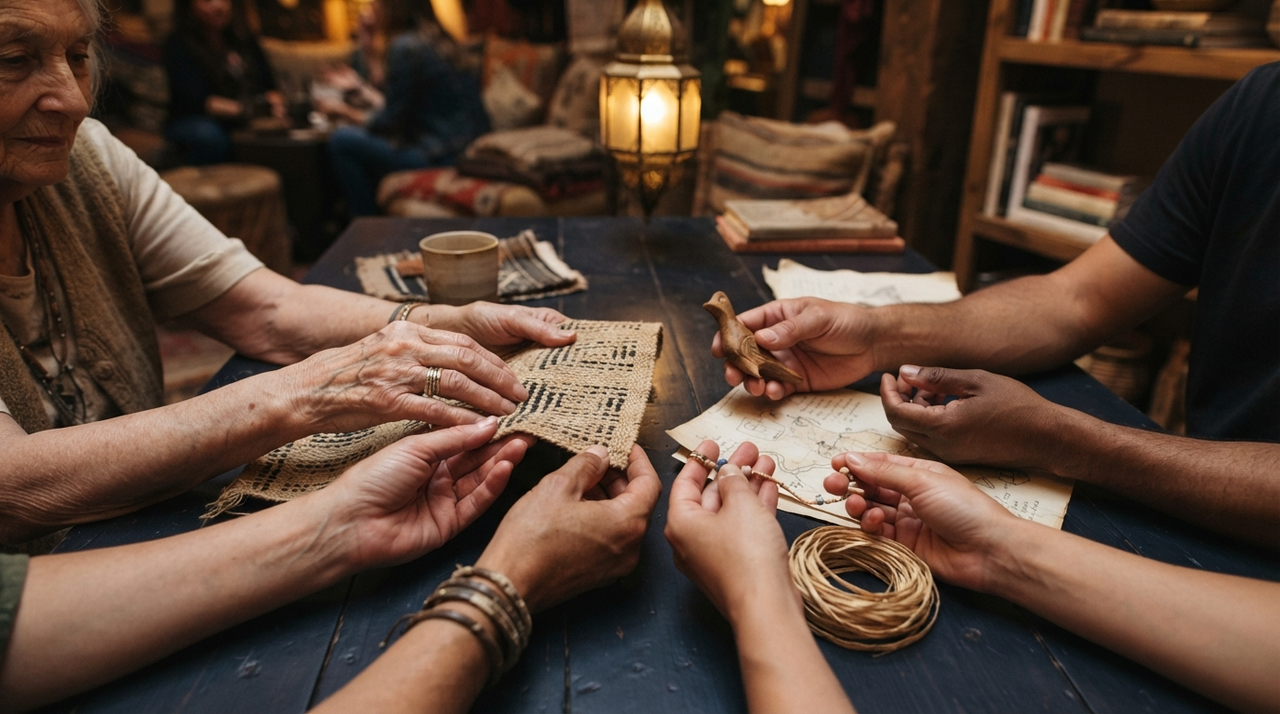
Picture a highland community where herders name kin through animal lineages, their songs echoing grazing patterns tied to seasonal rains. Or urban weavers in a river delta whose patterns symbolize ancestral migrations, blending craft with cosmology. The door emphasizes listening over lecturing: ethnography ethics demand we hear voices in context, not pluck them for exotic display. This is collaborative anthropology at its core—co-creating understanding with those we study, honoring positionality as our own lens shapes what we see.
A Brief Lineage of Anthropological Inquiry
Anthropology's path winds from early travel accounts—merchants' logs and explorers' journals offering raw glimpses of difference—to the disciplined art of ethnographic fieldwork. By the late 19th century, long-term immersion emerged, with participant observation becoming the hallmark: living among people, sharing meals, labor, and laughter to grasp meanings from within.
From Description to Reflexive Interpretation
Early efforts focused on description: cataloging tools, tongues, and taboos. But interpretation soon followed—decoding symbols, unraveling why a mask terrifies or a feast binds. The reflexive turn in the 20th century urged anthropologists to own their positionality: How does the observer's background color the observed? This paved the way for collaborative anthropology and Indigenous anthropologies, where communities lead the narrative, blending outsider curiosity with insider wisdom.
Ethical representation threads through all: distinguish fact (a village builds round huts) from interpretation (they symbolize cosmic cycles), always weighing power dynamics. No single authority governs; the field thrives on debate, urging us to avoid cultural hierarchy and embrace avoid cultural hierarchy as a guiding ethic.
How Seekers Can Approach Anthropology in Aetheria
Entering the Anthropology Door in Aetheria demands humility, like a guest at an unfamiliar hearth. Follow the Seeker's Code: approach with open inquiry, not extraction. Shun the hunt for 'exotic' details that exoticize; instead, consider your positionality—your cultural upbringing, privileges, blind spots—and journal them upfront.
- Keep comparisons contextual, not hierarchical: Note how two foraging groups adapt to scarcity, without ranking 'advanced' versus 'primitive.'
- Protect the journey: Pause when emotions stir—frustration at complexity, urge to simplify—and return to listening.
- Embrace ethnography ethics: Ask, 'Whose story is this? How might my words honor or harm?'
In Aetheria's cosmic library, this isn't armchair speculation. It's an invitation to collaborative anthropology, where seekers co-weave insights.
Common Misconceptions About Human Variation
Missteps abound at this door. Cultures aren't ranked on a single ladder of 'progress'—no society sits 'higher' because of tech or literacy. Tradition doesn't mean static; Amazonian shamans innovate with new plants, just as coders remix ancient myths in apps.
- Biological differences don't explain cultural complexity: Skin tones track sunlight, not intellect or morals.
- Anthropology can't 'speak for' others; it amplifies voices, never ventriloquizes.
- Humanity hasn't one story—nor infinite silos. Variation thrives in overlap, like shared laughter across tongues.
Dispelling these frees us to explore human variation and meaning responsibly.
Connections Across Batch 3 Humanity and the Wider Door Map
Batch 3 Humanity in Aetheria unites four doors as vital lenses: History (remembered time, where memory is culturally shaped), Ancient Civilizations (diverse social forms across epochs), Archaeology (material traces needing cultural interpretation), and Anthropology (study of human variation and meaning today). Together, they reveal how pasts echo in presents— a potshard from Archaeology gains life through Anthropology's kinship insights; History's oral epics parallel Anthropology's rituals.
Wider ties enrich: Consciousness explores mind's cultural molds; Psychology probes individual threads in collective webs; Linguistics decodes language as meaning's vessel; Ethics weighs just representation. These don't collapse into one claim but illuminate: Why does a symbol stir awe? How does ecology shape psyche? Use them to deepen, not dilute, the Anthropology Door.
Concrete Ways to Begin Your Inquiry
- Listen to one kinship term in context: Explore 'cousin' in English versus 'parallel cousin' in some African systems—note how it shifts alliances, without judging.
- Map one practice across three societies: Trace greeting rituals—from Inuit nose rubs to Japanese bows to Maori hongi—contextually, avoiding ranks.
- Journal positionality: Write: 'As a city-dweller, how might I misread rural rhythms?' Revisit weekly.
- Bring a respectful question to Community or Study Circle: 'How does your background shape your view of ritual?' Watch meanings unfold collaboratively.
These sparks ignite open inquiry, grounding abstract wonder in practice.
A Reflective Invitation Back to the Aetheria Community
As you linger at the Anthropology Door, remember: human variation and meaning aren't puzzles to solve, but horizons to approach with care. We've sidestepped cultural hierarchy, honored ethnography ethics and positionality, and championed collaborative anthropology—all to protect the journey.
In Aetheria's cosmic library, the stacks hold endless stories. Care for diversity as you turn pages.
Return to the Community, share your reflections in a Study Circle, and keep the door ajar. Students of existence, the inquiry calls—what variation will you listen to next?