
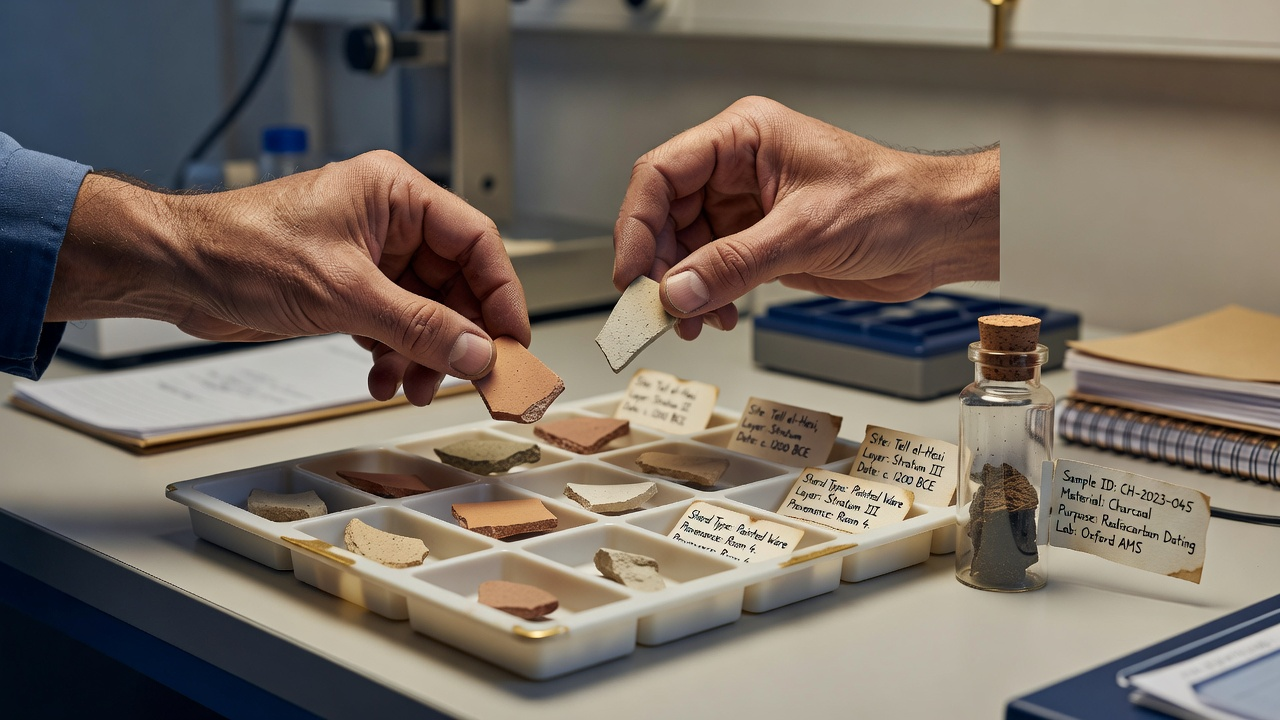
Archaeological Dating Methods Explained: Radiocarbon, Relative Dating, and Chronology Mastery
Picture this: you're knee-deep in a sun-baked excavation pit, brushing dirt from a fragile bone fragment. How old is it? A thousand years? Ten thousand? Pinning down the age of artifacts and sites is the heartbeat of archaeology, transforming scattered finds into coherent stories of human history. Yet archaeological dating methods are no crystal ball—they demand precision, skepticism, and a healthy respect for uncertainty. This guide unpacks relative dating and absolute techniques like radiocarbon dating, equipping you to master archaeological chronology with care.
We'll distinguish the broad strokes of relative dating, which sequences events without calendar years, from absolute methods that aim for specific dates. Along the way, we'll probe what each technique truly measures, grapple with calibration curves and error margins, and stress the power of converging evidence. No dramatic "history rewritten" claims here—just the tools for thoughtful interpretation.
Relative Dating: Sequencing Without Calendars
Relative dating methods form the bedrock of archaeological dating methods. They answer "before or after?" rather than "when exactly?" Think of them as ordering events on a timeline, like stacking books by publication date without noting the years.
Stratigraphy: Layers Tell the Tale
The law of superposition reigns supreme: in undisturbed soil, lower layers are older. A potsherd in a deep stratum predates one higher up. But beware—worm activity, animal burrows, or human disturbance can jumble layers, demanding vigilant context analysis. Stratigraphy excels at site formation processes, revealing what happened when, even if deposition lags behind an object's creation.
Typology and Seriation: Styles in Sequence
Artifacts evolve like fashion trends. Typology groups similar styles—say, arrowhead shapes—and seriation plots their popularity peaks. A site rich in late-stage types sits chronologically after one dominated by early forms. This relative dating shines for ceramics or tools but assumes cultural continuity, faltering with trade or invasion resets.
Absolute Dating: Anchoring to Calendar Time
Absolute methods strive for calendar years, yet they're tethered to specific events. Radiocarbon dates the moment an organism dies, not when a hearth's ashes settled or a bone was buried. Misalignments like these underscore why context matters.
Radiocarbon Dating: Cosmic Clocks and Caveats
Radiocarbon dating measures carbon-14 decay in organic remains. Living things absorb C-14; death halts intake, and the isotope decays with a 5,730-year half-life. Labs count remaining atoms via accelerator mass spectrometry for tiny samples.
Raw results? Uncalibrated "radiocarbon years BP" (before present, 1950 CE). Atmospheric C-14 wiggles, so calibration against tree rings or corals yields true calendar dates—often 14C 3000 BP becomes cal AD 1200 ±50 years. Error bars (±) reflect counting stats, sample quality, and curve fits; always report at 95% confidence.
- Contamination: Modern carbon skews young; rootlets or humic acids fool the clock.
- Old wood problem: Heartwood from long-dead trees dates centuries before use.
- Marine reservoir effect: Ocean uptake delays for shellfish.
Short-lived seeds or charcoal from annual plants minimize offsets, dating the event closer to deposition.
Beyond Radiocarbon: Dendrochronology and OSL
Dendrochronology counts tree rings, cross-matching patterns for exact annual resolution—perfect for wood up to 12,000 years. Optically stimulated luminescence (OSL) dates quartz grains' last sunlight exposure, ideal for sediments in caves or dunes, clocking deposition directly.
Mastering Archaeological Chronology: Embracing Uncertainty
Archaeological chronology thrives on integration. A single radiocarbon date is a probabilistic blur; stack multiples with Bayesian modeling for tight phases. Stratigraphy brackets dates; typology refines them. Converging lines—say, OSL on a layer matching calibrated C-14 from artifacts—build robust timelines.
Uncertainty bands aren't flaws; they're honest. A 5000–4500 cal BC range invites scrutiny, not dismissal. For deeper dives into statistical models, explore our Mathematics Door.
Chronology sequences evidence; meaning emerges from culture, economy, and context.
What Dates Reveal—and Conceal
A precise date confirms a sherd was made circa 2000 BC, placing it in a Bronze Age sequence. But it whispers nothing of the potter's beliefs, trade networks, or why it shattered. Dates scaffold history; interpretation breathes life into bones.
Pause now: for your latest find, jot what a date would tell you (temporal order, site phases) and wouldn't (social meaning, individual intent). This discipline sharpens every archaeological dating method into a tool for discovery.