
Mohenjo-Daro: Indus Valley Civilization's Urban Planning Marvels, Great Bath, and Harappan Seals
Picture this: a sprawling metropolis rising from the dusty plains of ancient Pakistan around 2600 BCE, its streets laid out in a precise grid, sewers humming beneath baked-brick homes, and a grand public bath drawing crowds for ritual immersion. No kings' palaces dominate the skyline. No monumental temples pierce the horizon. This was Mohenjo-Daro, the beating heart of the Indus Valley Civilization, a testament to urban planning ancient societies could only dream of matching.
Rediscovered in 1922 by archaeologist R.D. Banerji amid the floodplains of the Indus River in modern-day Sindh, Pakistan, Mohenjo-Daro—meaning "Mound of the Dead" in Sindhi—spans about 250 acres. Flourishing between 2600 and 1900 BCE, it housed up to 40,000 people in a society that prized order, hygiene, and trade over ostentatious power. As one of the world's earliest major urban centers, alongside Harappa, it challenges our notions of what "ancient" means when it comes to sophisticated city design.
Engineering Feats: Urban Planning Ancient Marvels of Mohenjo-Daro
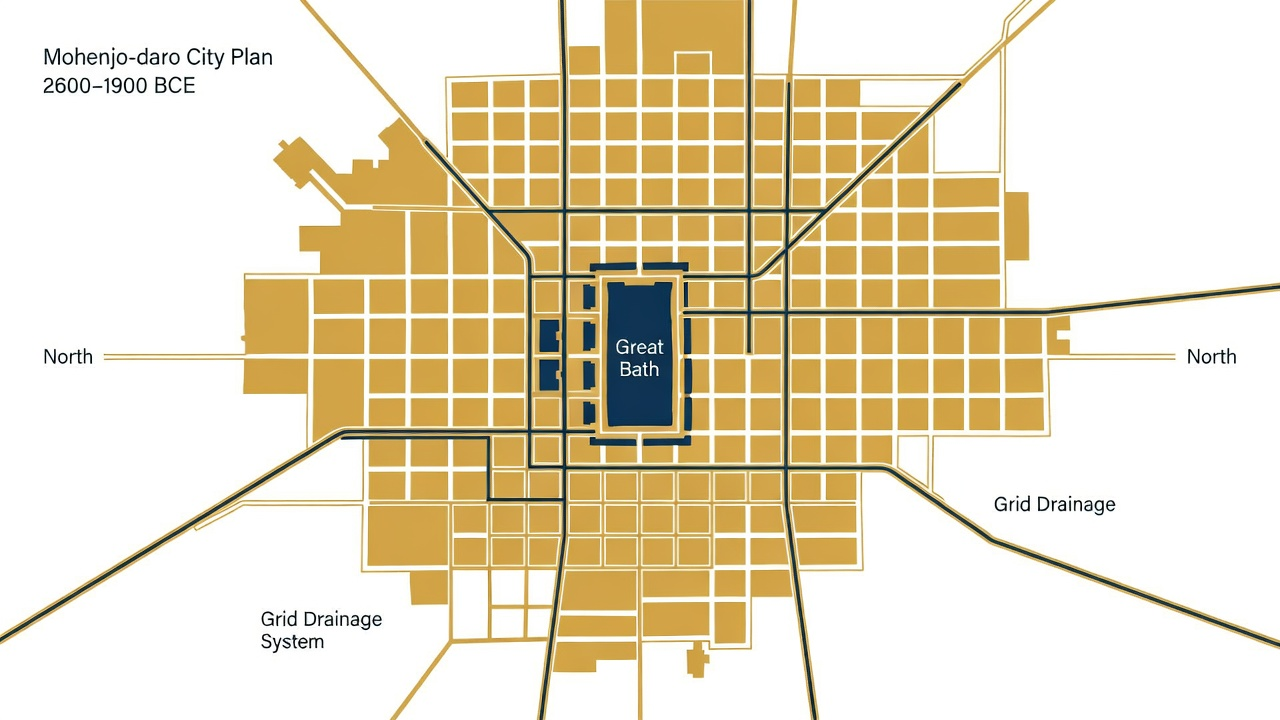
Step into Mohenjo-Daro's streets, and you're walking a blueprint for efficiency. The city divides into a raised "Citadel" mound for public structures and a lower "Lower Town" for residences, all aligned on a north-south grid intersected by east-west lanes. Major thoroughfares stretch 9-12 meters wide, perfect for carts and processions, while narrower alleys weave between homes.
What sets Indus Valley Civilization urban planning apart? Baked bricks—uniform at ratios like 4:2:1—form walls up to 3 meters thick. But the real genius lies underground: a drainage system channeling wastewater through covered brick-lined channels sloping gently toward the city's edge. Each house connects privately to this network via chutes and soak pits, ensuring cleanliness in a pre-plumbing era.
- Standardized Housing: Over 700 dwellings, from modest single-room units to spacious multi-story homes with courtyards, wells, and bathrooms—no grand mansions signaling inequality.
- Public Wells: More than 700 dot the city, spaced every 30-40 meters for easy access.
- Granaries and Warehouses: Massive structures on the Citadel suggest organized storage and trade in wheat, barley, and cotton.
- Weights and Measures: Cubical stone weights in binary progression (1, 2, 4, 8, etc.) point to a standardized economy reaching Mesopotamia.
This wasn't haphazard growth; it was deliberate design, treating the city as a living organism where water, waste, and people flowed harmoniously.
The Great Bath: Ritual Heart of Mohenjo-Daro
A Monument to Purity and Community
Atop the Citadel stands the Great Bath, a 12x7 meter watertight pool, 2.4 meters deep, lined with bitumen-sealed bricks and flanked by changing rooms, verandas, and a large assembly hall. Staircases descend into water once fed by adjacent wells, possibly changed for each use.
Was it for bathing rituals, healing, or seasonal festivals? Evidence leans toward communal purification, akin to later South Asian traditions, but its exact purpose remains a tantalizing mystery. Nearby wells and a corbelled drain hint at meticulous maintenance, underscoring the Indus Valley Civilization's obsession with water management.
Harappan Seals: Cryptic Emblems of a Lost Script
Over 2,000 tiny steatite seals unearthed at Mohenjo-Daro bear the iconic "unicorn" motif—a mythical creature beside a grid-like symbol—and short inscriptions in the undeciphered Indus script. Stamped with intaglio designs, these Harappan seals likely served as trade markers, amulets, or administrative tools, found on goods shipped afar.
The script, with 400-600 symbols in brief 5-7 sign bursts, reads right-to-left but defies decoding despite decades of effort. No bilingual "Rosetta Stone" exists, leaving voices, names, and beliefs silent. Yoga-like figures on some seals evoke continuity with later Indian iconography, yet Mohenjo-Daro stands as a distinct urban tradition, not a precursor mythologized beyond evidence.
In the quiet precision of these seals lies the Indus Valley Civilization's enduring puzzle: a literate, seafaring people whose words evaporate like morning mist over the Ravi River.
Decline and Legacy: Mohenjo-Daro's Silent Echoes
By 1900 BCE, Mohenjo-Daro emptied—perhaps from shifting rivers, drought, or migration. Skeletal remains show no invasion scars, just a gradual fade. Today, UNESCO-protected yet threatened by salinity and erosion, it survives as ruins, bricks crumbling under survival limits.
Mohenjo-Daro links directly to The Buildings Door, exemplifying how ancient urban planning shaped human habitats. In an age of megacities straining under waste and inequality, its grid, drains, and equity whisper lessons: true marvels endure not in scale, but in thoughtful design. What if we built like this again?