
Reconstructing Ancient Economies: Mesopotamian Ration Lists, Price Tablets, and Hidden Household Production
Picture this: a small clay tablet, no bigger than your palm, etched with cuneiform signs listing names like Lu-Nanna the potter and his wife, allotted thirty liters of barley each month. Nearby lies another tablet, recording the exchange rate for sesame oil at one shekel of silver per two hundred liters. Then imagine the dusty corner of an excavated house in ancient Ur, where jars once held emmer wheat, dried fish, and wool skeins, their contents long decayed but their shapes whispering of daily toil. These three objects, a ration list from Mesopotamia, a price tablet, and a household storeroom, form the starting point for reconstructing ancient economies. They pull us into the gritty reality of life five thousand years ago, where economic history methods reveal not just numbers, but glimpses of human striving.
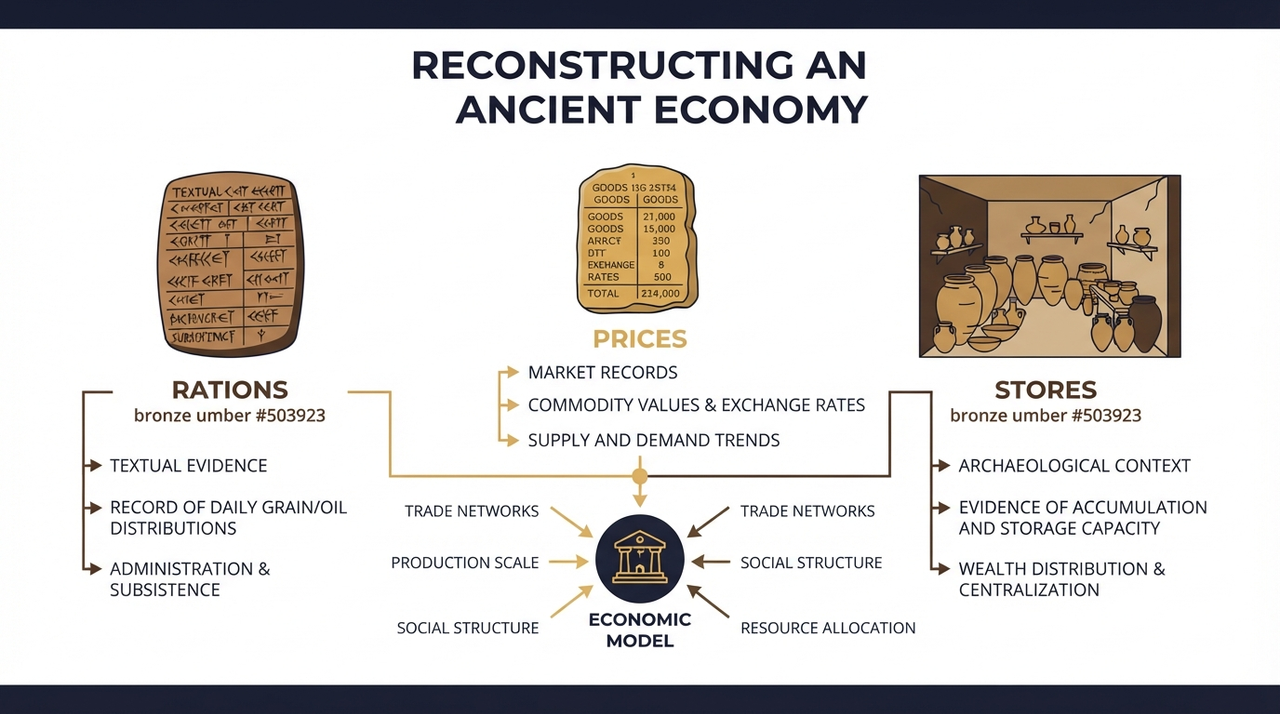
In the cradle of civilization, between the Tigris and Euphrates rivers, scribes captured fragments of economic activity on tens of thousands of clay tablets. Yet these records never tell the full story. Readers eager to grasp ancient economic history methods must learn to read between the lines, piecing together ration lists, price tablets, and archaeological traces of household production. This essay offers a practical toolkit for that work, suited for students of existence who seek open inquiry into how societies sustained themselves without modern ledgers or markets.
Ration Lists: Naming the Dependent, Silencing the Market
Ration lists Mesopotamia style dominated the archives of the Ur III period, around 2100 to 2000 BCE. These documents tracked distributions of barley, emmer wheat, and occasionally fish or cloth to temple and palace workers. A typical list from the city of Umma might enumerate hundreds of individuals: brewers receiving sixty liters monthly, weavers thirty, and children half that amount. The scribe noted gender, occupation, and family size, creating a snapshot of the labor force bound to institutional service.
What do they record? Dependence and control. Rulers used rations to motivate labor, doling out just enough calories for survival. An adult male plowman might get a sila of barley daily, about a liter, which, when milled, boiled, or baked, fueled a day in the fields. These lists expose hierarchies: higher allotments for overseers, lower for orphans or the elderly. They even hint at seasons, with extra grain during harvest.
But what do they hide? The bustle of markets escapes these tallies. Did Lu-Nanna trade surplus barley for tools at the city gate? Ration lists ignore such exchanges, focusing only on institutional flows. Barter with nomads, gifts to kin, or sales of homegrown vegetables vanish into silence. Moreover, rations measure inputs, not outputs. The tablet says nothing of the pots fired by the potter or the bread baked from that barley. To reconstruct economies, pair these lists with field surveys showing crop yields or zooarchaeological data on animal slaughter patterns.
Decoding Dependencies
Consider a list from Puzriš-Dagan, a livestock center. It records sheep rations for shepherds, but the sheep themselves, fattened on pasture, end up in temple feasts. The method here: cross-reference with slaughter reports. Suddenly, the economy expands beyond grain to meat, wool, and hides. Yet families receiving rations likely supplemented with garden plots or foraging, unrecorded pursuits that sustained the system.
Price Tablets: Equivalencies Without the Bazaar
Price tablets offer another lens, often from Old Babylonian times around 1800 BCE. These rectangular slabs list commodity values in shekels of silver: one shekel buys roughly thirty liters of barley, or a cubic meter of dates, or two liters of prime sesame oil. Scribes used them for loans, sales, or contracts, establishing ratios like the ma-na standard where silver anchored fluctuating goods.
They record standardization in a world of scarcity. In lean years, oil might equate to three shekels per two hundred liters, reflecting drought's bite. These tablets illuminate long-distance trade too: lapis lazuli from Afghanistan priced at sky-high rates shows elite demand trickling through networks.
Hidden, however, lies the informal economy. Barter dominated daily life; a farmer might swap onions for a haircut without silver changing hands. Gifts sealed alliances, dowries built families, and temple offerings flowed freely. Price tablets capture monetary poles, but not the web of reciprocity. To fill gaps, turn to lexical lists equating goods or legal texts detailing disputes over unpaid trades.
From Silver to Surplus
A tablet from Larsa equates wool at one shekel per two minas, hinting at textile output. But who spun that wool? Prices suggest value, yet ignore production chains. Combine with tool finds, like spindle whorls in every household, to estimate scale.
Storerooms and Household Production: The Archaeology of the Unwritten
Household production emerges from dirt and stone, not clay. Excavations at sites like Nippur reveal terracotta jars for oil, grindstones for flour, and loom weights tucked in corners. A single house might hold fifty storage vessels, their residues analyzed via spectrometry to identify beer, fish sauce, or pistachios.
These traces record self-sufficiency. Women ground grain into flour, brewed beer from barley malt, spun wool into thread. Men repaired tools, tended goats. Storerooms bulge with evidence: carbonized bread loaves in ovens, fish bones by hearths. Shipwrecks like the Uluburun off Turkey, laden with ten tons of copper ingots, copper oxhide, and ebony logs, attest to bulk trade feeding households.
What hides? Perishables and people. Papyrus receipts dissolved; names of home workers faded. Archaeology misses intent: was that storeroom for family or sale? Yet paired with texts, it builds the picture. A ration list names a weaver; whorls in her house confirm her output fed markets unlisted.
In the quiet of a Mesopotamian home, grain became bread, wool became cloth, and life persisted beyond the palace gates.
Navigating Scholarly Frames: Formalists, Substantivists, and Practical Methods
Later scholars framed these sources in debate. Karl Polanyi saw ancient economies as embedded in social relations, not rational markets; critics like Douglas North countered with supply-demand models. We sidestep full theory here, favoring reconstructing ancient economies through mixed evidence. Use ration lists for labor pools, prices for value scales, archaeology for volume. Ask: what surplus did households generate after rations? Test via seed ratios in trash middens, showing excess for trade.
The Shadow Economy: Unpaid Work and Social Bonds
Unpaid labor pulses beneath records. Women’s household production processed rations into meals, textiles for trade. Enslaved people, captured in wars, toiled in fields without allotments noted. Corvée drafts sent farmers to canals yearly, their sweat unpriced. These cross to Relationships and Ethics Door: economy as kin and obligation, not wage.
- Women brewed beer, a staple earning silver informally.
- Slaves herded temple flocks, rations proxy for control.
- Corvée built irrigation, enabling all production.
Method: tally female names in rations, match to spindle finds. Estimate brewing from jar counts. Shadows gain form.
Avoiding Modern Traps in Ancient Economic History Methods
Beware analogies. No GDP tallied output; temples coordinated, not firms competed. Entrepreneurs? Traders risked, but kin networks buffered. Labor sought sustenance, not optimization. Stick to evidence: rations cap calories at subsistence, storerooms show diversification.
Cross-Doors: Linking Evidence Across Disciplines
Enrich methods via doors:
- Archaeology Door: Residue analysis quantifies hidden production.
- History Door: Kings’ annals contextualize famines.
- Economics Door: Model flows without capitalism.
- Technology Door: Irrigation tech scales yields.
Your Turn: Cook the Invisible Grain
Pick a ration list, say from Umma. Note the barley for a family of four. Ask: who milled it? Who kindled the fire, stirred the pot? That grain, never appearing in ledgers, nourished the scribes themselves. In this inquiry, economies live. For students of existence, ancient economic history methods unlock not just past wealth, but enduring human craft.
Explore further in Aetheria Journal’s Business Door. The universe awaits your questions.