
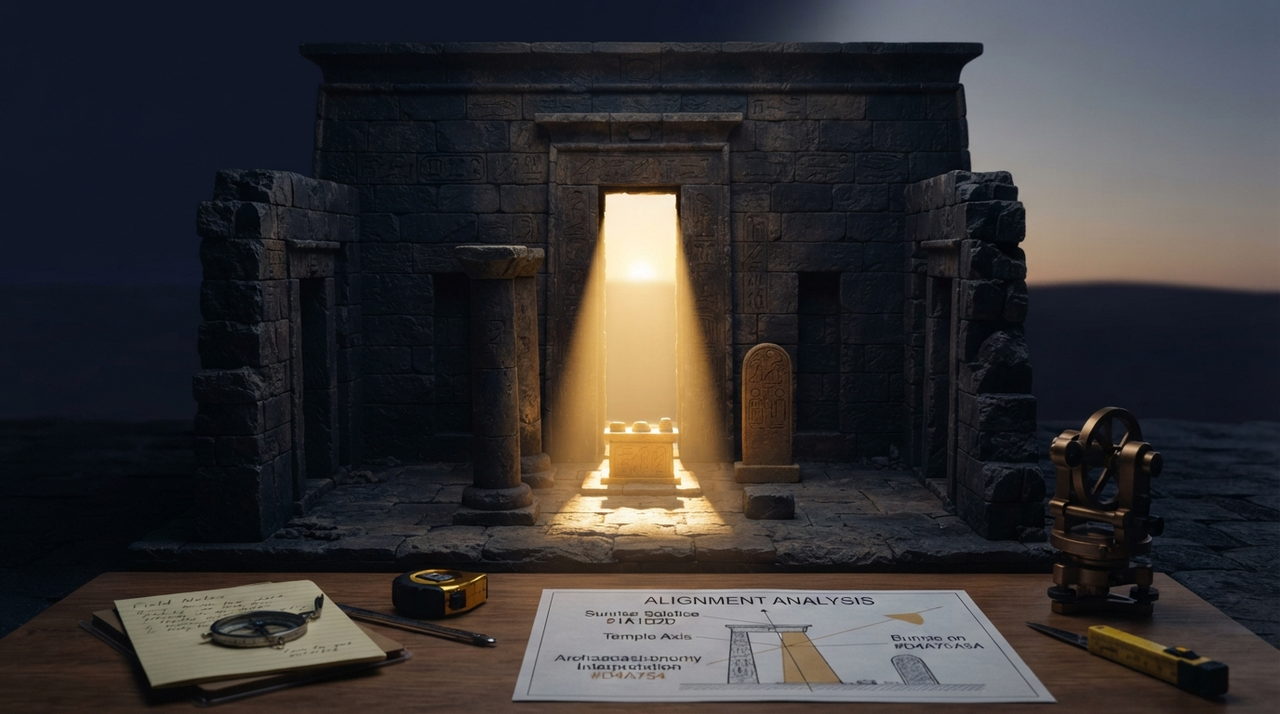
Stars Aligned with Stone: Archaeoastronomy Reveals Temple Alignments at Newgrange and Karnak
Imagine standing in the chill dawn of a winter solstice, eyes fixed on a narrow passage where a beam of sunlight pierces the darkness like a divine finger. This isn't fantasy—it's the reality at Newgrange, an ancient tomb in Ireland where stones whisper secrets to the stars. Archaeoastronomy, the study of how ancient peoples tracked celestial events through their monuments, unveils these cosmic connections. From temple alignments at Karnak to horizon astronomy at Chaco Canyon, evidence suggests our ancestors were keen skywatchers, building what some call ancient observatories. But was it intention or coincidence? Let's explore.
Unveiling the Sky: What Archaeoastronomy Reveals
Archaeoastronomy bridges archaeology and astronomy, scrutinizing monuments for celestial ties. It probes temple alignments, asking if orientations toward solstices, equinoxes, or lunar standstills were deliberate. Unlike modern tools, ancient builders relied on naked-eye horizon astronomy—observing sunrises and sunsets against the landscape to mark time.
Survey methods are rigorous: researchers use theodolites and GPS to measure azimuths (compass bearings) precisely. They model horizons with digital terrain data, accounting for hills that might shift apparent rise points. Statistical tests gauge chance—aligning perfectly with a solstice by random luck is improbable, like flipping heads 20 times in a row. Yet skeptics note selection bias: with thousands of sites, some alignments emerge by happenstance.
Newgrange: Passage Tomb as Celestial Calendar
Winter Solstice's Golden Light
Built around 3200 BCE, Newgrange in Ireland's Boyne Valley predates Stonehenge and the pyramids. Its 19-meter passage aligns to 508° azimuth, capturing the winter solstice sunrise. On December 21, sunlight floods the chamber for 17 minutes, illuminating carved spirals. Excavations by Michael O'Kelly in 1968 confirmed this; crowds now gather yearly to witness it.
Horizon astronomy here is key—the nearby hills frame the exact rise point. Nearby tombs like Knowth show lunar alignments, hinting at sophisticated knowledge. But interpretations vary: ritual rebirth symbolism? Agricultural calendar? No texts survive, leaving room for debate.
Karnak: Egyptian Temple Grid and Stellar Precision
Solar and Stellar Sightlines
In Luxor, Egypt, the Karnak Temple Complex spans centuries, its axes aligned to cardinal directions with solstice precision. The main east-west axis targets summer solstice sunrise at 63° azimuth. Juan Belmonte's surveys show pylon gateways framing heliacal risings of Sirius, linked to Nile floods in ancient lore.
This temple alignment suggests intentional horizon astronomy. Yet processional changes over 2,000 years complicate claims of original intent. Counterevidence includes slight deviations, possibly from Nile shifts or construction drift. Still, the pattern across Egyptian sites bolsters the case for purposeful celestial orientation.
Chaco Canyon: Puebloan Ancient Observatories?
Sun Daggers and Lunar Cycles
In New Mexico's Chaco Canyon, 11th-century Puebloans erected great houses like Pueblo Bonito. A slit in Fajada Butte's slabs creates 'sun daggers' marking solstices and equinoxes on a spiral petroglyph—discovered by Anna Sofaer in 1977. Casa Rinconada's niches align to solstice sunbeams.
Archaeoastronomy surveys reveal window alignments to lunar extremes every 18.6 years. Critics argue natural erosion formed the daggers, and statistical analyses question uniqueness. Nonetheless, the site's road networks and kivas suggest communal skywatching rituals.
Intentional Design or Cosmic Coincidence?
Claims of encoded mathematics—like pyramid pi ratios—or tuning to 432Hz frequencies lack robust evidence and often stem from fringe sources. Mainstream archaeoastronomy attributes alignments to practical needs: calendars for farming, rituals tying earth to heavens. Uncertainties persist—did builders compute precession? Tools were simple, yet repeatable observations sufficed.
For further reading, explore Clive Ruggles' Ancient Astronomy or the SEAC journal. These sites invite us to gaze upward, honoring ancestors who saw the universe as a grand, aligned story.
In stones that endure, stars find their echo—reminding us the sky has always guided human hands.