
Tracing Ancient Trade Routes: Lapis Lazuli, Obsidian, and Indus-Mesopotamia Connections
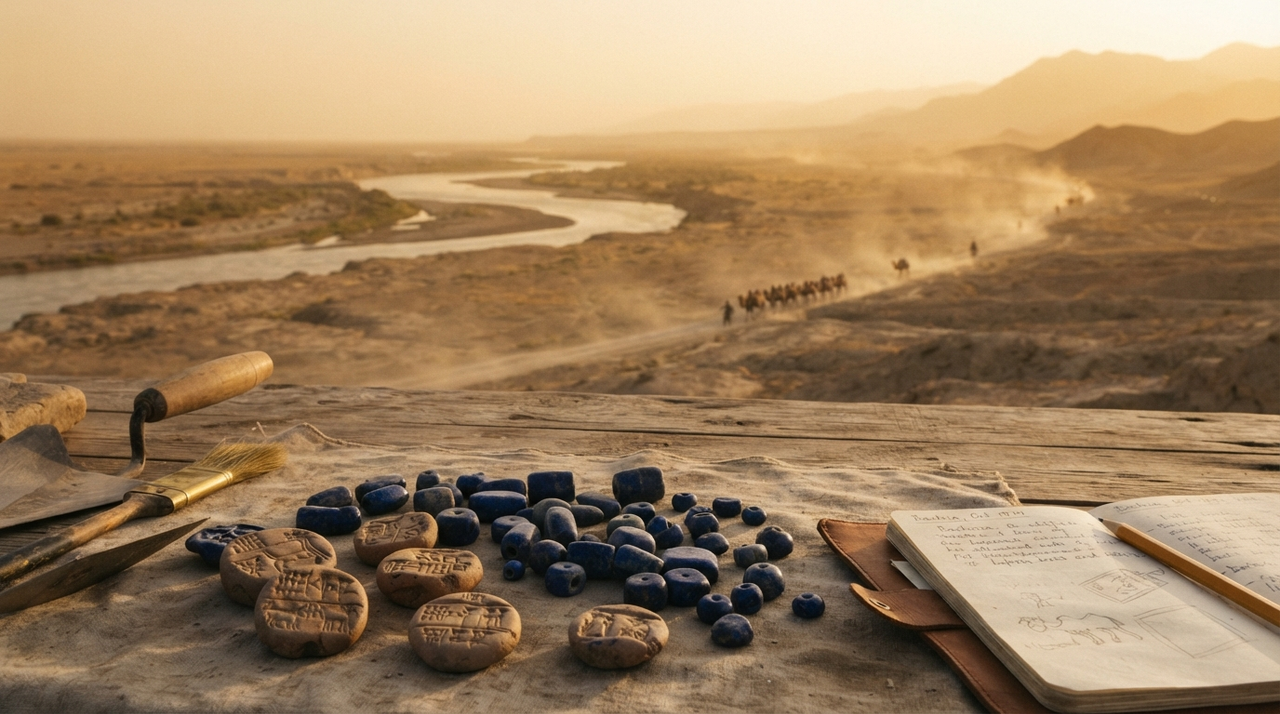
Imagine a weary porter, sweat-streaked under the Hindu Kush sun, hefting a sack of shimmering blue stones across jagged passes. Not for kings alone, but for the hands that shaped them—artisans, traders, families sustained by the rhythm of ancient trade. Long-distance exchange wasn't mere elite luxury; it was the pulse of material movement, leaving indelible fingerprints on pottery shards, grave goods, and cuneiform tablets. In Aetheria's Knowledge Library, we trace these threads through archaeology, revealing interconnected ancient worlds driven by everyday people: sailors battling monsoon swells, seal-cutters etching motifs of cultural contact, porters bridging deserts and seas.
This exploration spotlights concrete artifacts—lapis lazuli, obsidian, and Indus carnelian beads—unveiling Indus-Mesopotamia trade and beyond. Chemical sourcing pins their origins; distributions map the routes; texts whisper of merchants. Yet inferences have limits: no grand diffusionist tales, just bounded comparisons of pathways, overlapping chronologies, and functional contrasts between prestige gems and bulk tools.
Lapis Lazuli: The Celestial Stone's Epic Trek
Sourced from Badakhshan's remote mines in modern Afghanistan, lapis lazuli reached Sumerian Ur around 2600-2000 BCE, adorning Queen Puabi's headdress and temple inlays. Archaeological evidence shines through: trace element analysis via neutron activation confirms the stones' Himalayan provenance, with beads and plaques scattered from Pakistan's Mehrgarh to Mesopotamia's royal tombs. Distribution patterns reveal overland caravans snaking through Iran, perhaps skirting the Persian Gulf.
Textual hints emerge from Mesopotamian records, like inventories listing "lapis from the mountains," but direct merchant archives are scarce pre-2000 BCE. Everyday heroes fueled this: miners chipping veins at 5,000 meters, porters relaying loads in 20-kilometer shifts, Meluhha (Indus) traders docking at Dilmun (Bahrain) entrepôts. Functional prestige defined it—sky-blue symbol of divinity—yet limits persist: was it direct Indus-Mesopotamia trade or multistage relay?
Obsidian: Volcanic Glass on the Move
From Anatolia to Levantine Workshops
Obsidian, nature's sharp-edged scalpel, journeyed from central Anatolian volcanoes like Cappadocia to sites across the Levant and Mesopotamia by the fourth millennium BCE. Chemical sourcing—X-ray fluorescence—matches blades from Jericho and Tell Brak to Göllü Dağ quarries, 800 kilometers distant. Distributions cluster at coastal middens and inland hubs, hinting maritime hops via Cyprus and overland donkey trains.
Old Assyrian texts from Karum Kanesh (ca. 1950-1750 BCE) detail "black stone" shipments, with merchants like Elam-nada haggling loads. Sailors navigated Aegean winds; knappers in Levantine workshops flaked edges for sickles and surgery. Bulk utility set obsidian apart from lapis prestige, enabling bulk ancient trade. Chronology overlaps Indus peaks by ~300 years, but pathways diverged: northern arcs versus southern seas, with no direct cultural fusion proven.
Indus-Mesopotamia Trade: Carnelian Beads and Seals of Contact
Etched carnelian beads from Indus sites like Chanhudaro appear in Mesopotamian graves ca. 2300 BCE, their long barrel shapes and white-filled motifs unmistakable. Sourcing via laser ablation ICP-MS ties them to Gujarat's Cambay River beds; over 3,000 turn up at Ur and Kish. Seals amplify cultural contact: Indus 'unicorn' stamps echo in Susa hybrids, suggesting shared admin motifs without deep borrowing.
Sumerian texts name "Meluhha ships" unloading ivory and beads at Umma. Seal-cutters, porters, and Gulf sailors—anonymous movers—bridged 2,000 kilometers. Prestige again, but etched seals imply functional exchange: trade docs, not just bling. Limits: sporadic finds, no massive volumes, chronology tight to Early Dynastic III.
- Pathways: Dilmun as pivot, monsoon voyages.
- Overlap: ~2600-1900 BCE with lapis flows.
- Bulk vs. prestige: Beads elite, but tech hints everyday use.
Bounded Horizons: Nubian Gold and Broader Echoes
Comparatively, New Kingdom Egypt's Nubian gold (ca. 1550-1070 BCE) underscores patterns: inscriptions from Hatshepsut's Wadi Hammamat expeditions boast fleets and porters hauling ingots. Chemical assays match Sudanese reefs to Theban hoards. Later chronology, Nile-centric paths, but same human engine: coerced laborers, prospectors.
Across these, everyday fingerprints endure—worn tools, shipwrecks—over kingly boasts. Explore further in The Great Journey for migrations or The Ancestors for lineage ties.
Tracing Provenance: Your Next Step
In shards and spectra, the unsung porters speak—inviting us to map our own connections in antiquity's vast web.
Modern tools like isotope analysis propel this quest, but questions linger: who were these sailors' tales? Dive into Aetheria's archaeology doors, and let ancient trade awaken your inner explorer.