
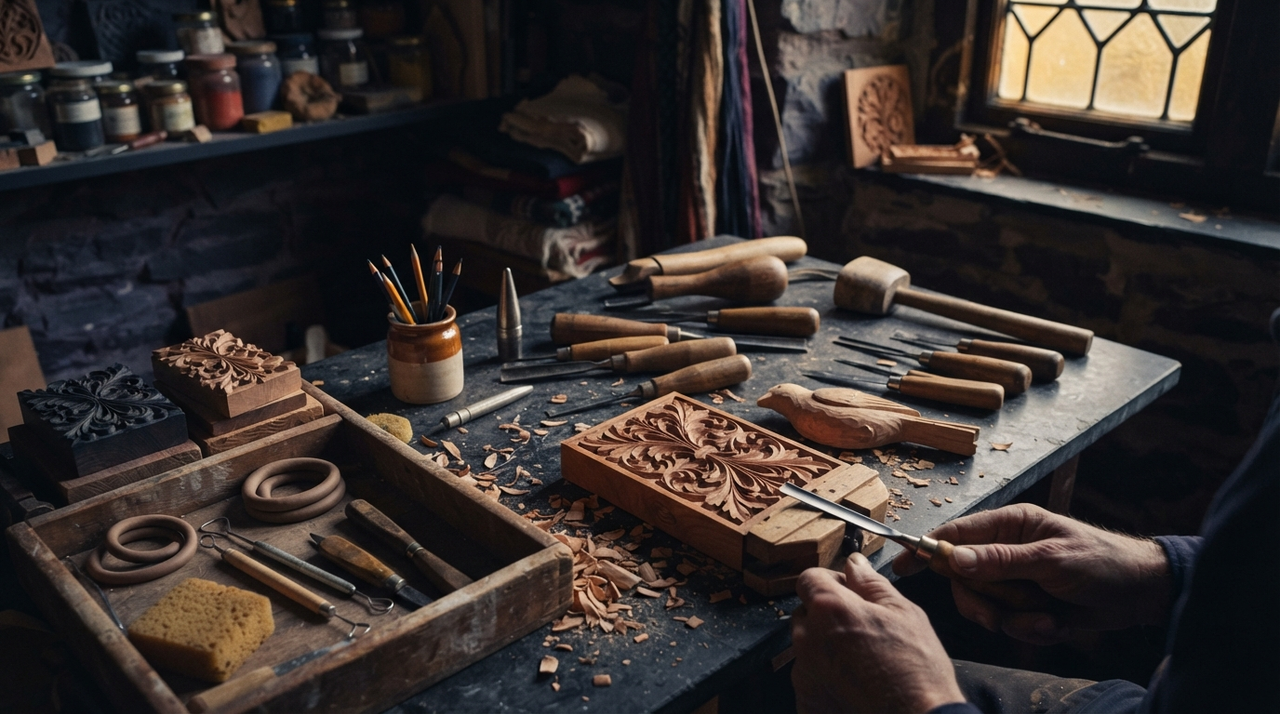
Creativity and Constraints: How Artistic Limitations Ignite True Innovation
Imagine a poet staring at a blank page, boundless possibility stretching out like an endless horizon. Yet history whispers a different truth: some of the most enduring works emerge not from freedom's expanse, but from the forge of restriction. In Aetheria's Creativity Door, we've traced the sparks of invention. Here, we delve deeper into creativity and constraints—not as mere hurdles, but as the very bellows that fan innovation's flame. This isn't an entry-level sketch of the creative process; it's a companion inquiry into how artistic limitations demand ingenuity, revealing craft's hidden levers beyond the thrill of unfettered ideation.
Constraints in the Wild: Material, Formal, and Social Boundaries
Constraints arrive uninvited yet indispensable in the maker's workshop. Material limits—think the fixed dimensions of a canvas or the warp threads on a loom—force decisions early, channeling energy into refinement rather than sprawl. Formal ones, like rhyme schemes or rhythmic structures, impose rhythm on chaos, turning raw impulse into architecture.
Social constraints add another layer: patronage demands, communal expectations, or cultural taboos. A sculptor in Renaissance Florence navigated marble's heft and Medici whims alike, each curbing excess while honing precision. These aren't abstract; they mark the creative process with labor's fingerprints—sweat on stone, ink on vellum—reminding us that innovation often brews in necessity's crucible.
Historical Threads: Forms Forged by Limits
The Sonnet's Strict Embrace, Italy 13th Century
From Giacomo da Lentini's Sicilian school in the 13th century, the sonnet emerged: 14 lines, iambic pentameter, a volta at line nine. This artistic limitation didn't stifle; it sculpted. Petrarch in 14th-century Avignon and Shakespeare in Elizabethan England bent the form to confession and drama, proving how confines birth variety.
Noh Theater's Jo-Ha-Kyu, Japan 14th Century
In Muromachi-period Japan, Zeami Motokiyo codified Noh drama around jo-ha-kyu: slow build (jo), rapid break (ha), swift resolution (kyu). Masked performers on a bare stage, bound by gesture and chant, evoked vast emotion through minimalism—a testament to how structural artistic limitations amplify presence.
Navajo Weaving's Loom Limits, American Southwest
Navajo weavers, using upright looms since the 19th century in the Southwest, faced practical bounds: loom width capped blankets at shoulder span, yarn from handspun wool dictated pattern repeats. These material realities spurred motifs of harmony and balance, weaving survival into art.
Scaffolding the Mind: Psychological Insights into Constraints
Psychologists describe constraints as cognitive scaffolds, narrowing options to spotlight viable paths. In problem-solving models, limits prune the decision tree, fostering depth over diffusion. Yet theory parts from practice here: lab experiments with puzzles differ from the studio's grind, where a constrained potter might smash pots before mastery dawns.
This scaffolding supports craft and innovation, but only if the maker claims authority over it. Access matters too—tools, time, training—lest limits become barriers rather than invitations.
The Shadow Side: When Limits Choke the Spark
Not all bonds liberate. Overly rigid rules—like a patron dictating every brushstroke—can smother invention, turning artisans into technicians. Historical ruptures show this: avant-garde rebellions against academic canons in 19th-century Paris arose precisely when artistic limitations ossified into dogma. Constraints must breathe, allowing subversion within their frame, or they calcify into cages.
Weaving Your Own Frame
In Aetheria's inquiry, creativity and constraints reveal themselves through doing. Forms preserve across time, echoing the Writing & Memory Door, where structure safeguards insight. They bind form to function, as explored in the Art Door.
What deliberate limit will you impose on your next making? Journal it: Describe the boundary, then trace one unexpected path it opens.
This prompt guards your journey, honoring the Seeker's Code: neutral, probing, humane. Step through the Creativity Door anew, limits in hand.