
Museum Provenance Unraveled: Colonial Collections, Restitution Debates, and Living Cultural Authority
Stand before a glass case in a grand museum hall. A bronze plaque gleams beside an intricate carving, its label crisp: "Acquired 1897, gift of explorer X." The object whispers of distant lands, ancient rituals. Yet what histories does that label bury? Museum provenance invites us to peel back layers, revealing not just origins but tales of power, loss, and contested claims. For those drawn to objects as living records of taking and keeping, this unraveling transforms passive viewing into urgent inquiry.
In the Aetheria Art Door, we explore these threads without verdict, honoring the tangle of legal title, ethical claims, scholarly insight, and community voices. Provenance emerges not as a tidy chain but a contested narrative, where findspots, dealers, donors, and accession numbers mark distinct chapters.
Unpacking Museum Provenance: Beyond the Label
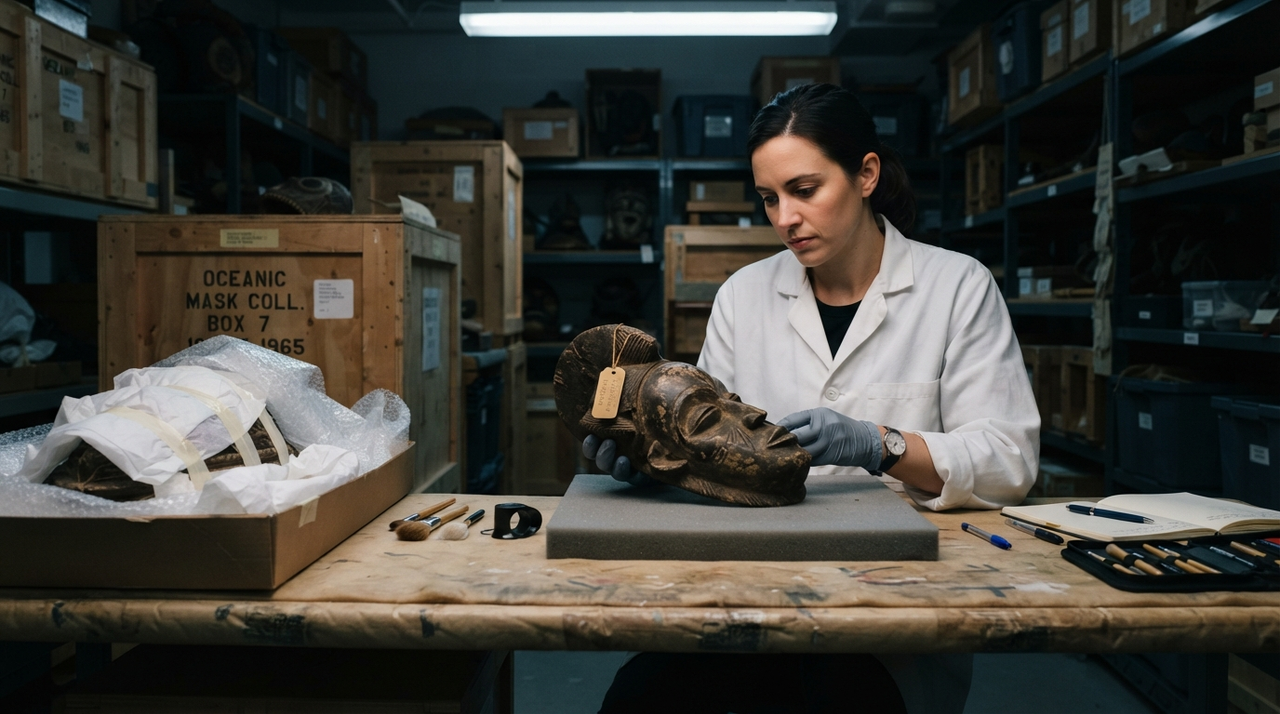
Museum provenance traces an object's path from creation to display, yet it often skips the grit. A colonial collection might list a purchase in Paris or London, silent on raids in Africa or Asia. Wartime collecting adds shadows: objects seized amid chaos, later "rescued" by scholars. Storage vaults hold thousands more, their stories dormant until digitization sparks questions.
Consider the divergence: legal ownership via deed contrasts ethical claims rooted in coercion. Scholarly expertise deciphers style and date; community authority invokes ongoing taboos. Access, too, proves nuanced. Sacred items from Indigenous traditions carry viewing restrictions, challenging the museum's open-treasury ideal. Here, provenance demands we read labels for omissions—what journey elides, whose voice absents, what ritual forbids display.
Colonial Collections: Echoes of Empire
From Conquest to Cabinet
European expansion flooded museums with treasures. Expeditions doubled as plunder; missionaries gathered icons under conversion's guise. These colonial collections now anchor institutions, their beauty inseparable from violent uprooting. Provenance records polish the rupture: a "field collection" masks a sacked palace.
Storage and the Hidden Archive
Most arrivals languish unseen. Vast reserves prompt debates on access versus preservation. Digitization offers glimpses, yet metadata falters without source community input. Provenance here bridges vault to vitality, questioning who controls the narrative.
Restitution Debates: Claims in Tension
Calls for return crescendo, spotlighting restitution debates. Source nations assert moral rights; museums cite public benefit, universal heritage. Legal title endures, forged in colonial law, yet ethics erode it. Scholarly discord thrives: some prioritize conservation expertise in the Global North, others descendant knowledge long sidelined.
Negotiations unfold in gray zones. Loans replace outright return; shared custody experiments emerge. No side owns truth absolute. These debates enrich provenance, forcing museums to confront keeping as active choice, not neutral inheritance.
Living Cultural Authority: Reclaiming the Narrative
Objects pulse with contemporary meaning. Living cultural authority elevates descendant communities as interpreters, beyond static "art." Ceremonial masks demand ritual context; ancestral figures carry genealogies untold in galleries. Western frames risk erasure, mistaking silence for inertness.
Museums evolve, co-curating exhibits, repatriating where possible. Yet tensions persist: who speaks for fragmented lineages? Provenance expands to include oral traditions, challenging paper trails. In this light, authority contests not ownership alone, but meaning's guardianship.
Aetheria Art Door: Portal to Contested Histories
The Aetheria Art Door opens these inquiries across Ethics, Anthropology, History, and Politics. Here, museum provenance, restitution debates, colonial collections, and living cultural authority intertwine. Next visit, linger on a label. Probe its gaps. What story hides? Whose authority awaits?
Objects endure as witnesses to human entanglements—taking, holding, reclaiming. In their unraveling, we glimpse our shared, fractured custody.