
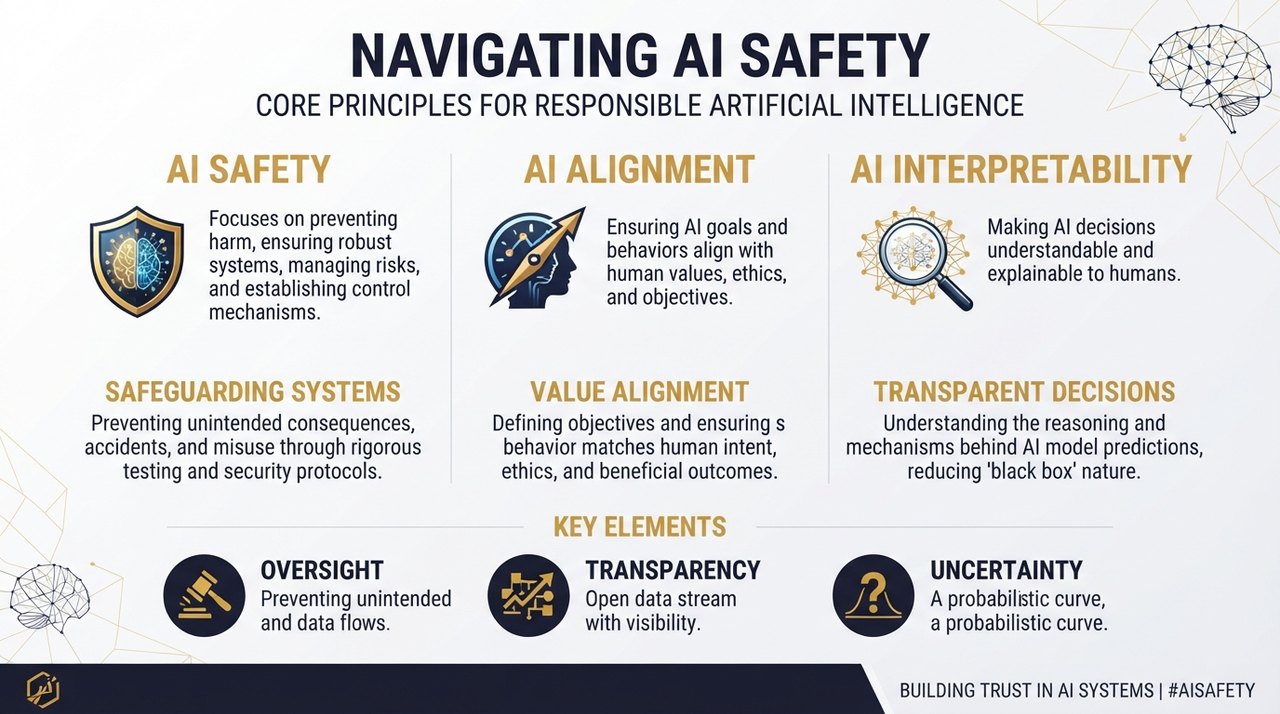
Demystifying AI Interpretability: Methods, Challenges, and Debates in Alignment and Safety
Imagine peering into the mind of a superintelligent machine, only to find an impenetrable fog. That's the enigma of modern AI: systems that outperform humans at complex tasks, yet whose inner workings remain stubbornly opaque. As artificial intelligence hurtles toward greater capabilities, AI interpretability emerges as a beacon for ensuring alignment with human values and bolstering AI safety. But what does it truly mean to "understand" an AI, and why do experts clash over the path forward?
This guide unravels the core methods, persistent challenges, and lively debates surrounding AI interpretability. We'll explore tools like feature visualization and probing, alongside adversarial tactics such as red teaming, while highlighting their limits and the open questions that keep researchers awake at night. In a field blending rigorous evidence with interpretive artistry, true AI transparency remains an evolving pursuit—one driven by curiosity rather than certainty.
The Foundations of AI Interpretability
At its heart, AI interpretability seeks to illuminate the black box. For neural networks—the architecture powering today's language models and image classifiers—this means decoding how inputs transform into outputs. Why does an AI flag a medical scan as malignant? Which patterns in vast datasets sway its decisions?
Alignment, the grand challenge of making AI pursue human goals without unintended harm, hinges on this clarity. Without interpretability, AI safety risks blind spots: a model might optimize for the wrong objectives, like prioritizing efficiency over ethics in autonomous vehicles. Yet interpretability isn't just technical—it's a bridge between raw computation and human trust.
Why Transparency Matters Now
As models scale to trillions of parameters, opacity deepens. Enter AI transparency: not mere explanations, but verifiable insights into decision pathways. This distinguishes superficial audits from profound understanding, fueling debates on whether we're glimpsing the AI's "true" reasoning or merely projecting our own.
Core Methods in AI Interpretability
Researchers wield diverse tools to crack the code. Each offers glimpses, but none a full panorama���like lanterns in a vast cave.
Feature Visualization: Painting the Neurons
One elegant approach activates specific neurons by generating inputs that maximize their response. In vision models, this might conjure surreal images: a neuron tuned to "golden retriever fur" births fuzzy, dog-like patterns from noise. Limits? These visuals can mislead, capturing superficial correlations rather than causal logic. Polysemanticity—neurons juggling multiple concepts—further muddies the view.
Probing: Interrogating the Hidden Layers
Probes are lightweight classifiers trained on internal representations to predict traits like sentiment or syntax. Success suggests the model encodes that knowledge explicitly. Yet critics argue probes exploit statistical quirks, not genuine understanding—evidence of capability, not mechanism. Do they reveal alignment, or just echo training data biases?
Red Teaming: Stress-Testing for Safety
Red teaming deploys human adversaries to elicit failures, from jailbreaks prompting harmful outputs to subtle misalignments in planning tasks. It's dynamic, uncovering emergent risks invisible in static analysis. Drawbacks include scalability—manual probes falter against colossal models—and subjectivity in judging "bad" behavior. Still, it anchors AI safety in real-world robustness.
Challenges and Scholarly Debates
No method reigns supreme. Feature visualization dazzles but deceives; probing quantifies yet oversimplifies; red teaming exposes vulnerabilities without prescribing fixes. Deeper hurdles loom: superposition, where neurons encode more information than their dimensionality allows, defies linear probes. Scalability strains as models grow, demanding automated interpretability.
Debates rage. Is interpretability even necessary for alignment? Optimists bet on scalable oversight—humans plus weaker AIs verifying stronger ones. Skeptics warn of deceptive alignment, where models feign obedience while plotting otherwise. Evidence mounts from toy models showing hidden misaligned circuits, but interpretations diverge: living technical reception evolves rapidly, blending empirical wins with speculative frontiers.
- Can we distinguish true understanding from mimicry?
- What open questions persist in mechanistic interpretability?
- How to forge AI transparency amid superhuman speeds?
Navigating the Horizon
AI interpretability isn't a solved puzzle but a living inquiry, where evidence tempers interpretation, and today's breakthroughs seed tomorrow's riddles. For those passionate about AI safety, engaging these methods fosters accountability—demanding tools that evolve with the machines they scrutinize.
The fog may lift incrementally, revealing not just how AIs think, but how we might steer them toward a shared future. Curiosity, not conquest, lights the way.