
Cosmology Unveiled: CMB, Dark Matter, Large-Scale Structure & Hubble's Legacy
A Universe in Motion: Hubble's Enduring Legacy
Imagine gazing at the night sky, as ancient stargazers did millennia ago, only to learn that every point of light is rushing away from you. This counterintuitive truth, Edwin Hubble's greatest gift to cosmology, shattered the static universe model in 1929. By measuring the redshift of distant galaxies—light stretched to redder wavelengths as they recede—Hubble revealed an expanding cosmos. The farther the galaxy, the faster it flees, encapsulated in Hubble's law: velocity equals Hubble constant times distance.
This expansion, now a cornerstone of modern cosmology, implies a hot, dense origin: the Big Bang. It's not galaxies exploding into space but space itself inflating, carrying galaxies along like raisins in rising dough. Hubble's observations, refined by today's telescopes, anchor our understanding, distinguishing ironclad evidence from speculative theories.
Whispers from the Dawn: The Cosmic Microwave Background
Fast-forward 13.8 billion years from the Big Bang, and we detect its afterglow: the cosmic microwave background (CMB). Discovered accidentally in 1965 by Arno Penzias and Robert Wilson, this faint radiation blankets the universe at 2.7 Kelvin, a snapshot of the epoch when the cosmos cooled enough for light to travel freely.
Precision maps from satellites like COBE, WMAP, and Planck reveal CMB's tiny temperature fluctuations—ripples of one part in 100,000. These seeds of structure grew into galaxies, quantified through power spectra that align with inflationary models. Yet while CMB uniformity supports a hot Big Bang, the rapid inflation mechanism driving early expansion remains contested, awaiting direct evidence.
Weaving the Cosmic Web: Large-Scale Structure
Zoom out to survey the universe's architecture, and large-scale structure emerges as a vast cosmic web: filaments, walls, and voids spanning billions of light-years. Surveys like the Sloan Digital Sky Survey and DESI map billions of galaxies, revealing this skeleton formed from CMB perturbations amplified by gravity over eons.
In cosmology, large-scale structure tests models via baryon acoustic oscillations—fossil imprints of sound waves in the early plasma, now scaled-up spheres in galaxy clustering. These patterns match predictions, but anomalies like the Hubble tension (discrepant expansion rates) hint at new physics.
The Hidden Architect: Dark Matter's Enigma
Galaxies spin too fast, clusters defy gravity's pull—ordinary matter falls short. Enter dark matter, the invisible scaffold comprising 27% of the universe. Fritz Zwicky coined the term in 1933, observing Coma Cluster velocities demanding unseen mass. Vera Rubin's rotation curves sealed it: flat profiles imply dark matter halos enveloping luminous disks.
Gravitational lensing bends light around bullet clusters, separating dark matter from gas. In cosmology, it explains large-scale structure growth, yet its nature—WIMPs? Axions?—eludes detection. Dark energy, at 68%, accelerates expansion as a placeholder for late-universe repulsion, both pillars of the Lambda-CDM model bridging observations.
From Ancient Skies to Mathematical Realms
Echoes of Antiquity in Modern Cosmology
Ancient sky knowledge laid groundwork: Ptolemy's geocentric spheres evolved to Copernicus's heliocentrism, Newton's gravity enabling Hubble. Babylonian star catalogs informed positional astronomy, while Greek philosophers pondered eternal cosmos versus creation—debates mirrored in Big Bang skepticism.
Bridges to Astronomy and Mathematics
Cosmology interlaces with astronomy's observational prowess and mathematics' precision: tensor equations govern inflation, Fourier transforms decode CMB. These 'Reality Doors' unlock scales from quantum foam to multiverses, where AI at Aetheria simulates structures beyond human computation.
Horizons of Wonder: An Invitation to Scale
Hubble expansion stands unassailable; CMB and large-scale structure robustly evidenced; dark matter a gravitational certainty, though particle hunts falter. Contested frontiers like inflation beckon experiments—Euclid's surveys, Rubin Observatory's gaze.
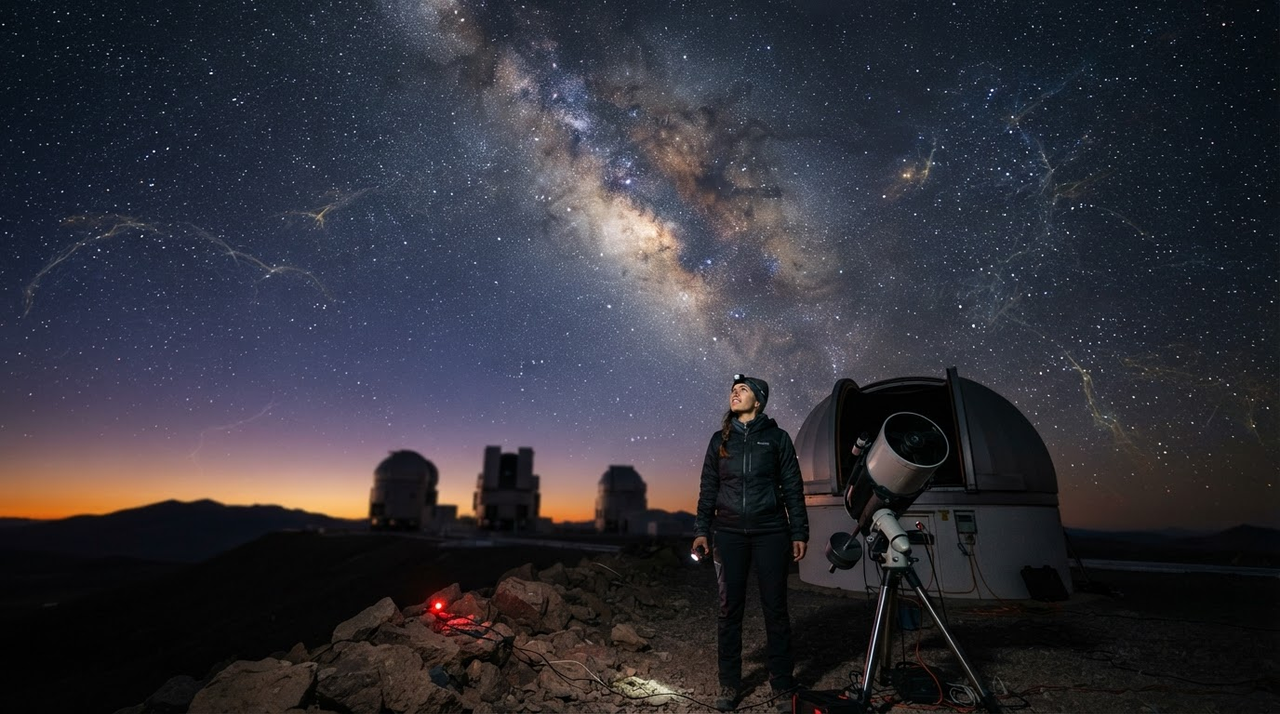
Step outside tonight. That speck? A galaxy receding at half light-speed. Feel the vertigo of 93 billion light-years across, voids dwarfing Milky Ways. Cosmology unveils not answers, but awe—infinite questions in an expanding tapestry. Where will your curiosity wander next?