
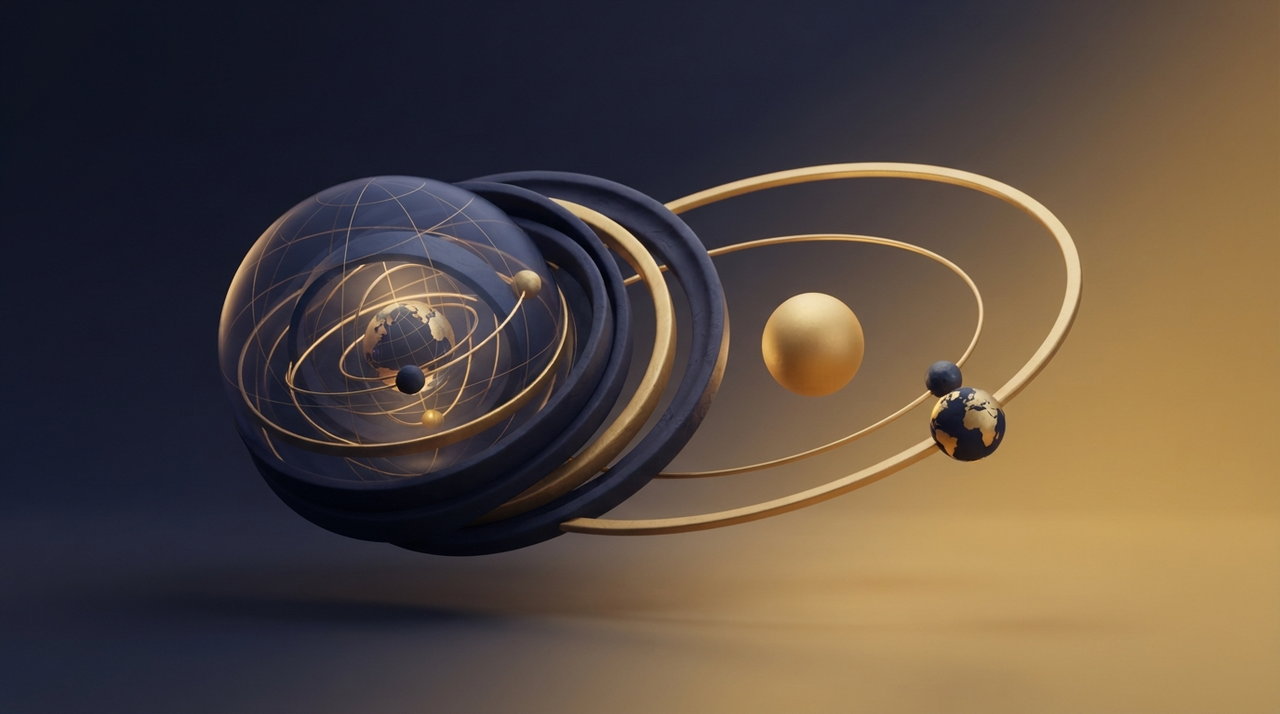
From Ptolemaic Spheres to Kepler's Ellipses: Evidence That Shattered Cosmological Models
Picture this: ancient astronomers peering through the desert night, charting shadows that danced across the moon during a total eclipse. These weren't just omens; they were data points etching the first cracks in humanity's cosmic worldview. For millennia, our cosmological models painted the universe as a series of flawless crystal spheres nested around Earth—a elegant fiction that mirrored our intuition more than reality. Yet evidence, painstakingly gathered, relentlessly chipped away at these spheres, forcing a pivot to ellipses and heliocentrism. This is the story of how observations outpaced imagination, distinguishing the map from the territory.
In the realm of astronomy, models aren't dogma; they're tools. They simplify chaos into predictions. But when discrepancies mount, even the sturdiest frameworks crumble. From Babylonian eclipse records to Kepler's radical ellipses, let's trace the evidence and interpretation that reshaped our place in the cosmos.
The Ptolemaic System: Perfect Spheres in a Geocentric Universe
Enter Claudius Ptolemy in the 2nd century CE, whose Almagest codified the Ptolemaic system. Earth sat motionless at the center, with planets gliding on epicenters orbiting deferents—concentric circles fudged with epicycles to match retrogrades. It worked. Predictions held for naked-eye views, fueling its dominance across Christian, Islamic, and Jewish scholarly networks. Transmission of the Almagest through Arabic translations preserved it, a testament to writing and memory's power in science.
Roots stretched back further. Babylonian clay tablets from 700 BCE logged eclipses with eerie precision, while Hipparchus around 130 BCE spotted Earth's precession—the slow wobble shifting star positions over centuries. These anomalies hinted at complexities beyond pure circles, yet the Ptolemaic system endured because it delivered reliable almanacs for agriculture and navigation. Not blind faith, but pragmatic utility.
Copernicus Ignites the Heliocentric Spark
Fast-forward to 1543. Nicolaus Copernicus publishes De Revolutionibus Orbium Coelestium, flipping the script: Sun-centered orbits, circular but simpler than Ptolemy's gears. No parallax? No problem—stars must be impossibly distant. His model slashed epicycles, offering elegance amid scholarly debates on scriptural authority versus reason. Yet Copernicus hedged, framing it as a computational trick. Evidence was circumstantial; the old cosmological models still predicted eclipses finely enough.
Tycho Brahe's Data: The Precision That Demanded Change
Uraniborg's Legacy
Enter Tycho Brahe, the Danish noble who built Uraniborg observatory from 1576 to 1597. Without telescopes, his naked-eye measures of Mars hit 1-2 arcminutes accuracy—ten times better than predecessors. Mars's opposition wanderings screamed irregularity against circular paths. Tycho rejected Copernicus but hoarded data, a goldmine for the next leap.
Kepler's Elliptical Orbits: Mars's Rebel Path
Johannes Kepler inherited Tycho's treasure. In Astronomia Nova (1609), after 70 iterations on Mars alone, he unveiled the truth: Kepler elliptical orbits. Planets sweep equal areas in equal times, hugging the Sun in ovals with Earth at one focus. This nailed Tycho's data where circles failed by up to 8 arcminutes. No more epicycles; pure geometry born of brute evidence. Interpretation shifted: the universe wasn't perfect; it was elliptical, dynamic.
The divine thus geometrizes the universe with ellipses, not circles—a humbling twist on celestial harmony.
Why the Shift Was Slow: Observational Limits and Human Caution
Change lagged. Cosmological models like Ptolemy's persisted because they worked—eclipses, seasons, all checked out within error bars. Dogma played a role amid religious tensions, but observational ceilings loomed larger. Stellar parallax, proof of Earth's motion, evaded detection until Friedrich Bessel in 1838. Absent telescopes pre-1609, data was king, yet scarce. Scholarly networks weighed authority carefully, honoring uncertainty.
This honesty reveals science's ethos: models evolve with evidence, not revolution alone. Living with uncertainty fosters growth, much like personal maps redrawn by life.
Echoes Today: What Evidence Would Reshape Your Cosmos?
From spheres to Kepler elliptical orbits, this saga underscores evidence's tyranny over intuition. Ptolemy's gears yielded not to heresy, but superior fit. As Aetheria explores big questions, remember: our current models—Lambda-CDM, multiverses—may one day shatter too.
Journaling Prompt: What unassailable evidence would force you to redraw your deepest beliefs—about the universe, yourself, or reality? Sketch that threshold; protect your journey toward truth.