
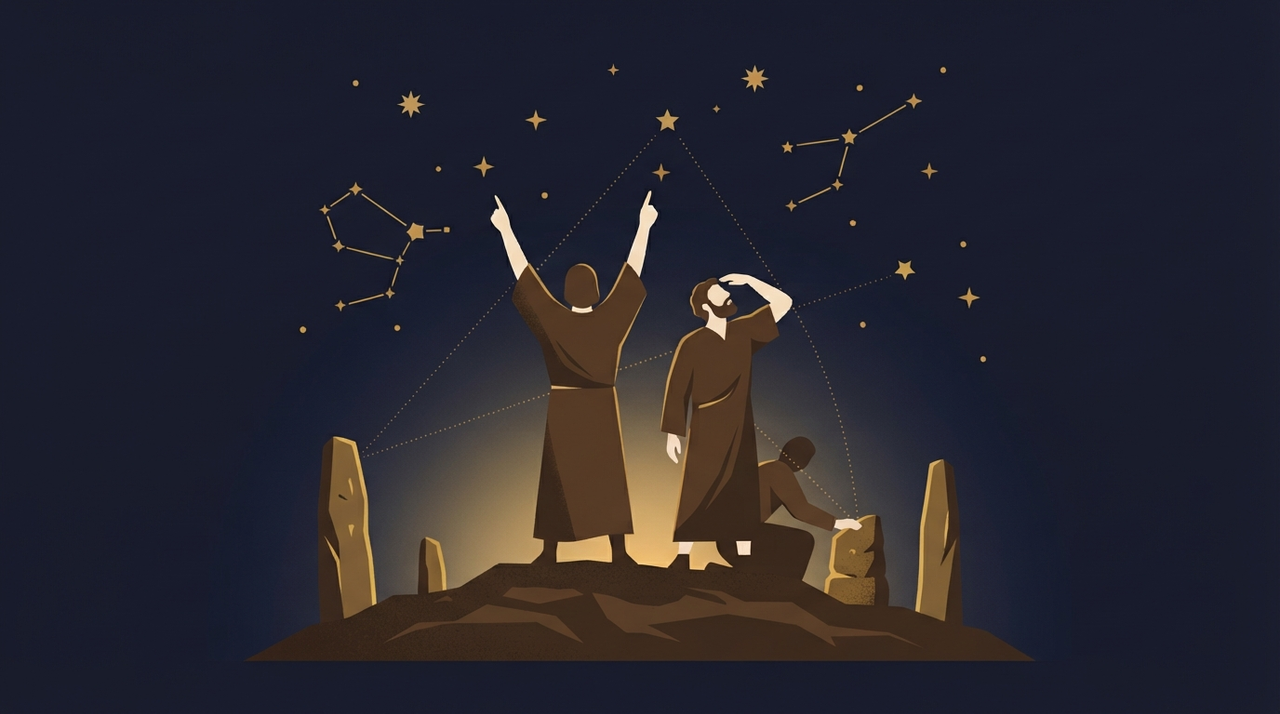
Naked-Eye Astronomy: Ancient Skywatchers' Secrets from Babylonian Diaries to Maya Horizon Markers
Imagine lying on your back under a star-strewn sky, no telescope in sight, just the vast dome above and the distant horizon as your only tools. For millennia, this was the reality of naked-eye astronomy—the art of reading celestial motions with nothing but human perception. From the ziggurats of ancient Babylon to the jungle-shrouded pyramids of the Maya, skywatchers tracked solstices, planets, and lunar cycles to anchor their world. This wasn't mysticism; it was precise observation honed by necessity, revealing secrets still studied today in horizon astronomy.
In Aetheria's Astronomy Door, we uncover how these communities deciphered cosmic rhythms before instruments blurred the line between eye and machine. Join us as thoughtful explorers, distinguishing hard evidence from interpretation, and marvel at humanity's innate sky literacy.
The Raw Power and Limits of Naked-Eye Observation
Naked-eye astronomy demanded patience amid profound constraints. The human eye resolves stars down to about magnitude 6 under ideal conditions—fainter than that, and they vanish. Time was the true bottleneck: observations spanned nights, months, even years, syncing with daily chores or rituals. Horizons framed it all, where mountains, temples, or simple stakes marked critical alignments like solstice sunrises.
No telescopes here—these were unaided gazes piercing atmospheric haze, extinction, and weather whims. Yet, this simplicity birthed sophistication: skywatchers noted heliacal risings (stars peeking just before dawn) and planetary wanderings, building calendars without clocks.
Echoes from the Past: Key Evidence in Babylonian Diaries, Maya Sky Records, and Solstice Markers
Babylonian Astronomical Diaries: A Millennium of Meticulous Logs
Clay tablets from Babylon, spanning roughly the 7th century BCE to the 1st century CE, offer the oldest systematic naked-eye records. These Babylonian diaries logged lunar eclipses, planetary positions relative to stars, and even commodity prices tied to celestial events. Scribes atop temple towers watched horizons for Venus's first gleams, their cuneiform scratches preserving data for predictions centuries ahead.
Maya Sky Records: Codices of Cosmic Tables
Across the Atlantic, Maya sky records in codices like the Dresden Codex detail Venus cycles and eclipses, cross-referenced with horizon events from sites like Chichén Itzá. Priests aligned structures to capture equinox shadows, blending observation with mythology in bark-paper pages that survived conquest.
Chaco Canyon's Sun Daggers: Precision in Stone
In North America's Chaco Canyon around 1000 CE, Ancestral Puebloans carved solstice markers at Fajada Butte. Sunlight slices through rock slabs like daggers, pinpointing summer solstice midday—a testament to horizon astronomy etched in desert stone.
Mastering the Method: Horizon Markers, Day Counts, and Heliacal Watchings
How did they achieve such accuracy? Horizon markers—distant peaks or built notches—framed rising suns or stars. Counting days between solstices tracked seasons; 182-183 days from summer to winter solstice, give or take. Heliacal risings signaled new cycles, like Sirius for Egyptians or Pleiades for Maya planting rites.
- Align a temple to catch the solstice sun's first ray.
- Tally nights until a planet halts its retrograde loop.
- Record anomalies: comets as omens, eclipses as portents.
These techniques, repeated across cultures, yielded calendars rivaling modern ones—pure naked-eye astronomy at work.
Navigating Uncertainties: From Atmosphere to Archaeoastronomy
Doubts linger: refraction bends light near horizons, clouds obscure tropical skies, oral traditions fade before writing. Dating alignments risks confirmation bias. Yet, archaeoastronomers today validate via field surveys—lasers measuring angles, software simulating ancient views—cross-checked against texts. This confirms evidence without invoking telescopes or hidden planets; those claims stray into speculation.
Cross-Cultural Tapestries: Parallels and Divergences
Compare Egypt's 1500 BCE pyramid shafts to Chaco's 1000 CE daggers: no contact routes linked them, yet both used solstice markers. Deserts offered clear vistas; Maya cloud forests demanded patient gaps. Functions varied—Egyptian agriculture versus Puebloan ceremonies. Evidence (alignments, diaries) is solid; interpretations (divine mandates?) interpretive.
Explore deeper in our Sacred Time Door for ritual ties, or Environment for ecological influences.
Gazing Anew: Your Next Horizon
In a telescope era, reclaim the ancient thrill: find your horizon marker, count to solstice, witness the sky's silent story.
Naked-eye astronomy humbles us, reminding that understanding the universe begins with wonder. Seeker's Code: Observe without instruments, question with evidence, connect across epochs. What alignment will you mark next?