
Unlocking the Cosmic Library: A Seeker's Guide to Astronomy, Stars, Planets, and Cosmic Observation
Entering the Cosmic Library Under the Starlit Dome
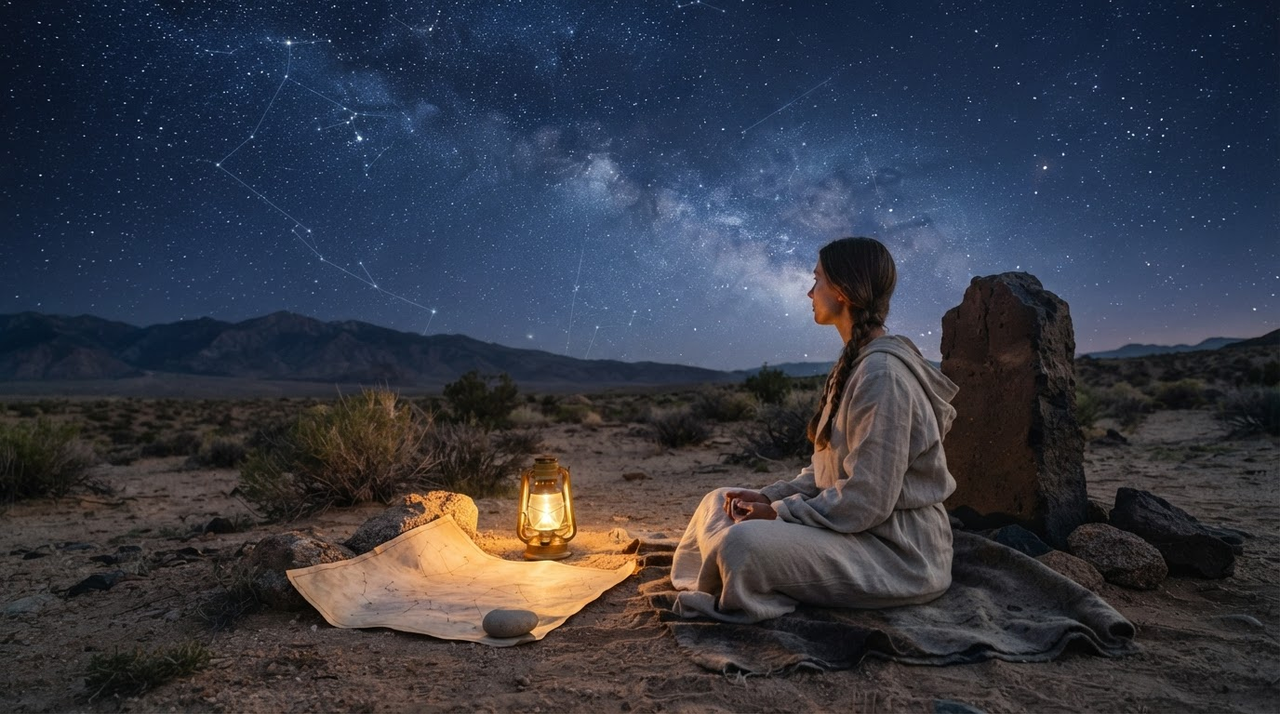
Imagine settling into a vast, shadowed hall—the Aetheria cosmic library—where the ceiling arches into an infinite dome not of stone, but of shimmering light. You tilt your head back, and there they are: points of fire suspended in the velvet black, each a chapter in an archive written across eons. This is no ordinary repository. The stars and planets overhead form a living catalog, their positions etched by gravity and glow, demanding only that you look, mark, and remember.
Astronomy begins here, in this simple act of observation. As students of existence, we are drawn to the night sky not for quick answers, but for the cosmic perspective it imparts—a reminder of our place amid the vastness. Long before instruments or equations, seekers raised their eyes, noting the wheel of seasons in the stars' slow dance, the wanderings of planets against fixed backdrops. This guide opens the Astronomy Community Door within the Aetheria cosmic library, inviting open inquiry into stars, planets, and the methods that unlock their stories. Here, wonder meets evidence, and the seeker's code whispers: observe with humility, question with rigor, protect the journey.
What This Door Holds: The Pillars of Astronomy
Step through, and the chamber reveals its treasures: not myths or mysteries, but the disciplined practice of cosmic observation. Astronomy rests on measurement and scale, turning raw sight into evidence. We chart planetary systems, where worlds orbit suns in predictable ellipses; trace stars through their life cycles, from fiery births in nebulae to the quiet graves of white dwarfs or explosive supernovae; map galaxies as island universes spiraling in the void; and detect the universe's expansion through the redshift of distant light.
At its heart lies interpreting light across time. Every photon we capture is a messenger from the past—starlight that left its source thousands, millions, or billions of years ago. Spectroscopy splits this light into spectra, revealing composition, temperature, motion. Radio waves unveil hidden nurseries of stars; space observatories like Hubble and James Webb peer through dust veils to infant galaxies. This is method in motion: hypothesize, observe, test, refine. Planets like Jupiter, with its swirling storms visible even to the naked eye, become laboratories for gas giants; Venus, our morning star, a hothouse warning. Stars, from blue-hot giants to red dwarfs, teach fusion's alchemy. Through these, astronomy builds a cosmic perspective grounded in what we can verify.
The Scale of It All
Grasp the scales, and humility follows. Our solar system spans billions of kilometers; the Milky Way, 100,000 light-years across; the observable universe, 93 billion light-years in diameter. Yet evidence anchors us: Kepler's laws predict orbits, Einstein's relativity bends light around mass, cosmic microwave background echoes the Big Bang. Active research probes open questions, like dark matter's nature—inferred from galactic rotations but unseen—or the universe's ultimate fate. Speculation arises only after evidence invites it.
A Brief Lineage: History of Astronomy, Fact from Interpretation
The history of astronomy unfolds as a tapestry of observation, where facts endure and interpretations shift like constellations with the seasons. Megalithic markers, such as Stonehenge's heel stone aligning with the midsummer sunrise, stand as early testimonies to sky-tracking. Babylonian records meticulously logged planetary positions on clay tablets, enabling predictions.
Greek geometry brought models: Aristarchus proposed heliocentrism centuries before Copernicus, while Hipparchus cataloged stars and measured Earth's tilt. Islamic observatories, like those in Baghdad and Samarkand, refined instruments—astrolabes plotting altitudes with precision—and preserved Greek works. Copernicus's 1543 De revolutionibus revived sun-centered orbits, confirmed by Galileo's telescopic views of Jupiter's moons and Venus's phases. Newton united it with gravity; photography captured faint nebulae; spectroscopy decoded stellar atmospheres; radio astronomy revealed pulsars; space telescopes pierced cosmic dust.
Facts: alignments hold, records match modern data, telescopes reveal moons and rings. Interpretations varied—geocentrism as divine order for Ptolemy, harmonious spheres for Kepler, mechanistic clockwork for Laplace. Cultures wove narratives: Indigenous Australian songlines mapped star paths for navigation; Chinese astronomers linked comets to emperors. Separate the measure from the meaning, and the seeker's code shines: evidence first.
How Seekers Approach Astronomy: Practices of Humility
Enter as a student of existence, notebook in hand. Start with naked-eye observation: log the sky nightly, noting Orion's belt rising later each evening, a seasonal shift driven by Earth's orbit. Learn light-travel time—the Andromeda galaxy's glow shows it as it was 2.5 million years past, an archive in the cosmic library. Ask always: What evidence supports this claim? Does the planet's retrograde loop fit heliocentric motion?
Humility tempers haste. A constellation's myth enchants, but its stars lie hundreds of light-years apart, connected only by our line of sight. Observation logs build pattern recognition; questioning evidence fosters the cosmic perspective that scales human concerns against stellar furnaces.
Common Misconceptions in Stargazing and Cosmic Observation
- Astronomy is rote memorization: No—it's understanding dynamics, like why Venus outshines all but Moon and Sun.
- Bigger telescopes always reveal truth: Resolution matters more than size; atmospheric turbulence limits ground views.
- We've photographed beyond the observable universe: Impossible—light speed caps our horizon at 13.8 billion years post-Big Bang.
- Constellations are physical clusters: They are projections; the Big Dipper's stars scatter across vast distances.
- Wonder demands mystery-mongering: True awe blooms from evidence, not obscuring facts.
Dispel these, and observation deepens. Planets wander predictably; stars evolve measurably. Clarity protects the journey.
Connections Across the Aetheria Cosmic Library
This Astronomy Door links to kin. Technology forges instruments—from Galileo's spyglass to Webb's mirror—shaping sight. Linguistics encodes stars' names, carrying cultural power: Sirius as the Dog Star or Sothis in Egyptian lore. The Future of Humanity gains cosmic perspective, informing stewardship amid exoplanet discoveries.
Wider ties: Physics governs motion and light; mathematics orbits; history navigation; mythology sky-stories; science method; environment fights light pollution; ethics ponders planetary protection. Together, they enrich open inquiry.
Concrete Ways to Begin Your Inquiry into Stars and Planets
- 7-Night Sky Journal, App-Free: Each evening, sketch the sky from one spot. Note Moon's phase, planets' positions relative to stars. Patterns emerge sans screens.
- Trace One Planet's Path: Follow Jupiter or Saturn monthly. Watch it loop against Aries or Taurus—evidence of orbit.
- Learn Names of 5 Stars in Two Traditions: Betelgeuse (Arabic 'shoulder of the giant'), Rigel; add Indigenous or Chinese names. Language reveals layers.
- Visit a Dark-Sky Site: Escape city glow. Milky Way unfurls; nebulae tease the eye.
- Map a Scale Model Solar System: Walk it: Sun at home, Pluto kilometers away. Steps reveal emptiness.
These anchor practice in evidence, fueling cosmic observation.
A Reflective Invitation: Join the Community of Seekers
As you close this tome in the Aetheria cosmic library, carry a sky question to the Astronomy Community Door. Why does the Sun rise due east only at equinox? What whispers do exoplanets hold? Hold evidence clear, interpretations tentative, beliefs earned. In this dance of stars and planets, the cosmic perspective humbles and elevates. Observe tonight— the dome awaits. Protect the journey, one light at a time.
The stars are the land-marks of the universe; we navigate by them, not to them.