
Book of Jubilees Explained: Little Genesis, Ethiopian Bible Gem & Jubilee Calendar Secrets
Picture Moses atop Sinai, the thunder rolling, as an angel dictates not only the Law but a precise chronicle of creation to exodus—every event pinned to a cosmic calendar of jubilees. This is the essence of the Book of Jubilees, a retelling of Genesis and Exodus through a 49-year Jubilee cycle, attributed directly to Moses on the mountain. Preserved in full only in Ge'ez within the Ethiopian Bible and echoed in Hebrew fragments from Qumran, it offers seekers of biblical chronology a hidden lens on Second Temple Judaism.
What Is the Book of Jubilees?
Composed likely in the 2nd century BCE amid the fires of Hellenistic pressure, the Book of Jubilees expands Genesis 1 through Exodus 19 into 50 chapters. An angelic narrator reveals to Moses the 'divisions of time'—a rigid timeline where history unfolds in 49-year jubilees, each marking sabbaths of years. This Second Temple literature masterpiece insists on solar purity, rejecting lunar calendars, and weaves ethical lessons into primordial tales, from Adam's creation on a Sunday to Noah's ark dimensions specified in cubits.
Far from mere paraphrase, Jubilees reshapes narratives: angels prosecute fallen watchers, demons are bound post-flood, and Israel's festivals align with creation's rhythms. For students of biblical timeline, it's a roadmap, synchronizing patriarchs' lives into neat jubilee blocks totaling 2,450 years from Adam to Sinai.
Why Is It Called Little Genesis?
A Compact Retelling with Expansive Secrets
Early Syriac and Latin traditions dubbed it Little Genesis for its concise yet amplified Genesis retelling—shorter in scope than the full Torah but bursting with details absent in the canonical text. Where Genesis whispers of Mastema, Jubilees names him as Satan's prince, commanding a tenth of spirits to tempt humanity. This nickname captures its role as a 'testament of Moses,' bridging proto-history and law-giving.
The Jubilee Calendar System Unveiled
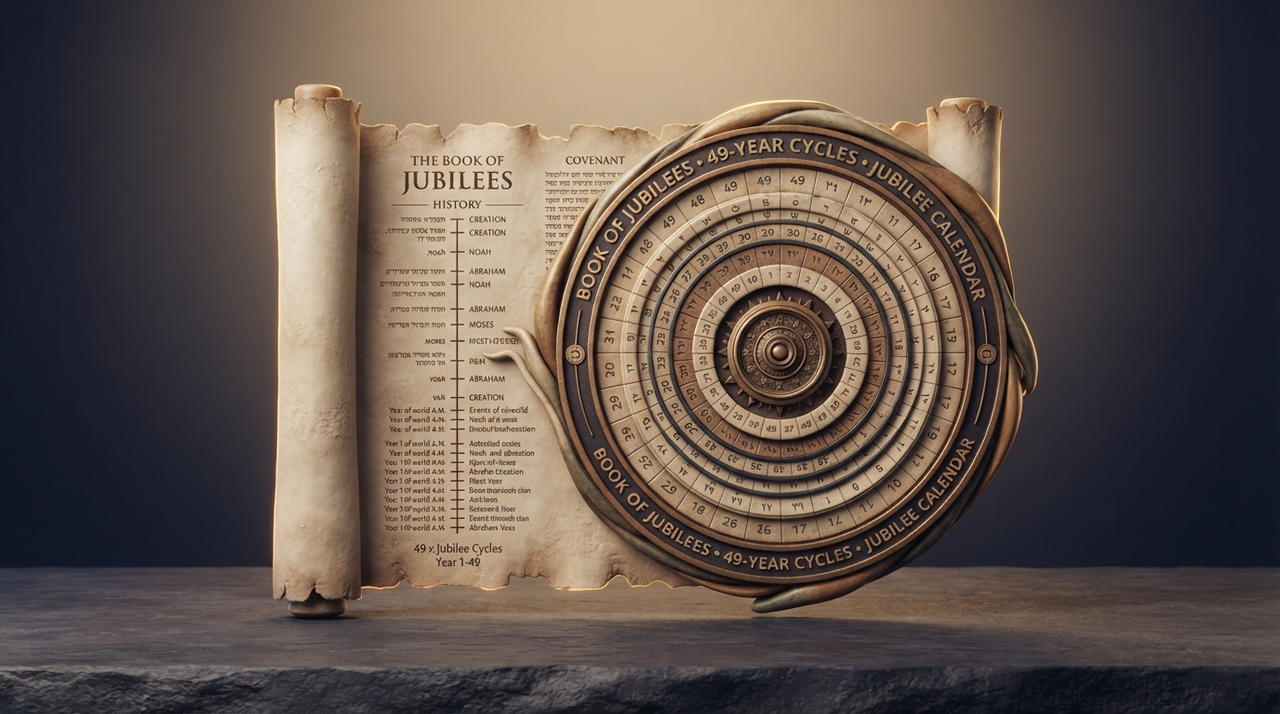
At its core throbs the Jubilee calendar: 364 days yearly, divided into four quarters of 13 weeks, anchored to eternal sabbaths. Every 49 years reset the cycle, echoing Leviticus 25 yet absolutized—no intercalations, no lunar drift. Jubilees dates creation to year 1, the flood to year 1308 (exactly 27 jubilees), Abraham's birth to 1876. This system, critics say, fueled sectarian divides at Qumran, yet for biblical chronology enthusiasts, it harmonizes disparate timelines into divine symmetry.
- Year 1: Adam formed on day 1, Eve on day 2.
- Year 1307: Angels descend, watchers fall.
- Year 2410: Sinai theophany.
Relationship to Genesis and Enoch
Jubilees dances in tandem with Genesis, amplifying its bones with Enochic flesh. Shared motifs—like Enoch's 365-year life matching the solar year—link it to 1 Enoch, another Ethiopian Orthodox canon treasure. Explore these ties in our Enoch Room or the Book of Enoch Explained companion piece. Unlike Genesis's poetry, Jubilees delivers prose precision, priestly calendar as covenant blueprint.
Manuscript Tradition: From Qumran to Ethiopia
Hebrew fragments from 15 Qumran scrolls (ca. 100 BCE) confirm its antiquity, covering 75% of the text. Full survival hinges on Ge'ez translations in the Ethiopian Bible, alongside partial Latin (Exodus sections) and Syriac palimpsests. This divergence reflects transmission paths: Essene libraries to Dead Sea, Jewish pseudepigrapha to Aksumite scribes. No conspiracy—just canons evolving separately, as detailed in How Biblical Canon Was Formed.
Theology and Halakha in Jubilees
Theologically, it elevates predestination: Israel's election etched in heaven pre-creation. Halakhically, it mandates sabbath rest for animals, forbids intermarriage, and dates Passover to the 14th (solar). Angels enforce purity; Mastema tests Job. This Second Temple literature bridges Enoch's cosmology and Pharisaic law, influencing Qumran community rules.
Canonical Status: Ethiopian Gem vs. Global Exclusion
Unique to the Ethiopian Orthodox canon, Jubilees thrives in 81-book Bibles, read liturgically. Protestant, Catholic, and Jewish canons sideline it as pseudepigraphal, per councils like Jamnia or Trent—decisions rooted in apostolicity and usage, not suppression. See why in Why Ethiopian Orthodox Church Preserved More Books and Apocrypha vs Pseudepigrapha.
Frequently Asked Questions
Key Queries on Book of Jubilees
- What makes Jubilees essential for biblical timeline mapping? Its Jubilee grid synchronizes Genesis events unavailable elsewhere.
- Is Little Genesis part of the standard Bible? Only in the full Ethiopian Bible; elsewhere, it's valued Second Temple literature.
- How does it connect to Enoch? Shared solar calendar and angelology; dive into /enoch.
Unlock Jubilees' layers: compare it side-by-side with Genesis in our Creation Room. Got questions on this Ethiopian Bible gem? Head to the Guide or Blog for more. Your chronological quest awaits.