
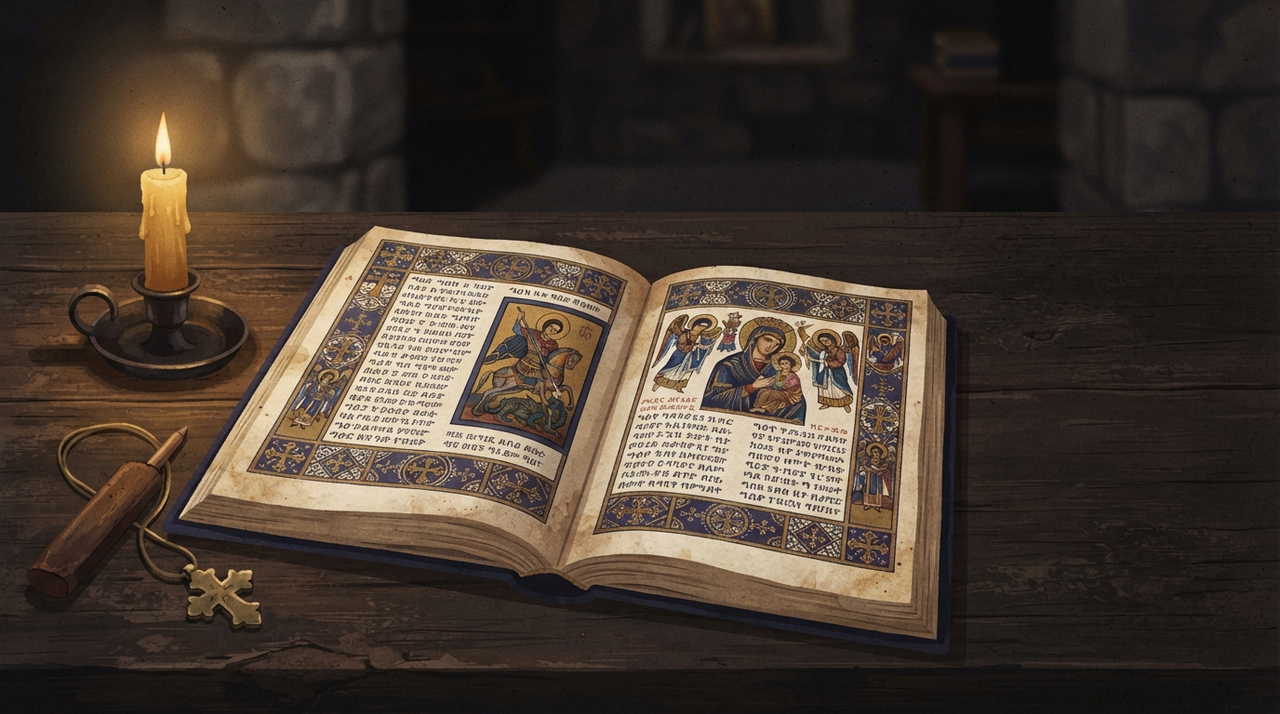
The Ethiopian Bible Explained: Why It Contains Books Missing From Most Bibles
Quick Answer
The Ethiopian Orthodox Tewahedo Church Bible contains 81 books, including the Book of Enoch and Jubilees, which are absent from most Protestant (66 books) and Catholic (73 books) canons. These differences arise not from books being "removed" but from divergent historical processes in biblical canon formation across Christian traditions. The Ethiopian canon reflects a broader collection preserved in Ge'ez manuscripts, rooted in ancient Jewish and early Christian texts.
What is the Ethiopian Bible?
Imagine ancient scrolls unfurling in the highlands of Ethiopia, their pages etched in Ge'ez, a Semitic language older than Latin. This is the Ethiopian Bible, the sacred canon of the Ethiopian Orthodox Tewahedo Church—one of the world's oldest Christian communities, tracing its roots to the 4th century. Unlike the familiar King James Version or Vulgate, it stands as a testament to Christianity's diverse tapestry, holding texts that echo the whispers of Second Temple Judaism and early church fathers.
Central to worship and theology, the Ethiopian Bible isn't just a book; it's a living tradition, chanted in liturgies and studied in monasteries carved into cliffs. Its uniqueness sparks curiosity among those exploring biblical canon history: why does it embrace writings overlooked elsewhere?
How Big is the Ethiopian Bible Really?
Count them: 81 books in total. The Old Testament section boasts around 46 to 51 books (depending on enumeration), while the New Testament expands to 35. This dwarfs the Protestant 66-book standard or Catholic 73.
- Old Testament extras: Book of Enoch, Book of Jubilees, three Books of Meqabyan (Ethiopian Maccabees), and others like 4 Baruch.
- New Testament additions: Sinodos (church orders), Book of Clement, and Didascalia.
These aren't fringe additions; they're integral, preserved through Ethiopia's isolation from Roman and Byzantine influences.
Why Does It Include "Extra" Books?
The story unfolds not in conspiracy or suppression, but in the organic evolution of sacred texts. Early Christians drew from the Septuagint—the Greek Old Testament used by Jesus and the apostles—which included deuterocanonical books. Ethiopia, converted by the eunuch of Acts 8, inherited this broad tradition via Coptic and Syriac channels, compiling in Ge'ez by the 5th century.
While Western councils narrowed the canon, Ethiopian scholars safeguarded a wider array, valuing texts with apostolic echoes. Dead Sea Scrolls fragments of 1 Enoch at Qumran affirm their antiquity, predating Christianity.
The Book of Enoch
This apocalyptic vision, quoted in Jude 1:14-15, details fallen angels and end times. Explore Enoch's library here for deeper dives.
The Book of Jubilees
A retelling of Genesis-Exodus, emphasizing solar calendars and angelology. Compare it with creation narratives.
The Meqabyan Books (1-3)
Ethiopian counterparts to Maccabees, focusing on martyrdom and faithfulness amid persecution.
What is the Book of Enoch Doing There?
Jude's direct quote cements Enoch's place, yet it faded from Western canons post-4th century. Ethiopia retained it, mirroring Qumran's high regard. Not core doctrine for all, but vital for eschatology and angel lore in Ethiopian belief.
Historical Development of the Biblical Canon
Canons diverged like rivers from a common source. The Septuagint offered a fluid Old Testament; Masoretic Text standardized Hebrew later. Athanasius' 367 Festal Letter listed 73 books, echoed at Hippo (393) and Carthage (397). Synod of Laodicea (c. 363) was narrower.
Ethiopia's Ge'ez tradition, uninfluenced by these, formalized its 81-book canon organically. Distinguish: texts exist (manuscripts prove it), reconstructions vary, interpretations differ, beliefs honor the canon as inspired.
For context on sacred timelines, see our sacred time guide; learn our ethos at /founder.
Frequently Asked Questions
Was the Book of Enoch Removed from the Bible?
No—it was never universally canonical. Western traditions excluded it early; Ethiopia kept it alongside Septuagint influences.
How Many Books Are in the Ethiopian Bible?
81, per the Ethiopian Orthodox Tewahedo Church canon.
Are These "Books Removed from the Bible"?
Not removed—canons simply diverged. No single "the Bible" existed universally.
What Makes the Ethiopian Canon Unique?
Its Ge'ez preservation of ancient texts like Enoch, untouched by Reformation debates.
Where Can I Read More?
Ask The Guide or browse the blog archive.
In the quiet cadence of Ethiopian chant, these ancient words remind us: scripture's boundaries are as vast as faith's horizons.
Explore these texts inside the Aetheria Cosmic Library.
Start with our Enoch room and creation texts—gateways to this rich tradition.