
Hidden Hands: Household Production, Unpaid Labor, and the Unseen Domestic Economy in History
A Dawn of Household Production
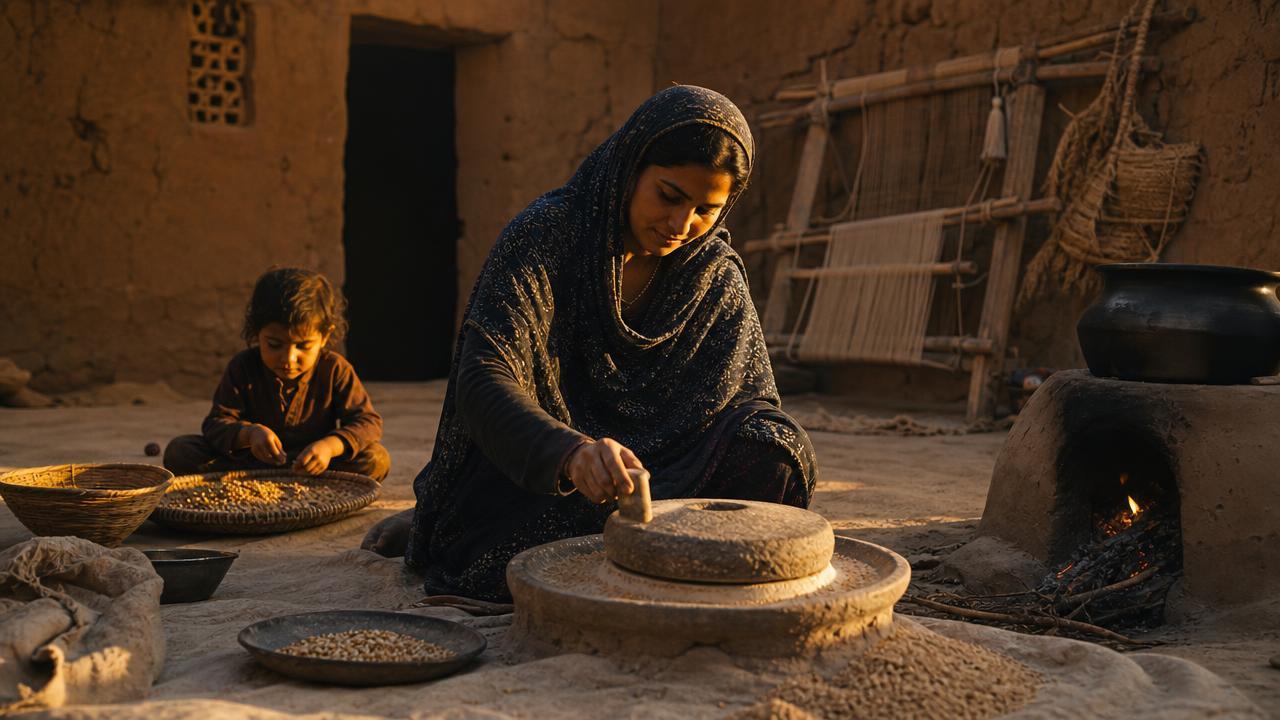
Picture a summer morning in a Mesopotamian village, around 2000 BCE. A woman rises before light pierces the reed-mat walls. She kindles a fire with flint and tinder, feeds it dried dung, and sets a pot of emmer wheat to boil. Nearby, her daughter grinds leftover grain on a saddle quern, the stone scraping rhythmically. The air thickens with smoke and the tang of fermenting barley mash for beer. Later, she will spin wool into thread on a drop spindle while watching younger children, then weave it into cloth on a warp-weighted loom. Her husband tends the date palms and irrigates the barley field. This cascade of tasks keeps the household alive. None enters a marketplace or wage ledger. It is household production, the backbone of subsistence.
Such scenes repeat across eras and places. Care work for the young and frail, cooking from gathered or grown stores, textile work from raw fiber to garment, water hauling from distant wells. These form the domestic economy, vital yet veiled. Official records glimpse them dimly, if at all.
What Records Count, What They Omit
Cuneiform tablets from temple granaries list barley rations for male plowmen and female weavers. Egyptian papyri tally linen output from state workshops. These capture coerced or institutional labor, often by unfree workers. But the daily churn inside free peasant homes escapes notation. No scribe records the hours spent winnowing grain or mending nets. Ration lists hint at unpaid labor by dependents, yet miss the full scope of household production that sustained communities beyond palace or temple control.
Power shapes these gaps. Elites documented their domains: corvee drafts for canals, slave outputs in breweries. Subsistence tasks by kin or servants blended into family life, invisible to tax collectors. This omission persists, framing economic history around traded goods while sidelining care work and informal exchange.
Ancient Households: Mesopotamia and Egypt
In Sumerian Uruk, households processed temple-issued grain into porridge and beer, staples doled as rations. Women brewed in home vats, a task demanding skill amid ecological limits of salted soils. Egyptian New Kingdom villas show similar patterns. Peasant women ground emmer into flour using handmills, their output feeding families not pharaohs. Textiles dominated: spindles and looms turned flax into linen, traded informally or supplied to estates. Ration dockets note weavers' allotments, but not the child-minding or hearth-tending woven in. Coercion lurked here too, in servile women's long hours under household heads.
Andean Agrarian Worlds
Among Inca ayllus, household production blurred field and home. Women hauled quinoa from terraced plots, then processed it by hand, while men herded llamas. No wages divided tasks; kinship reciprocity bound them. Weaving alpaca wool on backstrap looms produced cloth for use and tribute. Spanish chronicles note this, yet colonial encomienda systems extracted surpluses, heightening coercion within families of unequal status by age or gender.
The Framing of Early Modern Economies
By 1700s England, enclosure and factories split spheres. Men sought wages in mills; women managed homes, spinning linen or minding looms at piece rates when possible. Political arithmeticians like Gregory King tallied national outputs, counting male farm wages but deeming domestic labor unproductive. Industrial-era censuses followed suit, birthing GDP metrics that valued market sales over unpaid care work. Women's work varied: elite ladies oversaw servants, peasants toiled in fields alongside kin, enslaved women in Americas combined field gangs with cabin provisioning. Custom and class dictated burdens.
Scholarly Debates on Naming the Unseen
Feminist economic historians parse these silences, arguing household production formed economies alongside markets. Substantivists like Karl Polanyi highlight embeddedness in social ties, cautioning against projecting capitalist growth backward. These views interpret primary evidence: ration tablets, Andean quipus, probate inventories. They draw on community oral histories where available, admitting speculation on unrecorded hours. Uncertainty remains; no ledger quantifies a mother's lullaby as care work. Yet such lenses reveal unpaid labor's centrality without claiming ancient consensus on modern theory.
Echoes in Aetheria's Doors
This domestic economy links to Relationships, through kin-based informal exchange. To Health, via subsistence nutrition. Business histories overlook it, yet it underpins markets. History archives demand rereading; Environment records show ecological attunement in small-plot tending.
An Invitation to See Anew
Next time you scan an economic source, ask: Whose hands ground the grain? Whose care sustained the workers? Probe the gaps. Share your findings in Aetheria's forums. Together, we uncover the hidden hands that have always moved history.