
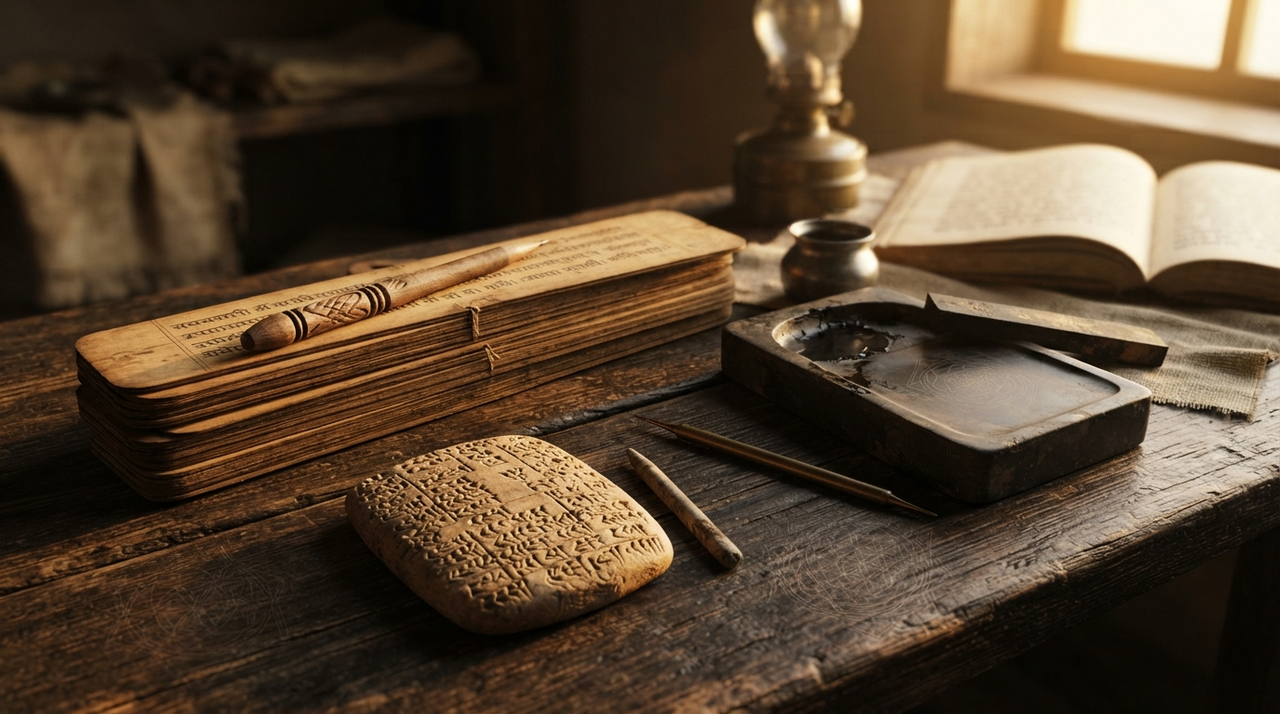
From Clay Tablets to Colonial Barriers: The Unequal History of Literacy, Tools, and Access
Imagine a young apprentice in ancient Nippur, fingers caked with clay, pressing a reed stylus into a soft tablet under the relentless Mesopotamian sun. This was literacy's dawn—not a universal gift, but a guarded craft shaping empires and excluding the many. The history of literacy reveals itself as profoundly technical, social, and political: a skill honed through material tools like clay tablets, papyrus scrolls, and palm leaves, yet always tangled in who could access education. From scribal cultures to colonial barriers, writing tools have long dictated power, learner roles, and the stark realities of education inequality history.
Clay Tablets and the Scribal Elite of Sumer
In the Old Babylonian period around 1800 BCE, the city of Nippur stood as a hub of Sumerian learning. Here, in temple schools called edubba, boys—almost exclusively sons of scribes or elites—mastered cuneiform, the wedge-shaped script of Sumerian and Akkadian languages. The curriculum etched into thousands of clay tablets was rigorous: from basic signs to mathematics, law, and literature like the Epic of Gilgamesh.
Access to education was ruthlessly selective. Clay, abundant yet labor-intensive to prepare and bake, favored those with institutional backing. Scribes wielded styli as tools of divine order, recording taxes and myths, but women, slaves, and rural folk remained illiterate outsiders. Uncertainty loomed—tablets cracked, knowledge faded—yet this scribal culture built the first bureaucracies, excluding most from the ladder of learning.
Egypt's House of Life: Papyrus and Priestly Gates
Across the Nile, from the Middle Kingdom onward (c. 2000 BCE), the House of Life (Per Ankh) anchored Egyptian scribal culture. Priests and nobles trained in hieroglyphs and hieratic script on fragile papyrus, produced from reeds in a monopoly held by the state. Learners, often hereditary scribes, copied medical texts, astronomy, and spells in temple scriptoria.
Tools of Exclusion
Papyrus was costly, its production a barrier mirroring social hierarchies. Women like scribes' wives occasionally pierced the veil, but the masses toiled in fields, denied these writing tools. Power flowed through controlled knowledge—pharaohs as gods, scribes as intermediaries—highlighting how access to education reinforced divine inequality, with counterevidence in rare graffiti from laborers hinting at grassroots marks.
Alphabetic Sparks in the Levant
By the late 2nd millennium BCE, the Levant birthed proto-alphabets like Proto-Sinaitic, evolving into Phoenician script. No grand institutions here; literacy spread via merchants and masons incising letters on stone or ostraca with chisels and ink. This democratized writing tools somewhat—simpler than cuneiform—yet remained elite: traders' sons in ports like Byblos, scripting trade in Semitic tongues.
Exclusion persisted; alphabetic promise didn't erase class lines. Power shifted to fluid commerce, but rural herders scratched no records, underscoring education inequality history where tools enabled mobility for few.
Palm Leaves and Manuscripts in South Asia
In medieval South Asia, from the Gupta era (4th century CE) through Mughal times, palm-leaf manuscripts sustained Sanskrit, Tamil, and Prakrit learning. Brahmin pathashalas and Buddhist viharas trained initiates—caste-bound males—with styluses on etched, inked leaves. Epics like the Mahabharata lived in these fragile archives.
Access hinged on caste and gender; lower varnas and women barred from scribal roles. These writing tools, durable in tropics yet perishable, mirrored oral dominance—literacy a privilege veiling broader knowledge flows.
Colonial Barriers: Paper, Print, and Deliberate Divides
European colonialism from the 16th century weaponized paper and print. In India, British policies like Macaulay's 1835 Minute derided native learning, imposing English literacy via mission schools—tools of control, not uplift. Access to education skewed to loyal elites; indigenous scripts marginalized, legacies scarring postcolonial inequality.
Printing presses amplified exclusion, standardizing European tongues while suppressing others, a stark chapter in the history of literacy.
Echoes in Our Tools
These threads—from clay to code—cross into Writing & Memory, Sacred Places, and The First Laws, revealing literacy's foundation stones: not neutral ladders, but contested terrains.
What tools do you press into service to etch your learning today—and who might they still exclude?