
From Oral Memory to Written Canon: Ancient Memorization Methods and Canon Formation in Vedic, Homeric, and Rabbinic Traditions
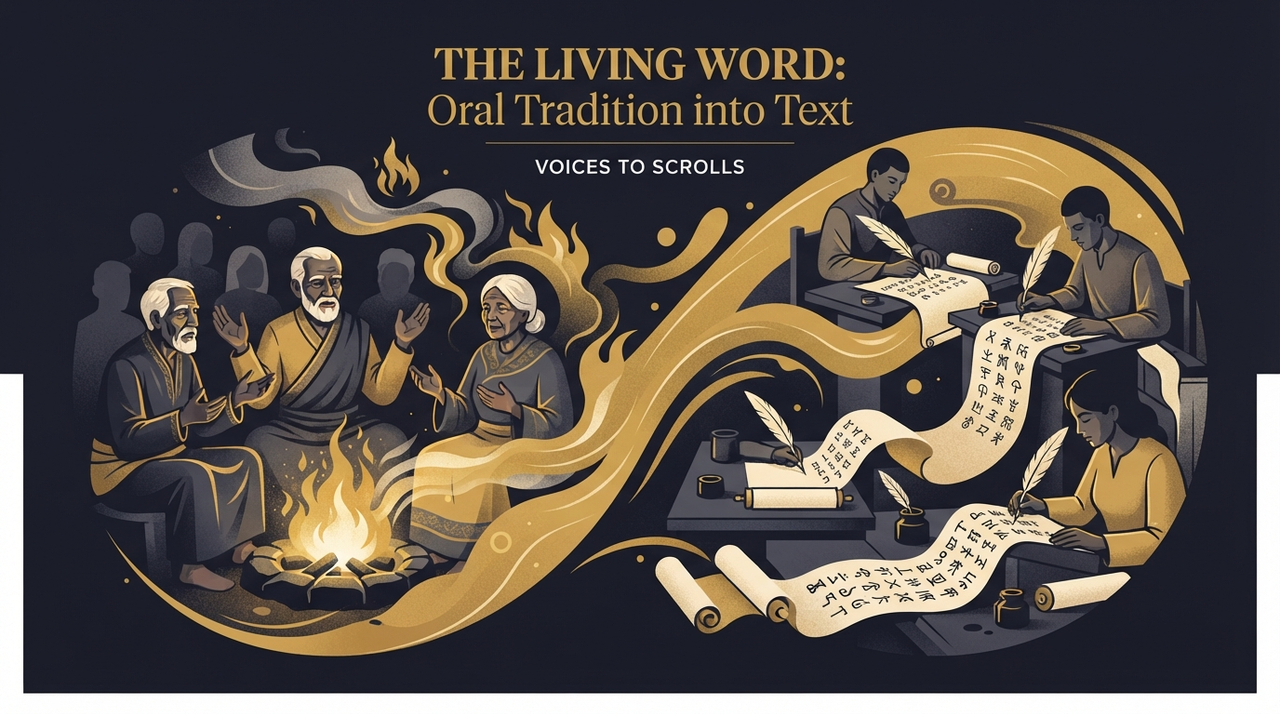
Imagine a Vedic priest, eyes closed in the flickering light of a sacrificial fire, reciting 10,000 verses without a single stumble. Or a Greek rhapsode, gripping his staff like a lifeline, weaving the Iliad's fury through a crowded agora. These weren't feats of superhuman memory but honed practices of oral tradition, where words lived in the breath, body, and community long before ink met palm leaf. In ancient worlds, memorization ancient methods bridged the ephemeral and the eternal, shaping canons that endure today. This journey—from voice to vellum—reveals not a march toward literacy's superiority, but diverse, situated practices of knowledge preservation.
Across Vedic India, Homeric Greece, and Rabbinic Judaism, oral mastery relied on lineage, performance, and formulaic composition. Lineages ensured fidelity: guru to shishya, master bard to apprentice. Performance turned recitation into ritual, rhythm etching lines into muscle memory. Formulas—stock phrases like Homer's "wine-dark sea"—offered mnemonic anchors, allowing improvisation within ironclad structures. Yet evidence for these techniques often mingles firsthand learning traces with later pedagogical glosses, urging caution in our reconstructions.
Vedic Transmission: Chanting the Eternal Sound
In ancient India, the Vedas embodied oral tradition at its zenith. Composed around 1500 BCE, these hymns and rituals spanned 100,000 words, transmitted verbatim for millennia. Priests employed memorization ancient via pathas—recitation modes twisting syllables into patterns: ja ta (forward-backward), ghana (complex permutations). A single verse might spawn hundreds of variants, drilling precision through sheer volume.
Performance was sacred: voices layered in unison during sandhi rituals, correcting drifts via choral feedback. Formulaic verses, rich in meter and alliteration, aided recall. Uncertainty lingers—early texts hint at these, but full systems appear codified later, around 500 BCE. Writing emerged around 300 BCE, not as replacement but fixative: manuscripts standardized oral variants, birthing the written canon amid ongoing recitation.
Homeric Epics: Formulaic Artistry in Performance
The Bard's Repertoire and Oral Poetics
Homer's Iliad and Odyssey, crystallized around 750 BCE, showcase formulaic composition as pedagogy history's cornerstone. Milman Parry's 20th-century fieldwork among Yugoslav bards revealed the system: epic hexameters built from reusable phrases ("swift-footed Achilles"), fitting dactylic meter seamlessly. This wasn't rote drudgery but creative scaffolding, enabling real-time composition.
Rhapsodes trained in guilds, performing at festivals like the Panathenaea. Staff in hand, they paced, gestured, modulating pitch for emphasis—embodied cues reinforcing memory. Lineage mattered: fathers passed repertoires to sons. Writing's role? Papyri from 600 BCE suggest early notation, but fixation came via Alexandrian scholars (3rd century BCE), editing performances into a written canon formation that tamed oral fluidity.
Rabbinic Orality: Layers of Interpretation
Post-Temple Judaism (after 70 CE) elevated oral tradition in the Mishnah and Talmud. Rabbis memorized vast tractates through shakla v'tarya—pilpul, dialectical repetition—and chavruta pairs, debating to embed texts. Formulas abounded: mnemonic acronyms (notarikon) and rhythmic lists. Performance thrived in academies, voices rising in call-and-response.
Here, orality persisted longest: the Oral Torah stayed unwritten until crises demanded the Mishnah's redaction (200 CE). Even then, standardization involved editorial layers—Rabbi Judah compiling disputes—while recitation endured. Evidence mixes: tannaitic reports describe techniques, but full pedagogy evolved later, highlighting interpretive richness over verbatim stasis.
Fixation and Canon: Literacy Methods Enter the Fray
Transition wasn't linear. Cuneiform lexical lists from Sumer (2500 BCE) blend oral drills with clay tablets—scribes memorized signs via repetition, then inscribed for permanence. In all traditions, writing fixed variants: Vedic shakhas (schools) yielded scripts; Homeric Peisistratus allegedly unified recensions; Rabbinic gemara expanded orally before Babylonian codices.
Written canon formation brought editing—omissions, harmonizations—but orality lingered as authority. These were literacy methods complementing, not conquering, voice: performance validated texts, lineages guarded nuances.
Echoes in Linguistics and Pedagogy History
Linguists like Walter Ong chart how orality fosters additive, agonistic thought; writing, analytic abstraction—"writing-memory doors" unlocking analysis atop recall. For pedagogy history, these traditions inspire: spaced repetition echoes pathas, storytelling revives formulas. Aetheria AI explores this nexus, probing how digital tools might revive oral depths in literate eras.
Uncertainties remain—archaeology yields fragments, texts retrospective lenses. Yet these practices affirm: knowledge thrives in community, whether chanted or coded. In our scroll-saturated age, reclaiming oral roots might just rekindle memory's fire.