
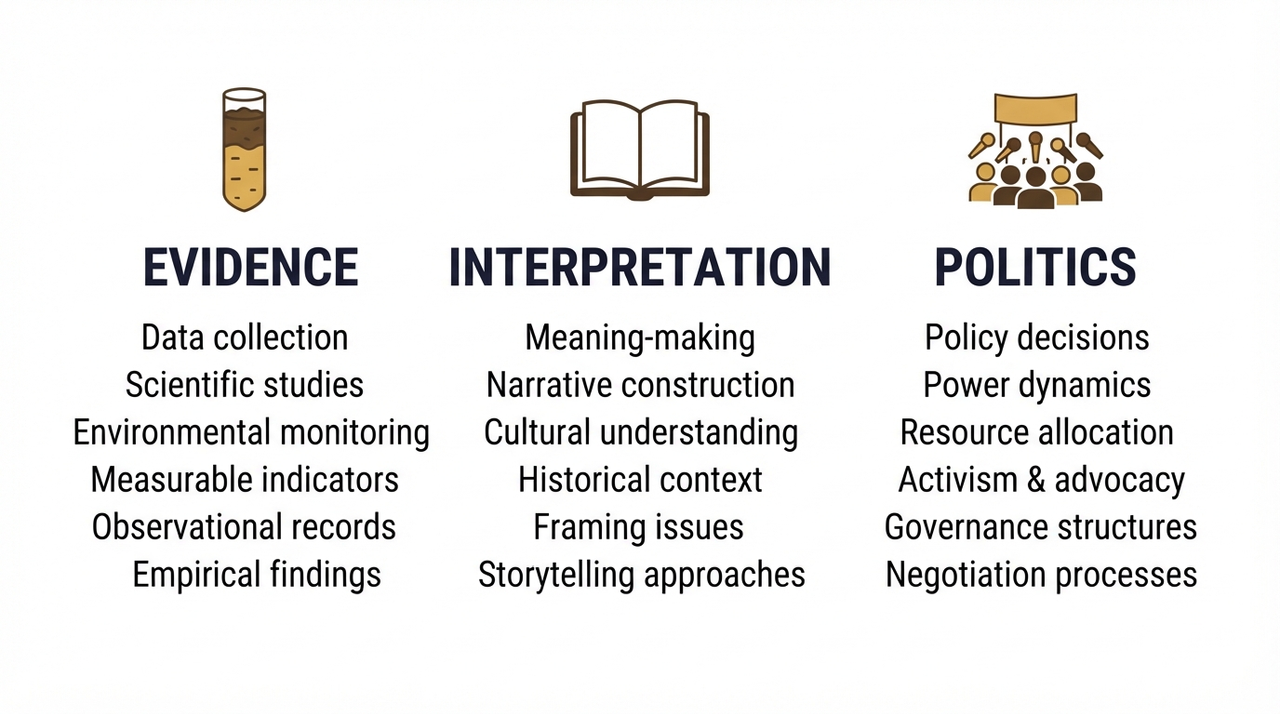
Untangling Landscapes: Environmental Evidence, Cultural Interpretation, and Modern Politics
Picture a terraced valley in the high Andes. Layers of earth hold pollen grains from long-lost crops. Ancient stone inscriptions speak of skies withholding rain as a divine rebuke. Today, a rally echoes with calls to protect this land from mining, drawing on ancestral harmony with nature. Three voices converge on one place. Yet they address different questions. This essay explores how Aetheria distinguishes environmental evidence from cultural landscape interpretation and modern environmental politics. Clarity here guards against false certainty.
The Earth's Archive: What Environmental Evidence Reveals
Landscapes archive change through tangible traces. Soil cores expose erosion patterns and nutrient shifts from plowing or abandonment. Pollen trapped in peat or lake beds signals vegetation succession, hinting at temperature or moisture trends via paleoecology methods. Charcoal flecks mark fire regimes, shaped by lightning or torches. Bones scattered in middens track hunted species and pastoral shifts. Sediments layer floods and droughts at basin scales.
Texts record harvest shortfalls, while archaeological furrows and terraces map labor-intensive fields. Each proxy captures local signals over decades to millennia. Pollen might span centuries but miss short famines. Bones reflect elite diets more than common ones. These records demand source criticism: what scale? What chronology? Human choices, from irrigation canals to herd sizes, entwine with nonhuman rhythms like pest cycles or soil microbes.
Human Narratives: Cultural Interpretation of Land and Weather
Cultures read landscapes through their own lenses. Festival calendars aligned sowing with star positions and first rains. Sacred groves preserved old-growth trees amid cleared hills, blending reverence with utility. Royal inscriptions in Mesopotamia bewailed drought as failed omens, justifying tribute hikes or conquests. These are not raw data but claims rooted in cosmology and power.
A village elder's tale of angry spirits might coincide with sediment-proved floods. Coincidence invites curiosity, not equation. Such stories highlight human agency: unequal exposure to scarcity, labor in dikes, infrastructure like granaries. They enrich environmental evidence without becoming it. Traditions evolve, carrying memory across generations without uniform wisdom.
Present Claims: Environmental Politics and the Past
Modern movements and states summon history for traction. Conservation campaigns cite ancient terraces to argue sustainable limits. Energy projects dismiss pollen-inferred dry spells as overblown. These invocations fuel environmental politics, legitimate as living debate. Yet past landscapes neither vote nor endorse. Climate reconstruction uncertainty looms: proxies blur exact timings, intensities, causes.
Recruiting the past risks distortion. A sediment core's drought signal becomes "proof" of collapse morality. Cultural omens morph into timeless ecology lessons. Distinction preserves rigor.
Source Criticism Amid Uncertainty
Scales, Chronologies, and Human Factors
Evidence varies by grain. A core from one pond misses valley-wide rains. Bones favor preserved sites, skewing toward the wealthy. Cultural landscape interpretation adds texture: groves as refugia amid farms, texts noting labor migrations. Nonhuman life thrives or falters independently. Uncertainty demands humility. Reconstructions blend proxies probabilistically, acknowledging gaps.
- Scale: Local cores versus regional trends.
- Chronology: Radiocarbon wobbles, text dates debated.
- Agency: Choices in crops, herds, walls shape outcomes.
Living Authority: Communities and Landscapes Today
Descendant and Indigenous communities hold present stakes. They speak to ongoing ties, infrastructure needs, unequal exposures. Their voices stand as contemporary authority, not proxies for ancient uniformity. Aetheria honors this by centering living claims alongside archives.
Cross-Disciplinary Threads
These layers link fields. Archaeology unearths fields amid pollen shifts. Sacred places host groves with charcoal traces. Politics debates economics of past labor. Sacred time weaves festival cycles into harvest logs. Untangling invites richer synthesis.
An Invitation to Discern
Next time a claim bridges soil cores and policy, pause. Is this environmental evidence? A cultural echo? Political strategy? Label first. Inquiry flourishes in distinction. Landscapes whisper many truths. Listen closely, separately, humanely.