Healing Hands and Ancient Artifacts: The Material Culture of Medicine from Sumerian Tablets to Islamic Hospitals
Picture a healer's calloused fingers tracing incisions on sun-baked clay, etching lists of bitter roots and pungent resins to quell a fever's grip. This is no abstract philosophy—it's the history of medicine made tangible, woven into the material culture of ancient healing tools and texts. Far from disembodied ideas, healing practices have always been anchored in objects: tablets that crumble, papyrus that frays, instruments that gleam under lamplight. These artifacts carry the weight of touch, the precision of measurement, and the quiet negotiations of power and consent. Join us on a journey through time and place, exploring how Sumerian healers, Alexandrian scholars, and Cairene physicians embodied medicine in their hands and halls.
Eridu’s Asû Healer: Clay Tablets and the Dawn of Sumerian Medicine
In the marshy cradle of Eridu, around the 3rd millennium BCE, the asû—healer-priest—huddled over a lump of river clay. Archaeological digs have unearthed these medical texts: cuneiform tablets listing over 250 plants, minerals, and animal parts for poultices against scorpion stings or incantations for headaches. One fragment details a salve of myrtle, willow, and beer-soaked dough, measured by finger-widths and palmfuls—dosages born of observation, not whim.
Touch was paramount: the asû kneaded mixtures with bare hands, applying them to skin in temple annexes linked to sacred ziggurats. Access skewed toward elites and priests, though folk remedies rippled outward. Power dynamics whispered through preparation—who ground the herbs, who received the balm? Consent emerged in ritual dialogue, blending supplication with care. These tablets, reconstructed from shards in museums today, distinguish hard evidence from cultural echoes. Explore Eridu and Uruk on our Civilization shelves for the full urban backdrop.
Alexandria’s Physician Libraries: Papyrus Recipes and Hellenistic Synthesis
Unfurling Knowledge in the Mouseion
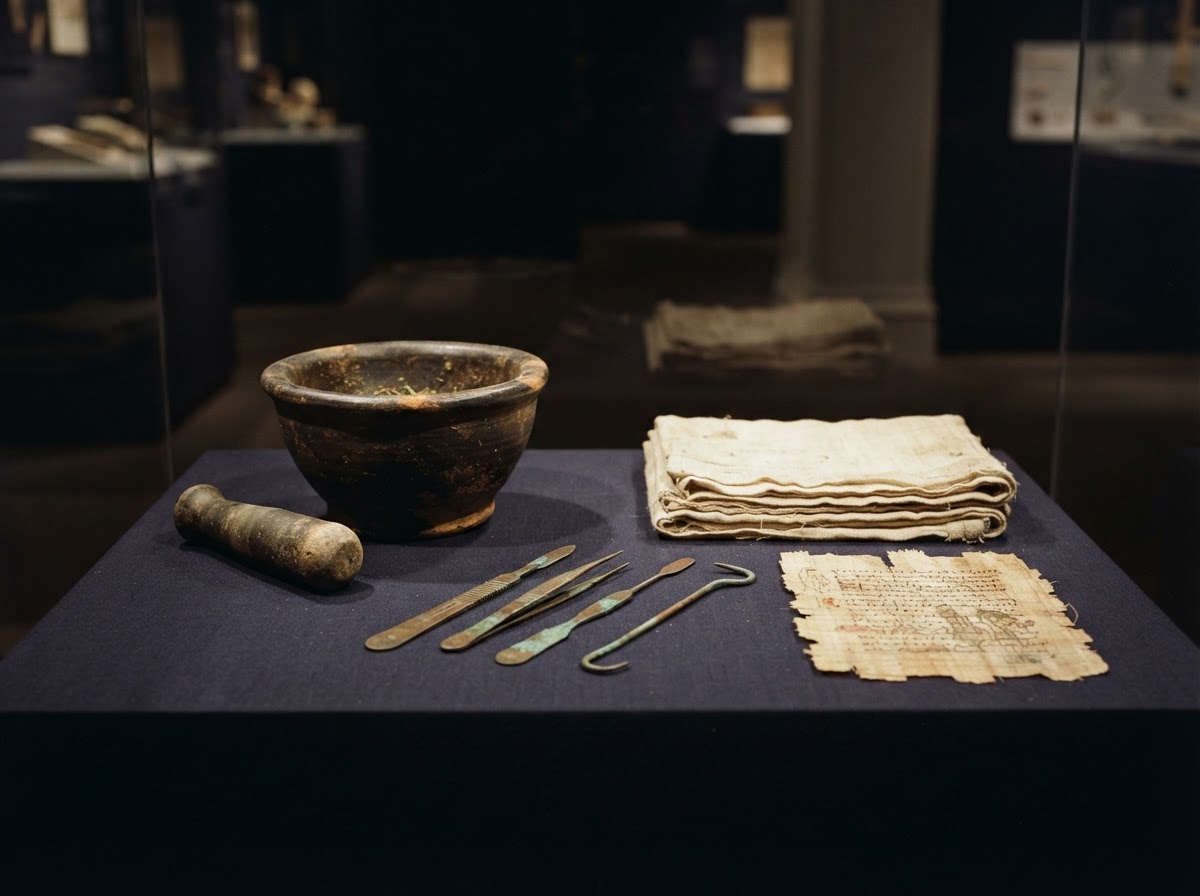
Fast-forward to 1st century CE Alexandria, where the Mouseion's library brimmed with papyrus rolls—slender scrolls of Egyptian, Greek, and Persian medical texts. Physicians like those echoing Herophilus consulted recipes for theriac, a complex electuary of 60+ ingredients balanced for humoral equilibrium: opium for pain, viper flesh for venom, honey for binding. Tools included bronze scalpels and glass vials, their edges honed by apprentices' steady hands.
Here, institutions democratized somewhat; libraries welcomed scholars, though preparation fell to slaves or juniors, received by paying patients. Language shifted—Greek terms overlaid Semitic ones—demanding translation. Touch conveyed what ink could not: the feel of a pulse, the scent of overripe fruit signaling imbalance. Papyrus fragments, pieced from dumps like Oxyrhynchus, blend textual fidelity with lived practice. Trace the first prescriptions in Writing & Memory.
Islamic Hospitals in 14th-Century Cairo: Waqf Instruments and Institutional Care
By 14th-century Cairo, the bimaristan al-Mansuri towered as a beacon of organized healing. Waqf endowments—legal charters on vellum—funded free care, with surgical kits of silver scalpels, cautery irons, and lancets for bloodletting. Texts like Ibn Sina’s Canon prescribed rosewater distillations and theriac variants, dosages calibrated by body type and season through meticulous observation.
Healers, trained in apprenticeships, passed tactile wisdom: the grip on a syringe, the bind of splints. Access expanded—waqfs ensured care for poor Muslims, Christians, Jews alike, though gender segregated wards hinted at consent's contours. Power balanced via endowments, yet hierarchy persisted: physicians prepared, attendants administered. Artifacts from digs and collections reveal this fusion of material culture. Visit Sacred Places for healing temples.
Transmission and the Limits of Text: What Hands Carry Beyond
Across eras, materia medica traveled via trade and conquest: Sumerian plant lists into Greek herbals, Alexandrian compendia into Arabic translations fueling Cairo's pharmacies. Yet texts faltered where apprenticeship shone—nuanced touch detected fevers' heat, balanced mixtures by eye and tongue. Archaeological troves (tablets, tools) anchor us, textual reconstructions fill gaps, cultural practices evoke the rest.
In every era, medicine's true measure lay not in words alone, but in the healer's hand meeting the patient's skin.
Reflect and Trace Your Own
What of your aspirin bottle or herbal tea tin? Trace one everyday care object backward: Who measured its dose? What ancient root inspired it? Whose hands first mixed its kin? In this inquiry, the history of medicine pulses alive, inviting your touch to the past.