
As Above, So Below Meaning: Emerald Tablet Origins & Hermetic Secrets Revealed
The Timeless Echo: What Does "As Above, So Below" Really Mean?
Imagine a single phrase rippling through centuries, whispered in alchemist's labs and splashed across modern Instagram reels. "As above, so below." It's the As Above So Below meaning that has captivated seekers for ages—but strip away the social media gloss, and you'll uncover a profound Hermetic principle of cosmic correspondence. At its core, this Hermetic phrase explanation reveals a fundamental unity: the macrocosm of the universe mirrors the microcosm of the individual, and vice versa. What happens in the heavens reflects on earth; the patterns of the stars echo in the human soul.
But this isn't a manifesting mantra for parking spots. Born from ancient wisdom traditions, it guides the alchemical quest to transmute base matter—and the self—through understanding these interconnected realms. Let's trace its roots back to the source: the legendary Emerald Tablet.
Emerald Tablet as Above So Below Origin: The Mythic Genesis
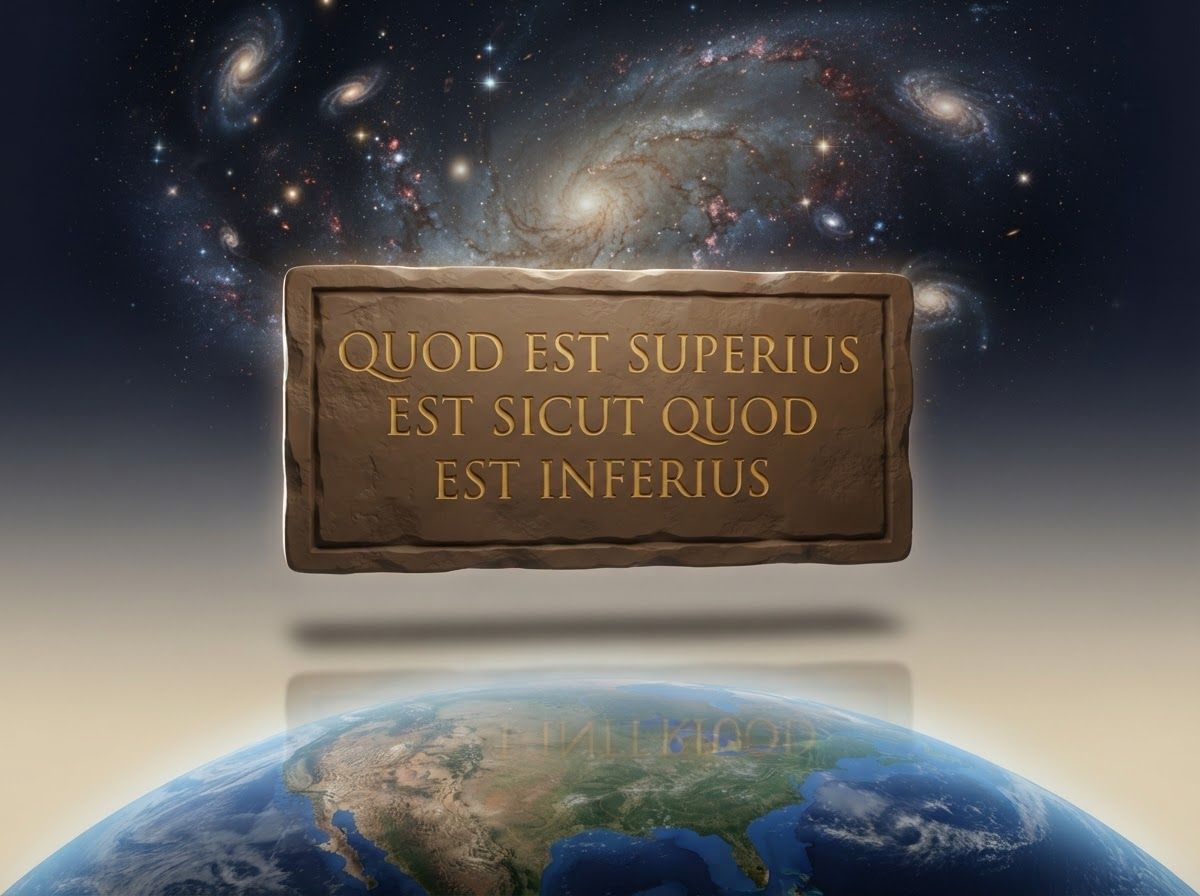
The phrase's origin lies in the Tabula Smaragdina, or Emerald Tablet, a cryptic text attributed to Hermes Trismegistus, the thrice-great sage blending Greek god Hermes with Egyptian Thoth. Picture a slab of emerald inscribed with divine secrets, discovered in a cave or tomb—legends vary. The key line, in Latin: "Quod est superius est sicut quod est inferius, et quod inferius est sicut quod est superius." Translated: "That which is above is like to that which is below, and that which is below is like to that which is above."
Scholars agree this isn't from ancient Egypt, despite the hype. The earliest versions emerge in Arabic texts from the 8th-10th centuries, like the Secret of Creation (Kitab sirr al-khaliqua), linked to Balinas (pseudo-Apollonius of Tyana). These draw from Hellenistic alchemy, fusing Greek philosophy, Egyptian mysticism, and early Islamic science. No pristine Egyptian precursor exists; the Emerald Tablet crystallized in the Abbasid era's intellectual ferment.
Dive deeper into the full tablet in our Emerald Tablets Journal article, or explore the enigmatic author via Who Was Hermes Trismegistus.
Hermeticism Unveiled: Microcosm, Macrocosm, and Alchemical Fire
The Original Alchemical Context
In its native habitat—Hermeticism—this axiom isn't vague spirituality. It's the cornerstone of as above, so below meaning: a blueprint for operation. Alchemists saw the universe as a grand laboratory where celestial influences (above) govern earthly processes (below). To create the Philosopher's Stone, replicate solar perfection in leaden matter. The human body, a microcosm, mirrors the starry macrocosm; purify one, and the other aligns.
This correspondence fueled experiments in distillation, fermentation, and spiritual ascent. Hermes Trismegistus taught that true knowledge comes from perceiving these links—uniting opposites like sulfur and mercury, sun and moon.
From Arabic Manuscripts to Latin Libraries
Arabic recensions spread via trade routes, reaching Europe in the 12th century through Spanish translations. Hugo of Santalla rendered it into Latin around 1140, igniting the medieval alchemical revival. By the Renaissance, Marsilio Ficino included it in his 1471 Corpus Hermeticum edition, cementing its status. Humanists pored over it, seeing echoes of Plato and the Kabbalah.
Renaissance Revival to Modern Misuses: A Phrase Transformed
Ficino's Florence buzzed with Hermetic fervor; artists and philosophers invoked Quod est superius in frescoes and treatises. Fast-forward to 1908: The Kybalion repackaged it for New Thought, blending Hermeticism with occultism. Read our Kybalion article for the full story.
Today? Scholarly views stress its alchemical rigor—micro-macro unity as empirical insight. Popular culture twists it into "law of attraction" lite: think positive, attract wealth. This dilutes the depth, ignoring ethical transmutation. Yet, in chaos theory or quantum entanglement, modern science whispers similar harmonies.
For practical guidance, check our Hermetic guide and creation resources.
FAQs: Unpacking the Emerald Tablet's Enduring Mystery
Is "As Above, So Below" from ancient Egypt?
No—the Emerald Tablet's Arabic origins postdate pharaonic Egypt, though it claims Hermetic lineage.
What's the difference between scholarly and popular interpretations?
Scholars focus on alchemical operations and philosophy; pop versions emphasize personal manifestation.
How does it relate to The Kybalion?
The Kybalion modernizes Hermetic principles, prominently featuring the axiom as a universal law.
Can I apply it today?
Yes—observe nature's patterns in your life, aligning inner and outer worlds mindfully.
In the dance of stars and atoms, the ancient whisper endures: align the below with the above, and creation unfolds.
The Emerald Tablet beckons. Will you heed its call beyond the quotes?