
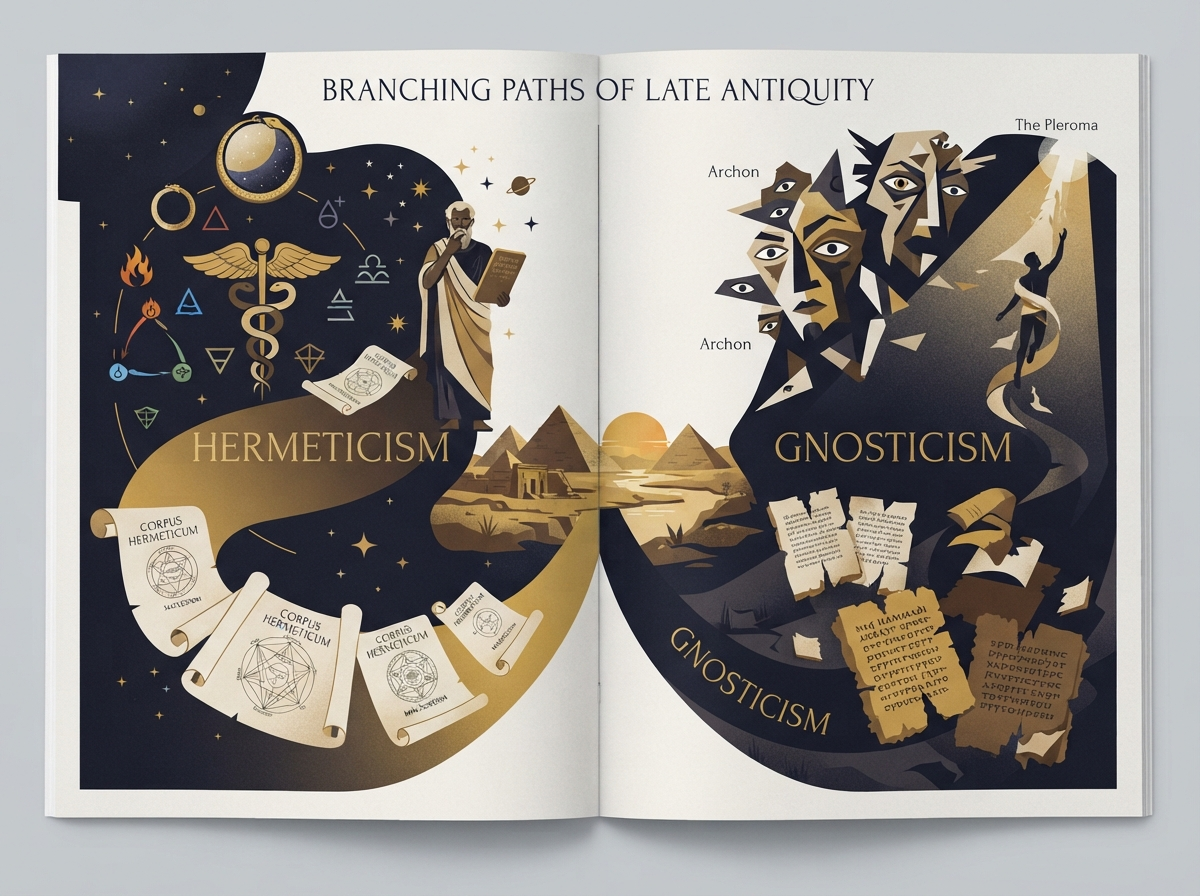
Hermeticism vs Gnosticism: Key Differences, Surprising Similarities, and Ancient Sources Revealed
Imagine wandering the sun-baked streets of Alexandria in the 2nd century CE, where philosophers debate under marble porticos and scribes copy forbidden scrolls by lamplight. In this crucible of ideas, two mystical traditions emerge: Hermeticism and Gnosticism. Often blurred together in popular lore, they offer profound paths to divine knowledge—but are they the same? This Hermeticism vs Gnosticism exploration uncovers their distinct flavors, shared roots, and the ancient texts that define them, helping curious seekers separate these late-antique gems.
Unveiling Hermeticism: A Cosmic Embrace
Hermeticism draws its name from Hermes Trismegistus, the thrice-great sage blending Greek Hermes and Egyptian Thoth. This tradition shines with optimism: the cosmos is a divine masterpiece, a living emanation of the One God. Knowledge—or gnosis in its purest form—transforms the soul, urging ascent through the spheres back to the divine source.
Core texts like the Corpus Hermeticum, a 17-tractate collection rediscovered in 1460, paint a reverent picture. In Poimandres, the divine mind reveals creation as harmonious, with humanity as a microcosm of the stars. The Asclepius laments Egypt's decline but affirms the world's sacredness. Fragments in Stobaeus and even Nag Hammadi Codex VI's Discourse on the Eighth and Ninth echo this: rituals, invocations, and noetic vision elevate the practitioner.
Explore deeper in our Hermeticism guide or the timeless Emerald Tablets and 7 Principles.
Decoding Gnosticism: Shadows and Sparks
Gnosticism isn't a unified church but a modern umbrella for diverse sects like those of Valentinus and Basilides. Its hallmark? A radical dualism: the material world as a flawed prison crafted by a demiurge, far from the true, transcendent God. Salvation comes via secret gnosis, awakening the divine spark within to escape cosmic chains.
Nag Hammadi's treasures, unearthed in 1945, reveal this vividly. The Apocryphon of John depicts Sophia's fall birthing the ignorant Yaldabaoth. The Gospel of Thomas offers enigmatic sayings for inner awakening. Sethian texts emphasize baptismal rites and otherworldly journeys, critiquing fleshly existence while celebrating the spirit's origin.
Surprising Similarities in the Greek-Egyptian Melting Pot
Shared Language of Hidden Wisdom
Both bloom in late antiquity's Hellenistic Egypt, blending Plato, Jewish mysticism, and local lore. They speak of gnosis as salvific insight, use revelatory dialogues (think teacher-disciple like Poimandres or John’s savior), and bridge philosophy with piety. Astrological ascent, divine intermediaries, and anti-fatalism unite them against vulgar religion.
Overlaps in Nag Hammadi
Even the same library holds both: Hermetic tracts amid Gnostic ones, hinting at shared scribal circles. Check our Nag Hammadi analysis.
Key Differences: Difference Between Hermeticism and Gnosticism
- Cosmology: Hermeticism's world is good, a theophany; Gnosticism's is a tragic error, demiurge-dominated.
- World Attitude: Hermetics revere creation's beauty; Gnostics often scorn the body as illusory tomb.
- Soteriology: Hermetic ascent harmonizes soul with cosmos; Gnostic escape rejects it outright.
- Ritual: Hermetics favor theurgic invocations; Gnostics lean on sacraments like Sethian seals, though varied.
Collapsing them erases nuances—Hermeticism inspires modern occultism; Gnosticism fuels existential revolt.
Corpus Hermeticum vs Nag Hammadi: Primary Sources
Hermetic canon: Ficino's Corpus Hermeticum (17 treatises), Latin Asclepius, Stobaeus excerpts. Gnostic: Nag Hammadi's 52 Coptic texts, plus patristic reports. No single "Gnostic Bible"—diversity reigns. Dive into our creation series.
FAQs: Gnostic and Hermetic Comparison
Are Hermeticism and Gnosticism the same?
Distinct yet overlapping—optimism vs dualism sets them apart.
What is the main difference between Hermeticism and Gnosticism?
Attitude to matter: embrace vs rejection.
Can I practice both?
Many do, drawing from shared gnosis.
As shadows lengthen over Alexandria's ruins, these traditions whisper: seek truth beyond dogmas. Ready to ascend? Join our guide, explore the blog, or create your path. The divine awaits.