
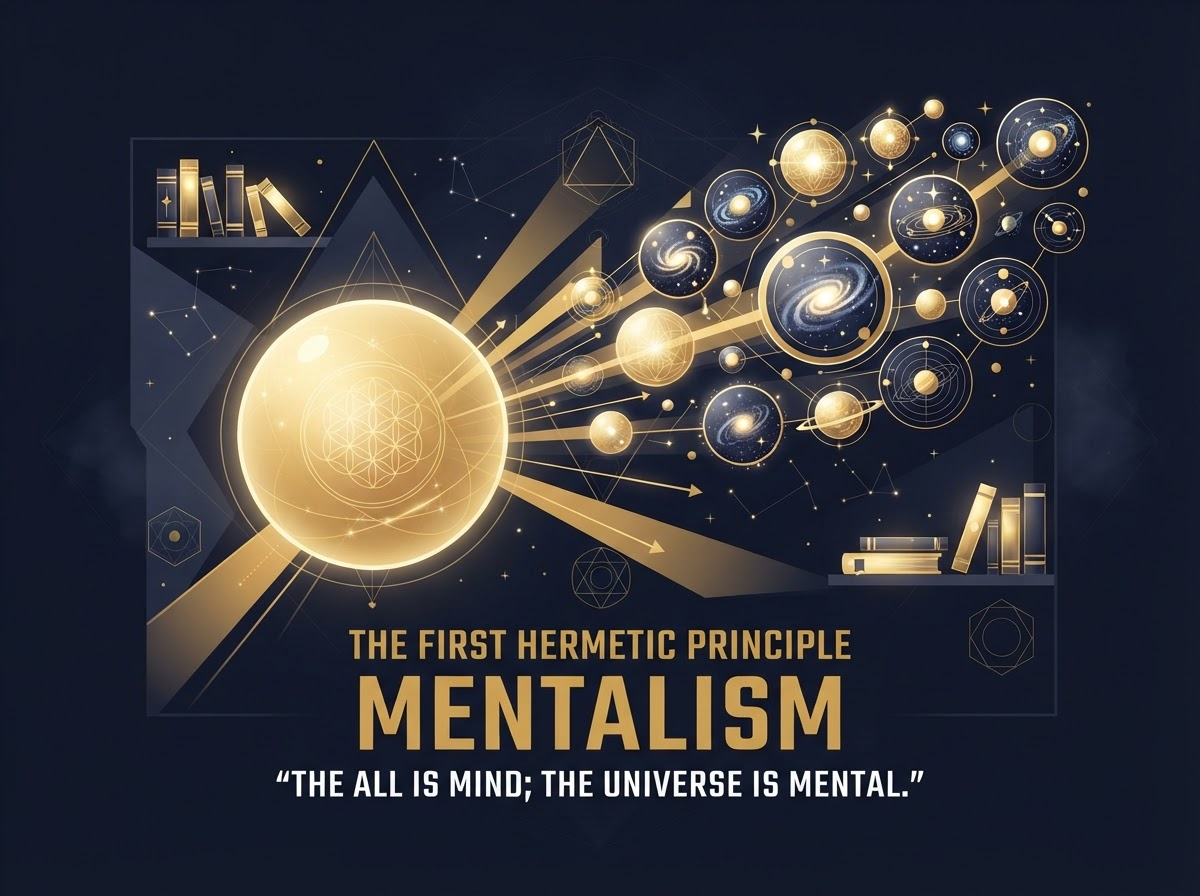
Mentalism explained: The First Hermetic Principle, "The All is Mind; the Universe is Mental," originates in the 1908 Kybalion, not the ancient Corpus Hermeticum, but echoes Hermetic ideas of Nous (Divine Mind) in texts like CH XI and XII. It differs sharply from New Thought's Law of Attraction by emphasizing cosmic mental reality over personal manifestation techniques.
Mentalism Explained: First Hermetic Principle 'The All is Mind' – Kybalion vs Ancient Roots & New Thought
Imagine a cosmos not forged from atoms or energy, but spun from pure thought—a vast, vibrating mind dreaming reality into being. This isn't science fiction; it's the core of mentalism explained through the First Hermetic Principle: "The All is Mind; the Universe is Mental." For students of Hermetic philosophy, this idea beckons like a half-remembered dream, promising clarity amid esoteric fog. But where does it truly originate? Not in the dusty scrolls of Alexandria, but in a modern text: the Kybalion. Yet its roots twist back to ancient wisdom. Let's unpack this principle non-dogmatically, contrasting Kybalion's bold phrasing with Hermetic origins and steering clear of New Thought misreadings.
The Kybalion's Take on Mentalism: A Modern Synthesis
Published in 1908 by "Three Initiates" (likely William Walker Atkinson), the Kybalion distills seven Hermetic principles into accessible prose. Mentalism leads the charge: Everything springs from The All—an infinite, unknowable Mind. The universe? A mental creation, held in this cosmic consciousness. Picture it as waves on an ocean: your thoughts, the world, even stars—ripples in the mental sea.
This isn't solipsism (your mind alone creates reality) but a grander vision. The Kybalion stresses: "The Universe is Mental—held in the Mind of The All." It invites mental transmutation—mastering vibration through focus—but warns against mistaking the map for territory. No rituals prescribed; just razor-sharp reflection.
Ancient Roots: Beyond the Kybalion to Hermetic Origins
Corpus Hermeticum and the Divine Nous
The phrase "The All is Mind"? Pure Kybalion, absent from the Corpus Hermeticum (2nd-3rd century CE), attributed to Hermes Trismegistus. Dive deeper: Hermetic texts pulse with Nous—Divine Mind or Intellect—as reality's architect. In Corpus Hermeticum XI, Nous begets the cosmos from itself, birthing elements through thoughtful emanation. CH XII echoes: God is "Mind and the Maker of all things," a generative intelligence beyond human grasp.
These aren't tidy axioms but dialogues—Poimandres visions, mythic ascents. Hermes teaches Tat: Salvation lies in aligning with Nous, shedding material illusions. For context, explore our guide on Who Was Hermes Trismegistus? or the enigmatic Emerald Tablets.
Hermetic Mentalism vs New Thought: Key Distinctions
Modern seekers often blur lines, equating Kybalion mentalism with New Thought's optimism—think Law of Attraction: Visualize wealth, attract it. Wrong turn. Hermetic Mentalism vs New Thought hinges on scope. Hermeticism views a singular cosmic Mind; New Thought (Atkinson included elsewhere) personalizes it—your mind shapes outcomes via universal laws.
- Hermetic: Universe as The All's dream; we participate humbly.
- New Thought: Mind over matter for prosperity; manifestation toolkit.
- Hermetic roots: Gnosis through Nous-union, not egoic control.
See comparative origins in our Creation Guide.
Practicing Reflection: Engage Without Endorsing
Test mentalism philosophically. Journal prompts: Does perception shape your world? Recall a bias-altered memory. Or meditate on CH XI: Sense Nous as ambient intelligence. No belief required—just inquiry. Try our Journaling Guide for structured dives.
FAQs on the First Hermetic Principle
Is 'The All is Mind' from ancient Hermeticism?
No—it's Kybalion's 1908 phrasing, inspired by Nous concepts in Corpus Hermeticum XI/XII.
How does Hermetic mentalism differ from Law of Attraction?
Hermeticism posits a unified cosmic Mind; LoA focuses on individual thought-power for results.
What is Hermeticism?
A philosophical tradition blending Greek, Egyptian wisdom on divinity, cosmos, and soul—ascent via knowledge.
Ready to reflect? Grab your journal, revisit the Kybalion or Corpus Hermeticum, and question the mental fabric of your world. Dive deeper with our Hermetic cluster—links above—and share your insights below.