
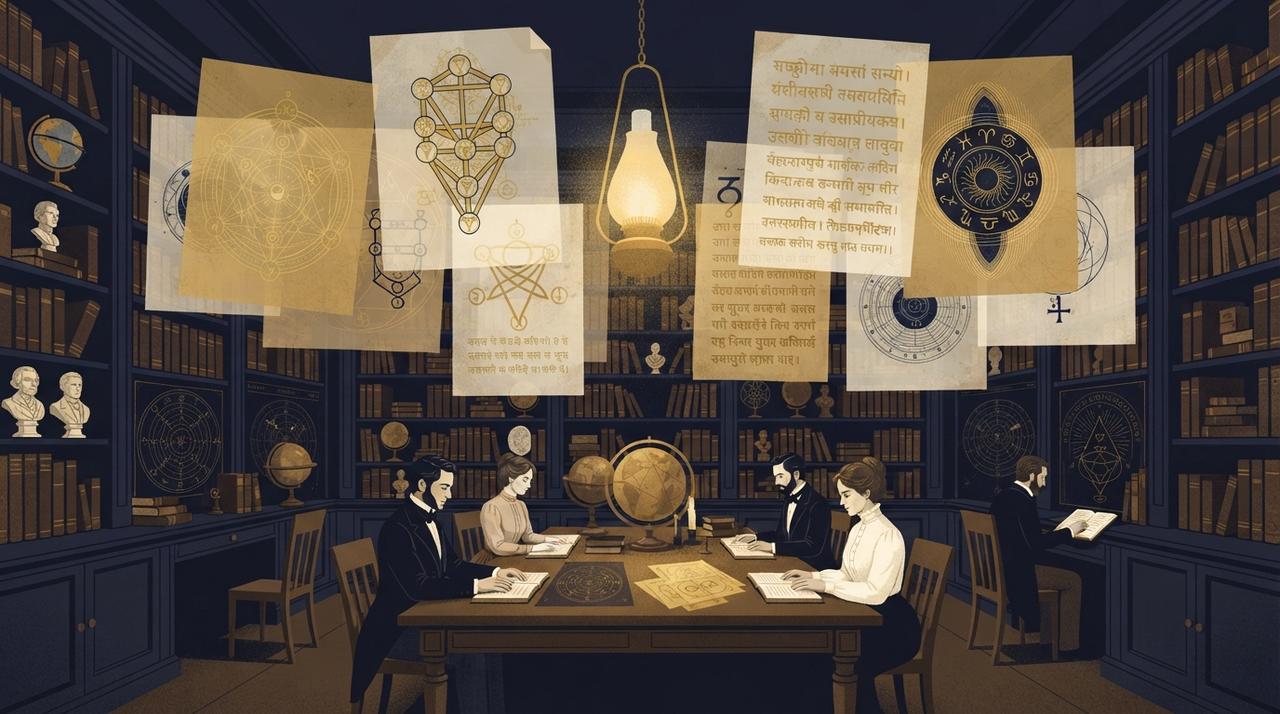
Theosophy and Modern Esotericism: How Blavatsky Reinterpreted Hermeticism and Ancient Wisdom
Imagine a Russian émigré in 19th-century New York, channeling visions from hidden masters in the Himalayas, weaving together scraps of Egyptian papyri, Hindu Vedas, and Greek mysticism into a grand tapestry of universal truth. Helena Petrovna Blavatsky wasn't just a mystic; she was a lightning rod for Theosophy, igniting modern esotericism by boldly reinterpreting Hermeticism and ancient wisdom traditions. Her work bridged dusty manuscripts and living spiritual quests, reshaping how seekers today approach the occult.
But what happens when a 19th-century visionary overlays her synthesis onto texts from late antiquity? This is the heart of Hermeticism reception in Theosophy—a story of bold esoteric interpretation that demands we separate fragile manuscript evidence from later rereadings. Let's trace this path through history, uncovering Blavatsky's innovations, their echoes in movements like Anthroposophy and New Thought, and the scholarly questions that linger.
The Ancient Roots of Hermeticism: Manuscript Truth vs. Mythic Aura
Hermeticism emerges from the Corpus Hermeticum, a collection of dialogues penned in Greek around the 2nd and 3rd centuries CE in Alexandria. Attributed pseudonymously to Hermes Trismegistus—a fused Egyptian-Greek sage—these texts blend Platonism, Stoicism, and alchemy into visions of divine ascent and cosmic unity. Surviving manuscripts, like the 14th-century Greek codices rediscovered in the Renaissance, reveal no primordial secrets but philosophical treatises from a Hellenistic melting pot.
Fast-forward to the 15th century: Marsilio Ficino translates them into Latin, sparking a reception history that casts Hermes as an ancient teacher predating Moses. This mythic layer—unsupported by archaeology—fueled Renaissance magi like Pico della Mirandola. By Blavatsky's era, Hermeticism symbolized lost wisdom, ripe for revival amid industrialization's spiritual void.
Blavatsky's Theosophy: A New Lens on Ancient Wisdom
Founding Theosophy Amid Victorian Skepticism
In 1875, Blavatsky co-founded the Theosophical Society in New York with Henry Steel Olcott and William Quan Judge. Her manifesto, Isis Unveiled (1877), and magnum opus The Secret Doctrine (1888) positioned Theosophy as a synthesis of East and West. Drawing from Hermetic principles like "as above, so below," she claimed access to stanzas of Dzyan—alleged pre-Vedic texts whose existence remains unverified by scholars.
Blavatsky's esoteric interpretation transformed Hermeticism from isolated philosophy into a perennial tradition. She read the Emerald Tablet not as medieval alchemy but as encoded cosmology linking Atlantis, Lemuria, and root races—ideas absent from original manuscripts.
Re-reading Hermeticism Through Eastern Veils
Where ancient Hermetica focused on nous (divine mind), Blavatsky infused karma, reincarnation, and septenary planes, blending them with Kabbalah and Neoplatonism. Her Hermeticism reception added evolutionary spirituality: humanity ascending through seven rounds, echoing but expanding Poimandres' gnosis. Uncertainty abounds—did she draw from genuine Tibetan sources, or was it creative synthesis? Manuscripts like the Nag Hammadi finds postdate her, complicating claims.
Ripples in Modern Esotericism: From Golden Dawn to Anthroposophy
Blavatsky's framework seeded modern esotericism. The Hermetic Order of the Golden Dawn (1888) adopted her hierarchies for ritual magic. Rudolf Steiner's Anthroposophy (1910s) refined Theosophy into Christian esotericism, critiquing Blavatsky while retaining Hermetic ascent motifs. New Thought pioneers like Annie Besant echoed her mind-over-matter ethos, sans occult drama.
- Theosophy added globalism: Hermeticism went from Eurocentric to universal.
- It popularized rereadings: Ancient texts as blueprints for psychic evolution.
- Modern orders like AMORC (1920s) commercialized this, blending with self-help.
This reception history connects to broader esoteric revivals, linking back to Renaissance grimoires and forward to today's channeled works.
Scholarly Critiques: Innovation or Invention?
Academics like Antoine Faivre praise Theosophy's role in Western esotericism's democratization, yet Wouter Hanegraaff notes Blavatsky's anachronisms: projecting 19th-century occultism onto antiquity. No ancient evidence supports root races or Mahatmas' letters, exposed in the 1885 Hodgson Report as potential fraud—though later re-evaluated with nuance. Still, her influence endures, inviting seekers to question: wisdom tradition or wishful synthesis?
Blavatsky didn't unearth ancient Hermeticism; she resurrected it for a restless age, fueling Theosophy's legacy in modern esotericism. Dive deeper via Isis Unveiled, Ficino's translations, or histories like Joscelyn Godwin's The Theosophical Enlightenment. In our quest to understand the universe's hidden doors, her bold rereadings remind us: the real magic lies in the seeking.