
Ancient Mathematics Practices: From Mesopotamian Scribal Schools to Egyptian Tablets and Beyond
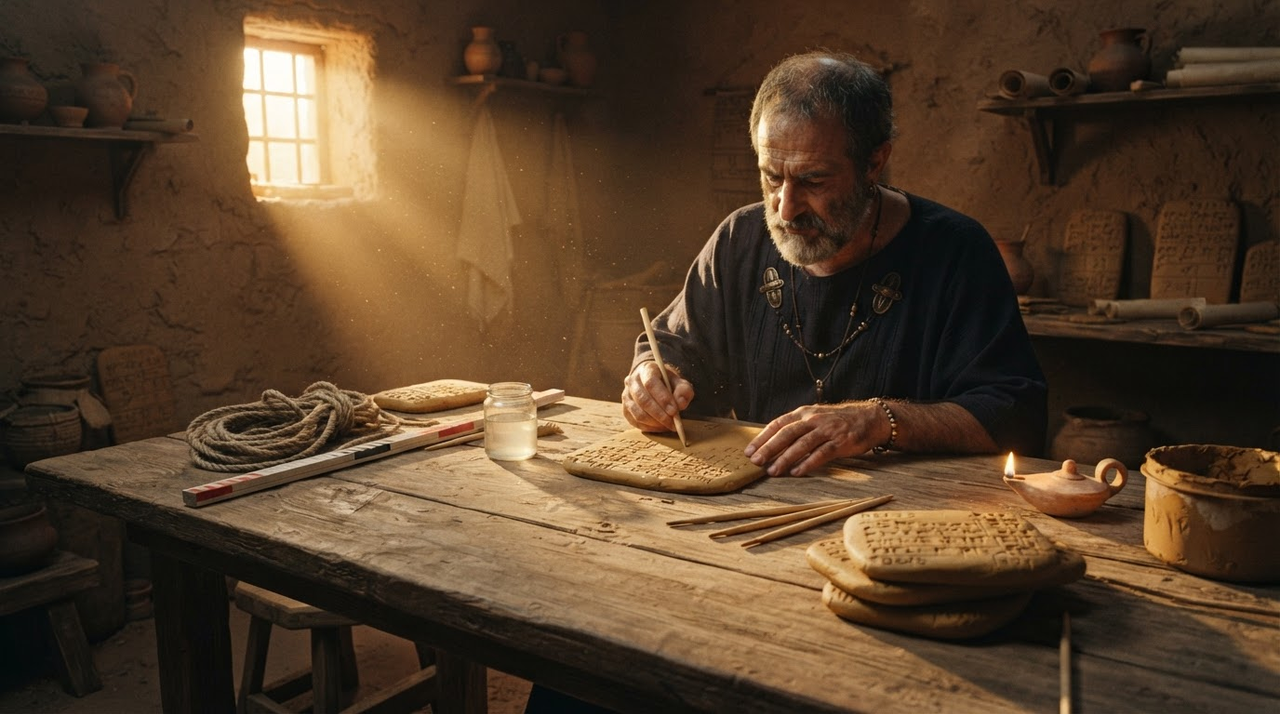
Imagine a young apprentice in ancient Mesopotamia, fingers caked with wet clay, pressing a reed stylus into a tablet under the flicker of an oil lamp. This wasn't abstract philosophy in a philosopher's ivory tower. No, this was ancient mathematics practices at work—raw, practical, essential for the grind of daily life. Scribes tallied grain silos, merchants haggled over volumes, surveyors mapped flood-prone fields. Mathematics lived in the workplaces of the world, wielded by those who kept empires humming: the scribal schools, the dusty offices, the riverbanks.
Far from the lone genius myth, the history of mathematical work reveals a collaborative craft, honed in edubbas and scribal ateliers. Clay tablets and papyrus rolls weren't treatises for posterity; they were exercises, ledgers, problem sets. Who did the math? Not elites pondering infinities, but functionaries ensuring bread on the table and pyramids piercing the sky. What tools? Unglazed clay, ink on reeds, humble counting boards. Why? Accounting floods, erecting monuments, dividing inheritances. Let's trace this thread from Sumerian cuneiform to medieval Baghdad, respecting the evidence—tablets unearthed, papyri unrolled—while questioning our interpretations of their purpose.
Mesopotamian Scribal Schools: The Edubba and Its Clay Curriculum
In the Old Babylonian period, around 1800 BCE, the Mesopotamian scribal schools—known as edubba, or "house of tablets"—buzzed with rigor. Boys from scribal families spent years mastering cuneiform, progressing from simple sums to quadratic equations. Evidence survives in thousands of tablets: student exercises, scratched with errors and corrections, revealing a curriculum tied to real-world demands like land measurement and trade.
Take YBC 7289, a fist-sized tablet from Yale's Babylonian Collection. It approximates √2 to six decimal places—1;24,51,10 in sexagesimal—as a geometric diagram with a step-by-step algorithm. Was this pure theory? Unlikely. Scribes used such methods for irrigation canals and ziggurats, where precision meant survival amid Tigris floods. Tools were basic: clay softened in water, styli for wedges, sometimes abacuses of pebbles. The why was bureaucratic—taxes, rations, astronomy for calendars. These weren't "inventions" in isolation; parallel developments echoed in neighbors' records, reminding us evidence shows practice, not priority.
Egyptian Scribes: Papyri Problems for Practical Power
The Rhind and Moscow Mathematical Papyri
Across the Nile, Egyptian scribes etched their legacy on papyrus, a flexible medium from reeds. The Rhind Papyrus (c. 1650 BCE), named for collector Alexander Henry Rhind, spans 5 meters with 84 problems: volumes of cylindrical granaries, pyramid slopes, bread divisions. The Moscow Papyrus adds cylinder and pyramid volumes, hinting at early calculus-like insights.
These were school texts, copied by apprentices training for pharaonic administration. Picture a scribe in Thebes, ink brush in hand, solving: "A circular field with a square of 9 khet equal to its area." Solutions used unit fractions (hekat shares), practical for Nile surveys post-flood. Tools? Papyrus rolls, reed pens, red ink for problems, black for answers. Purpose? Architecture for tombs, accounting for harvests—math as statecraft. Tablets appear too, like the Cairo leather roll for geometry, blurring lines with Mesopotamian clay. Interpretation caution: Were these exams or manuals? The repetitive phrasing suggests pedagogy over application.
Echoes Beyond: Chinese Bureaucracy and Islamic Transmission
In Han Dynasty China (c. 200 BCE), The Nine Chapters on the Mathematical Art codified problems for imperial exams—field division, taxation, engineering—on bamboo slips and silk, with counting rods for computation. Practical to the core, it influenced bureaucracy without direct Mesopotamian ties; parallel ingenuity.
Centuries later, the Islamic House of Wisdom in 9th-century Baghdad synthesized these streams. Translators pored over Greek, Indian, and preserved Mesopotamian/Egyptian works, advancing algebra amid commerce and mosques. Al-Khwarizmi's equations built on tablet traditions, tools evolving to paper and astrolabes. Here, math bridged eras, for trade routes and observatories.
The Enduring Work of Numbers
These mathematical tablets and scribal arts underscore math's roots in human labor, not abstraction. Cross paths with our Writing & Memory Door on scribes' power, or The First Laws Door on measurement's legal bite. Open inquiry invites: What work does your math do today?
Journal Prompt: Trace a calculation in your day—from budgeting to navigating. Who benefits? What ancient scribe might nod in recognition?