
Ancient Water Mastery: Mesopotamia Irrigation, Nile Flood Management, and the Institutions That Built Civilizations
Picture a parched plain between two wild rivers, the Tigris and Euphrates, where furious floods could drown villages or droughts could starve thousands. Here, in the cradle of civilization, ancient engineers didn't just survive—they conquered chaos with Mesopotamia irrigation. Across the sands, the Nile's rhythmic inundations demanded a different dance: prediction, channeling, and communal vigilance. These weren't mere tools; they were the beating hearts of empires, sustained by institutions and technology that turned river whims into reliable bounty. For students of ancient infrastructure, unlocking this water mastery reveals not flashy gadgets, but profound human practices etched in clay tablets and temple walls.
Taming the Unpredictable: Mesopotamia Irrigation Systems
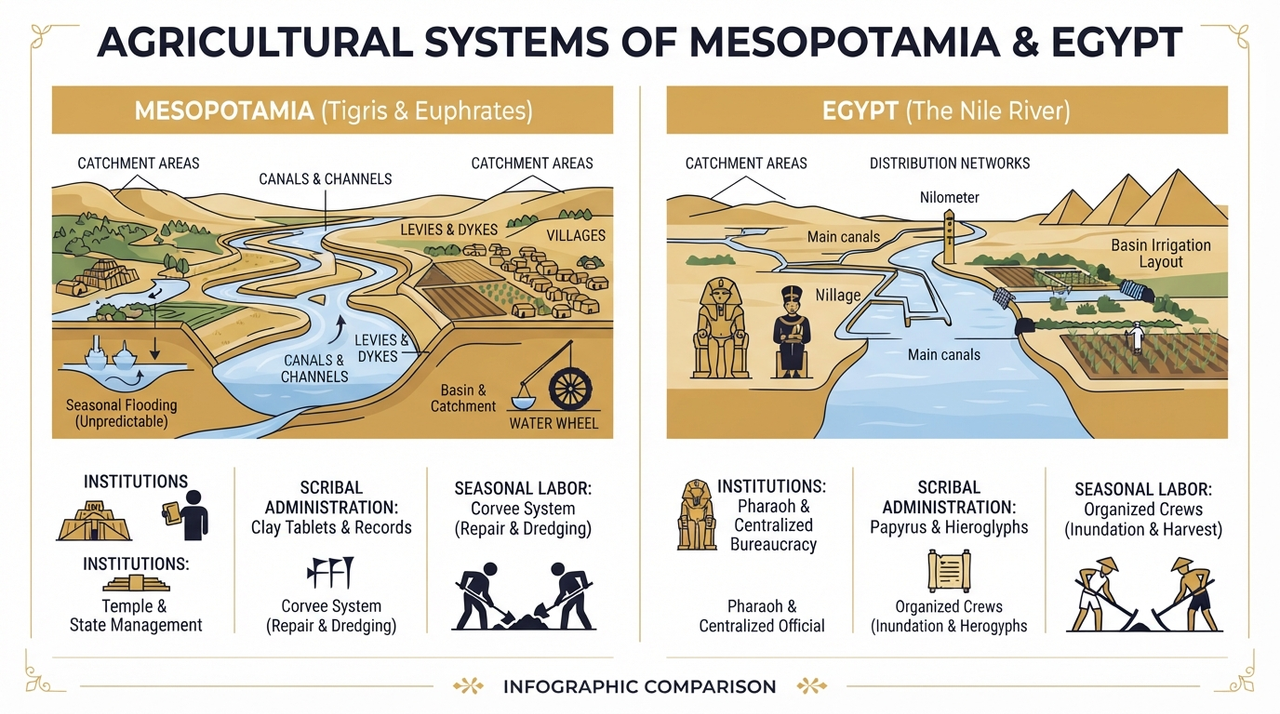
Mesopotamia's rivers flooded sporadically, dumping silt-rich water that could nurture or destroy. Farmers responded with ancient water technology: earthen canals dug by hand, branching from main channels like veins from an artery. Materials were simple—sun-baked mud reinforced with reeds—but the genius lay in scale. By 3000 BCE, Sumerian networks spanned hundreds of kilometers, irrigating barley fields that fed Uruk's teeming masses.
Hydrology Meets Human Grit: Canals and Crews
Distinguishing tool from practice is key. The shovel was basic, but Mesopotamia irrigation thrived on hydrology savvy: engineers read silt deposits to site intakes high on banks, avoiding summer lows. Crop calendars, inscribed on tablets, synced planting with river pulses—barley in autumn, dates year-round. Maintenance fell to corvée crews, conscripted villagers under overseers, dredging silt annually to prevent clogs. State archives brim with letters: a governor pleading for more laborers as canals silted, or disputes over water shares settled by royal decree.
Who controlled this? Temple priests and city kings, who owned prime lands. Excluded were pastoral nomads, barred from water rights, pushing tensions that sparked wars. Cuneiform records show limits—tablets preserve elite views, silencing laborers' voices.
The Nile's Rhythmic Gift: Flood Management Mastery
Contrast the Nile: a clockwork flood from July to October, swelling predictably from Ethiopian rains. Egyptians harnessed Nile flood management through basin irrigation—natural depressions filled by overflows, then drained to fields. No vast canals needed; instead, dikes of mud and levees guided the deluge, with nilometers (graduated pillars) at Elephantine tracking heights to forecast yields.
Institutions in Action: Scribes, Priests, and the State
Pharaohs embodied divine control, but functionaries did the work. Scribes tallied flood levels in hieroglyphs, adjusting tax quotas. Village headmen organized dike repairs, while temple granaries stored surplus. Legal papyri detail water disputes: a farmer suing over breached embankments, invoking Ma'at's justice. Crop calendars dictated emmer wheat after recession, flax in basins. Materials? Nile mud, endlessly replenished, formed barriers kings ritually breached to start floods.
Power concentrated in the state and temples; nomads in deserts watched enviously, occasionally raiding. Sources like tomb reliefs glorify pharaohs, veiling the corvée toil of peasants.
Institutions and Technology: The Pillars of Endurance
Beyond tools, institutions and technology wove water into civilization's fabric. In Mesopotamia, city-states like Lagash enforced water laws via assemblies; Hammurabi's code later codified shares. Nile realms relied on centralized bureaucracy, pharaohs as hydro-crats. Both demanded math: surveyors used ropes and plumb bobs for canal gradients, early geometry birthing ledgers that tracked flows—mathematics as the door to urban complexity.
Reading the Remains: A Method for Modern Scholars
Decode ancient water technology by layers: hydrology from sediment cores, soils revealing salinization's toll (Mesopotamia's Achilles' heel), archives voicing disputes. Canal ghosts under modern fields, basin scars in satellite views—practices leap from data. This method exposes exclusions: women rarely named, slaves unchronicled.
- Hydrology: River gauges predictably shaped calendars.
- Soil science: Silt built fertility, but overuse salted fields.
- Crews and codes: Communal labor, litigated rights.
Water as Civilization's Door
These systems didn't evolve linearly; they pulsed with crises—droughts toppling Akkad, over-irrigation dooming Sumer. Yet surplus fed scribes, ziggurats, pyramids: water mastery unlocked mathematics of administration, trade doors to bronze and writing. Today, probing Mesopotamia irrigation and Nile flood management reminds us: technology is practice incarnate, institutions its guardians. In an era of climate flux, their lessons endure—not as relics, but blueprints etched in mud and memory.