
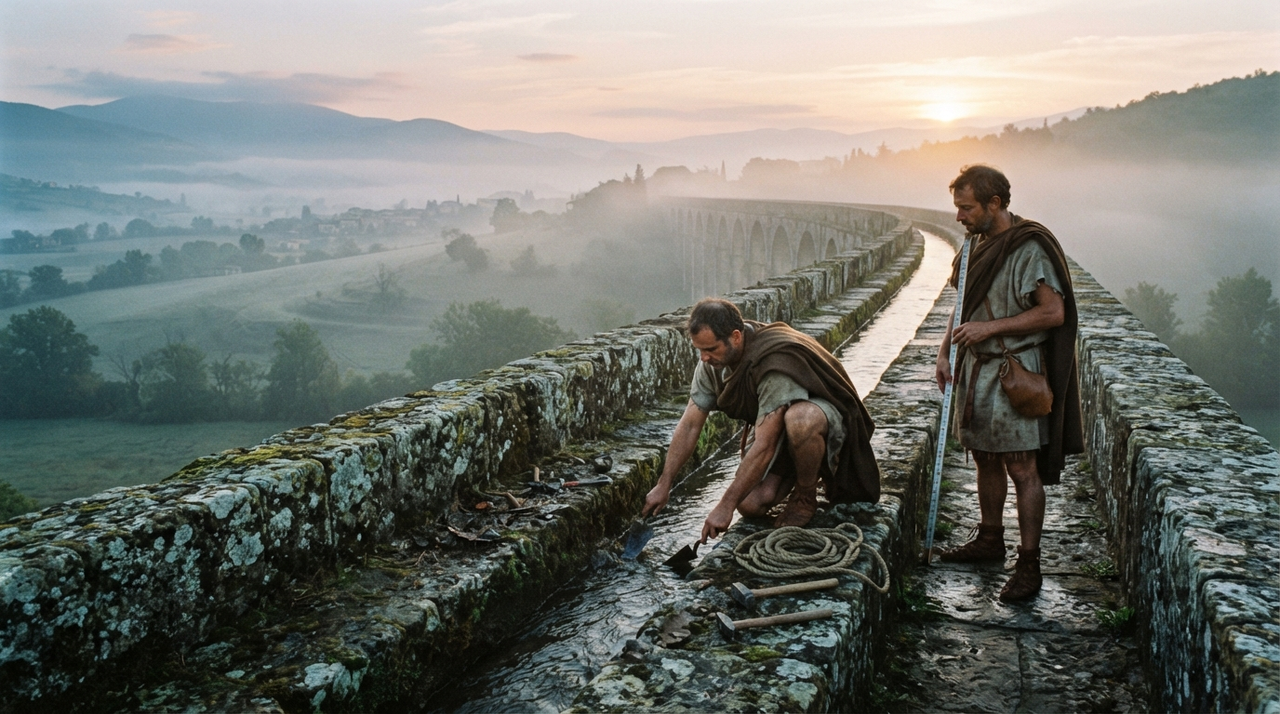
Beyond the Builders: The Invisible Labor Maintaining Roman Aqueducts, Persian Qanats, and Inca Bridges
Imagine the grandeur of Rome's arches piercing the sky, channeling life-giving water across valleys. We marvel at the engineers who conceived them, the laborers who hauled stone. Yet the true marvel—the pulse that kept those aqueducts flowing for centuries—lay in the unseen hands of maintainers. In our rush to celebrate builders, we overlook the invisible labor infrastructure that sustained these feats. This is the story of infrastructure maintenance, where technical practices, communal rituals, and institutional oversight blurred the line between artifact and living system.
Why do we fixate on origins, not endurance? The history of aqueducts reveals a pattern: grand openings fade, but quiet upkeep endures. From Rome's Aqua Claudia to Persia's Yazd qanats and the Inca's Q'eswachaka bridge, maintenance wasn't an afterthought. It was the core, demanding seasonal toil, specialized knowledge, and collective resolve—often by communities far from imperial glory.
Roman Aqueducts: The Machinery of Municipal Oversight
Completed between 38 and 52 CE under emperors Caligula and Claudius, the Aqua Claudia spanned 69 kilometers, its towering arches a testament to hydraulic genius. But the channel itself—the stone conduit—was just the skeleton. The lifeblood was technological upkeep: annual desilting with sponges and scrapers, resealing with lime-water mortar to combat leaks, and vigilant patrolling against theft or sabotage.
From Slaves to Curators: Layers of Labor
Frontinus, a first-century administrator, documented this in his De aquaeductu. Municipal magistrates oversaw water guilds—familia aquariorum—comprising hundreds of slaves, freedmen, and specialists. They budgeted for repairs, drawing from public funds and fines on polluters. Failures struck hard: sediment choked flows in droughts, earthquakes cracked spans. Yet the system persisted for 500 years, not through inevitability, but deliberate infrastructure maintenance.
Users felt it daily—plebeians queuing at fountains, elites piping water to villas. Power dynamics shone through: access favored the connected, while maintainers, often lowborn, toiled invisibly, their labor guilds wielding quiet influence over Rome's hydration.
Persian Qanats: Communal Vigil in the Desert
On Iran's Yazd plateau, qanat water systems tunneled underground for millennia, tapping aquifers via gentle slopes. Unlike visible Roman arches, these were hidden galleries—mother wells plunging 100 meters, branching channels fed by seasonal melt. Maintenance defined them: vertical shafts for access, where workers dangled ropes to excavate silt, risking cave-ins in the arid heat.
Seasonal Cycles and Shared Burdens
- Winter desilting: Communities rotated labor, village elders assigning shares based on irrigated land.
- Summer inspections: Mothers' wells checked for evaporation loss, linings reinforced with clay.
- Failures: Collapses from over-extraction dried fields, sparking disputes resolved by water councils.
Here, invisible labor infrastructure was egalitarian yet stratified—farmers, not kings, sustained the flow, tying water to sacred desert survival. Uncertainty clouds original builders, lost to oral lore, but maintainers left traces in shaft carvings and communal records.
Inca Bridges: Ritual Renewal Over Abyss
High in the Andes, the Q'eswachaka suspension bridge—woven from q'oya grass—spans a 45-meter chasm yearly. Incas rebuilt it annually, not as repair, but rebirth: communities from four ayllus gathered for a week-long rite, twisting fibers under mit'a labor obligations.
Beyond Stone: Fiber, Festival, and Fragility
Women spun ropes, men lashed beams; the old bridge was reverently dismantled mid-air. This technological upkeep wove social bonds, ensuring passage for traders and armies. Failures meant isolation—rotted cables plunging loads into ravines. Today, descendants maintain it, blending Inca tradition with modern oversight, a living counterpoint to monumental permanence.
Power flowed through participation: elites mandated, but locals executed, their rituals sacralizing the span as a communal artery.
Echoes Across Time: Lessons for Environment and Sacred Places
These systems—Roman oversight, Persian rotation, Inca ritual—highlight institutional webs beyond material feats. Maintenance budgets strained empires; seasonal labor knit communities. Failures exposed vulnerabilities, from silted channels to frayed ropes, reminding us infrastructure isn't progress's child, but humanity's ongoing pact.
In Technology Door's lens, they resonate with Environment (qanats' aquifer wisdom) and Sacred Places (Q'eswachaka's ritual). Maintainers, often marginalized, shaped access—who drank, crossed, thrived.
What aqueducts, qanats, or bridges in your world demand unseen care—and who tends them?
Next time you trace an arch's shadow or sip from a tap, ponder the hands that keep it whole. The builders launched dreams; maintainers made them real.