
Beyond the Lone Author: Scribes, Collaborative Writing, and the Hidden History of Literary Creation
Picture a dusty clay tablet unearthed from the sands of ancient Mesopotamia, its surface etched with wedge-shaped signs. At the bottom, a colophon humbly declares: "Copied by the scribe Sin-iddinam, servant of the god." No bold signature of a solitary genius. No claim to original invention. Just a name amid a chain of hands that shaped the text. This is the hidden history of authorship history—a world where the modern myth of the lone author dissolves into a vibrant tapestry of collaboration.
In our era of bylines and copyrights, we cherish the image of the isolated creator, penning masterpieces in attic solitude. Yet this notion is startlingly recent, emerging in the 18th century with the rise of print and individualism. Before that, literature thrived through scribes and literature, workshops, and communal stewardship. From cuneiform schools to medieval monasteries, texts were living entities, refined by many. For readers questioning sole authorship—drawn to collaborative writing and scribal culture—this story upends how we approach the written word.
Unpacking the Roles: Author, Scribe, Editor, Patron
To grasp this shift, let's define the players. The author—from the Latin auctor, meaning originator or increaser—was often more patron or compiler than inventor. Think of a figure like a Sumerian king commissioning epics, their name affixed not for writing but for authority.
Enter the scribe: the skilled artisan copying, correcting, and sometimes expanding texts. Scribes weren't passive copiers; they were guardians, spotting errors, adding glosses, adapting for new contexts. In authorship history, they often overshadow the originator.
Editors wove in variants, harmonizing traditions. Patrons funded and directed, their influence shaping content. These roles blurred: a scribe might author, an editor claim credit. Contrast this with today's stark lines—the bylined writer versus anonymous support staff. Recognizing these distinctions reveals anonymous texts not as voids but as communal achievements.
Cuneiform Scribal Traditions: Mesopotamia's Edubba Schools
Apprenticeship and the Art of the Tablet
Travel back to ancient Sumer, around 2500 BCE. In the edubba—"house of tablets"—young boys (and some girls) apprenticed under masters. They pressed reeds into wet clay, practicing signs for hours. Texts like the Epic of Gilgamesh survive not as pristine originals but through generations of copies, each bearing erasures, insertions, and colophons.
These colophons, formulaic notes at a tablet's end, named scribes: "Hand of the scribe X, who copied faithfully." Corrections—scratched-out lines, rewrites—dot the surfaces, evidence of vigilant editing. In cuneiform scribal traditions, authorship was collective: myths evolved via oral-scribal interplay, standardized in scribal hubs like Nippur. No single "Gilgamesh"; instead, a fluid tradition stewarded by schools.
- Edubba curricula blended literature, math, law—scribes as polymaths.
- Tablets circulated in libraries, copied en masse, variants coexisting.
- Scribal families passed lore, blurring personal and guild identity.
Here, collaborative writing was the norm, texts as shared inheritance rather than private property.
Cross-Cultural Transmission: From Egypt to the Islamic World
Diverse Attribution Practices
Egyptian scribes on papyrus rolls attributed works to gods like Thoth or pharaohs, but hieratic copies show interpolations. Hebrew texts, like the Torah, bear marks of redactors compiling sources—Yahwist, Elohist—over centuries, with scribal families like the Levites ensuring fidelity.
Greeks shifted toward named poets like Homer, yet the Iliad's oral roots and rhapsodic performance suggest collaboration. Alexandrian scholars edited and annotated, creating critical editions. Arabic traditions in the Abbasid era saw adab anthologies assembled by compilers, with chains of transmission (isnad) crediting reciters over originators.
Across these, anonymous texts proliferated—folk tales, proverbs—valued for wisdom, not provenance. Place mattered: desert scrolls, riverbank papyri influenced durability and spread.
The Medieval Scriptorium: Codex-Era Workshops
Glossators, Women, and Hidden Labor
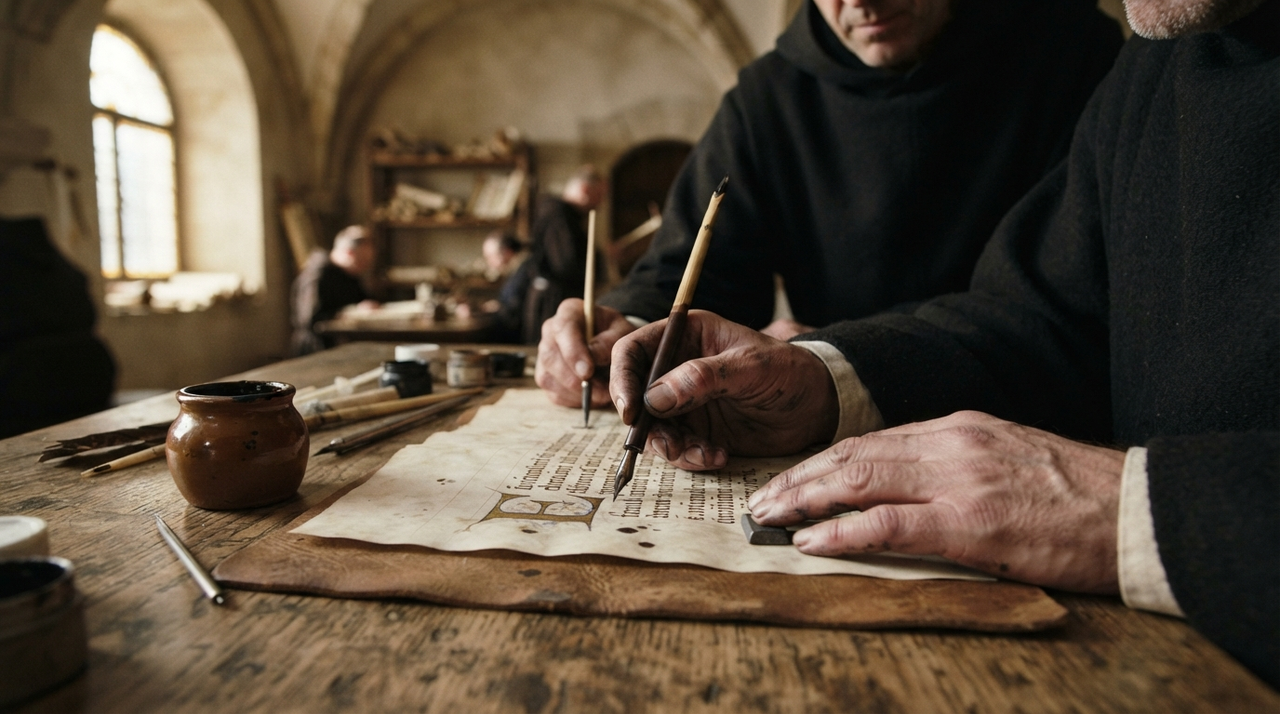
By the codex's rise—folded parchment books around 400 CE—< strong>medieval scriptorium buzzed like ateliers. Monastic rooms in places like Bobbio or St. Gall housed teams: principal scribes, rubricators for colors, illuminators. Texts like Boethius's Consolation of Philosophy accrued glosses—marginal notes debating meaning, layering interpretations.
Women scribes thrived too: in Anglo-Saxon nunneries, figures like Leoba copied and composed. Yet their labor often vanished under male attributions. Workshop models mirrored Renaissance studios—apprentices under masters producing Virgil manuscripts, each hand distinct yet unified.
In the dim flicker of whale-oil lamps, fingers blackened with ink, a team birthed volumes that outlasted empires.
This era's scribes and literature emphasized stewardship: copying as prayerful act, preserving amid chaos.
Re-reading Today: Intention, Function, and Collective Stewardship
What does this mean for us? In a world of AI-assisted writing and open-source projects, revisiting authorship history urges humility. We can't divine authorial intent when evidence is thin—a tablet's colophon, a glossed margin. Instead, distinguish intention (elusive) from function: how a text worked in its place, period, material form.
A Mesopotamian lament soothed city walls; a scriptorium Bible guided monastic life. Today, honor the chain: read for layered voices. This crosses into creativity and leadership—collaborative writing as collective making, where stewardship trumps ego.
Pause: In your next reading, who are the unseen scribes? The Seeker's Code whispers: protect the journey by naming makers—patrons, copiers, editors. In doing so, we steward the universe's grand narrative, one shared tablet at a time.