
Craft Guilds and Iemoto Lineages: The Workshop Roots of Historical Creativity
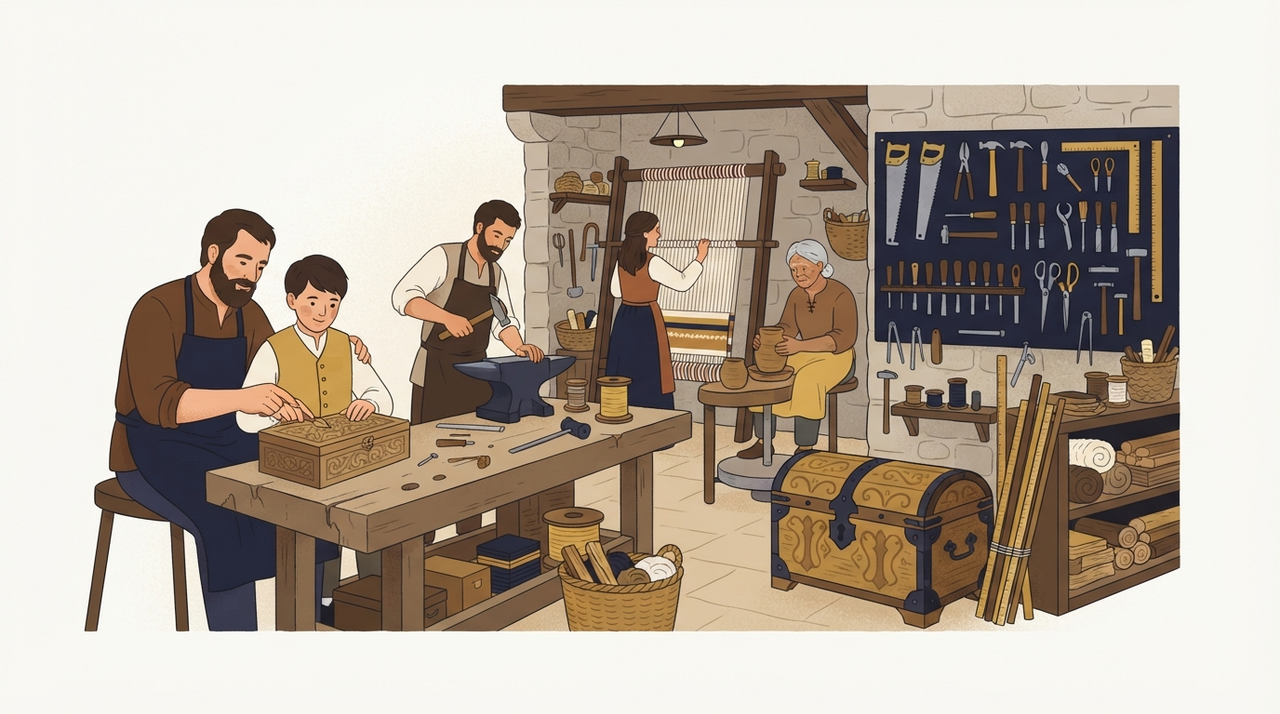
Picture a narrow workshop in fourteenth-century Paris. Smoke curls from a forge where apprentices hammer silver into chalices, their movements echoing the master's careful strokes from years past. Nearby, a journeyman sketches a new clasp design, tweaking a pattern tested in dozens of pieces before. No lone inventor paces here. The work belongs to the group, bound by tools, oaths, and the gleam of finished wares stacked for inspection. What shape does creativity take when the unit of making is not a solitary mind, but a workshop?
This reading, intended for the Aetheria Creativity Door, fills a history gap in our exploration of creativity. Existing pieces orient toward cornerstones and companions. Here, we turn to institutions: guilds, workshops, lineages. These formed the ordinary homes of making across cultures, training hands in craft amid materials, constraints, and collaborators.
Vocabularies of Making: From Techne to Workshop
Ancient terms anchor this social history of creativity. Greek techne meant skilled art, a way of working wood or words with practiced precision. Latin ars carried it forward, blending rule-following with subtle variation. English "craft" evokes the workshop production itself: repeatable yet attuned to wood grain or alloy temper. "Lineage" points to teacher-student chains, as in Japanese iemoto.
The modern word "creativity" emerges late, around the 1870s, tied to individual genius. Earlier makers pursued not invention alone, but craft mastery, copying faithful to form, improvisation within bounds, and problem-solving for patrons. Guilds and lineages trained these: variation on proven models, ritual exactness, collaborative refinement.
Case Studies in Craft Guilds History and Lineage Practices
European Craft Guilds: Paris Goldsmiths, c. 1270
Charters from Paris reveal craft guilds history in action. The goldsmiths' guild regulated apprenticeship making: boys aged twelve bound for seven years, sweeping floors before touching gold. Evidence survives in guild statutes, wage lists noting journeymen's pay, and unsigned cups bearing subtle style shifts. Masters stamped hallmarks for sale. Training focused on craft and variation: chasing motifs from antique models, solving alloy flaws. No charters praise wild invention; power lay with guild wardens judging quality.
Japanese Iemoto Lineage: Urasenke Tea, Seventeenth Century Onward
Iemoto lineage systems structured arts like tea ceremony and Noh theater. Urasenke, one tea school, traces to Sen no Rikyū's teachings in the 1590s, formalized later. Disciples trained under a iemoto head, copying gestures in charcoal-scented rooms. Primary evidence includes lineage scrolls, training contracts, and utensils inscribed with school marks. Ritual making dominated: precise whisking, flower arrangements echoing master's intent. Audiences were initiates; constraints, seasonal blooms and guest rank. Convergence with guilds appears independent, rooted in samurai-era hierarchies.
Ottoman Miniature Workshops: Topkapı Palace, Fifteenth to Seventeenth Centuries
In Istanbul's Topkapı kitabkhane, court painters worked in teams on manuscripts. Workshop remains and signed folios show master-pupil flows: novices grinding pigments, seniors layering inks on vellum. Sultans commissioned; wages listed apprentices' rice allotments. Training honed copying epic scenes with tiny variations, improvisation in costume details. No lone genius; unsigned pages blend hands.
Chinese Porcelain Family Trades: Jingdezhen, Ming Dynasty (1368–1644)
Family kilns passed secrets father-to-son, feeding imperial orders. Kiln-site shards and export jars bear reign marks, not individual names. Apprentices mixed kaolin clay, fired blues from cobalt. Evidence: contracts, traveler accounts. Constraints: wood fuel, glaze formulas. Creativity meant variation yielding flawless celadon.
What Institutions Decided: Access, Trade, and Credit
These structures set firm rules. Guilds dictated who might make (sworn members), sell (hallmarked wares), teach (licensed masters), and claim name (master's sign on choice pieces; most stayed anonymous). Iemoto heads licensed branches, controlling who bore the lineage name. Power flowed to overseers: guild elders fining shoddy work, iemoto expelling deviants. Collaborators included patrons funding materials, audiences judging fitness.
- Materials shaped practice: Paris silver from local mines, Jingdezhen clay hauled by river.
- Constraints bred skill: guild quotas curbed excess, palace deadlines spurred teams.
What Remains Unsettled: Cross-Door Connections
Workshops trained reliable craft, not romantic genius or raw invention. Scholarly views differ on innovation's sparks; primary records note tweaks, not breakthroughs. Living traditions, like iemoto today, blend old forms with new audiences.
This connects beyond the Aetheria Creativity Door: to Art Door on labor and patronage; Education Door on apprenticeship making; Ethics Door on fair attribution; Books Door on scribal shops copying texts.
An Invitation to Notice
Next time you hold a made thing, a bowl or book, ask: who was in the room? Apprentices at benches, masters at shoulders, patrons at thresholds. These workshops remind us making thrives in company. Join the Aetheria community to pursue such questions together, tracing creativity's social threads through history.