
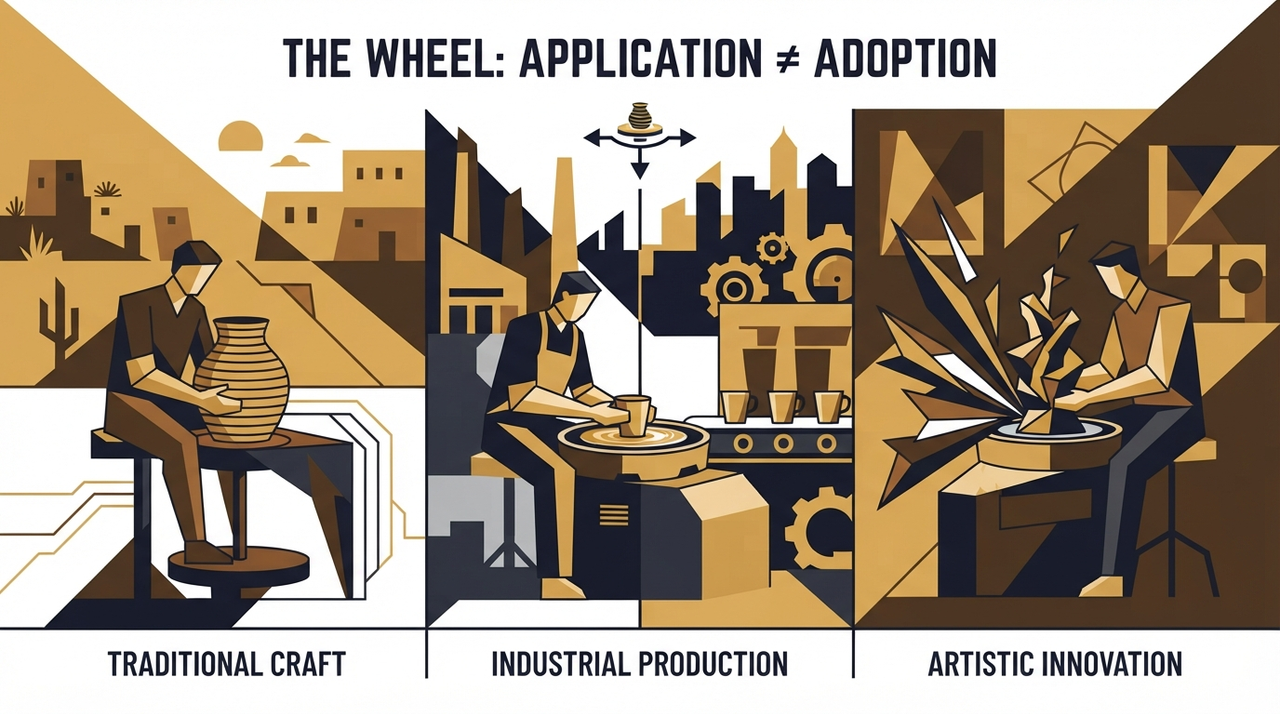
Debunking Technological Determinism: Pottery, Writing, and Metallurgy Spread by Choice, Not Inevitability
Imagine a world where the wheel rolls into every corner without resistance, where fire's mastery ignites progress everywhere it flickers. This is the seductive promise of technological determinism—the idea that inventions march forward, reshaping societies inevitably, like a river carving canyons. But history whispers a different tale. Pottery, writing, and metallurgy, cornerstones of human advancement, did not diffuse like clockwork. Their pottery spread, writing adoption, and metallurgy history reveal choices, resistances, and adaptations that shatter this myth. In this technological determinism critique, we explore innovation diffusion through human agency, not inevitability.
Why does this matter? In an era of AI ubiquity and smartphone saturation, questioning tech's inexorable pull invites us to ponder: Are we passengers or pilots? Let's journey through ancient networks of decision-making.
The Myth of Inevitable Progress
Technological determinism posits that tools drive history, societies mere vessels for their power. Yet, anthropology and archaeology paint a messier picture. Inventions often languish unused, or bloom without heralding 'progress.' Diffusion hinges on social networks, economic costs, skill barriers, and cultural meanings—not raw utility.
Consider network models of spread: ideas hop via trade routes, migrations, kin ties. But adoption demands investment. Pottery requires kilns and clays; writing, scribes and scripts; metallurgy, ores and forges. Each carries ritual weight—vessels for ancestors, texts for gods, metals for status. Resistance blooms when costs outweigh gains, or traditions clash.
Pottery Spread: A Patchwork, Not a Wave
Early Blooms and Stubborn Holds
Pottery emerged around 20,000 years ago in East Asia's Jomon culture—hunter-gatherers firing vessels long before farming. Yet, in the Americas, it arrived millennia later, around 5,000 years ago, despite ample clay. Why the delay? Not tech absence, but choice. Mobile foragers favored baskets; sedentary groups embraced ceramics for storage.
In the Fertile Crescent, pottery spread post-Neolithic Revolution, but pockets resisted. Australian Aboriginals, with millennia of continuity, never adopted it widely—baskets sufficed for their networks. Here, pottery spread followed ecology and lifestyle, not inevitability. Fuel costs for firing, breakage risks, and training apprentices stalled diffusion until surpluses demanded it.
Writing Adoption: Elite Tool, Not Universal Gift
Invention Without Embrace
Cuneiform dawned in Sumer around 3200 BCE for accounting, spreading to Egypt and beyond. But most societies rebuffed it. Mesoamerica birthed glyphs independently by 600 BCE; China and Indus followed suit. Yet, the Inca Empire thrived with quipus—knotted strings—for records, shunning phonetic script.
- High training costs: Years to master glyphs deterred masses.
- Ritual barriers: Oral traditions held sacred memory; writing risked dilution.
- Network limits: Scripts stuck to urban elites, rarely diffusing rurally.
Even in literate zones, writing adoption lagged. Sub-Saharan Africa integrated Arabic script selectively; Native Americans often prioritized pictographs. Progress? Oral epics rivaled texts in complexity. Invention sparked, but culture chose.
Metallurgy History: Forged by Human Will
From Cold Copper to Iron Revolutions
Native copper hammering predates 8000 BCE in Anatolia, but smelting waited until 5000 BCE. Bronze emerged around 3000 BCE in the Near East, diffusing unevenly—Europe lagged centuries. Iron, revolutionary for abundance, ignited in Anatolia by 2000 BCE but took 1,500 years to blanket Eurasia.
Why the crawl? Ore scarcity, furnace tech, metallurgist guilds. Ritual prestige hoarded knowledge—bronze for kings, iron taboo in some rites. African Nok culture smelted iron by 500 BCE independently, sans bronze phase. Metallurgy history shows innovation diffusion as elective paths: Polynesians voyaged sans metals; Andean smiths adapted locally.
Rethinking Diffusion: Costs, Networks, and Meaning
Compare these: Pottery's low barrier yielded patchwork adoption; writing's opacity bred elites; metallurgy's dangers forged specialists. Network models explain—ideas cluster in connected hubs, fading in isolates. No inevitability, only human calculus.
History isn't a conveyor belt of gadgets; it's a tapestry of choices, woven from necessity, tradition, and whim.
Against Determinism: Doors to Pattern and History
This technological determinism critique liberates inquiry. At Aetheria AI, we probe these patterns. Explore our Pattern Door for diffusion models, or History Door for case deep-dives. What tech will we choose next? The question endures.
In the end, tools bend to us—or we to them? History votes choice. Step through, question boldly.