
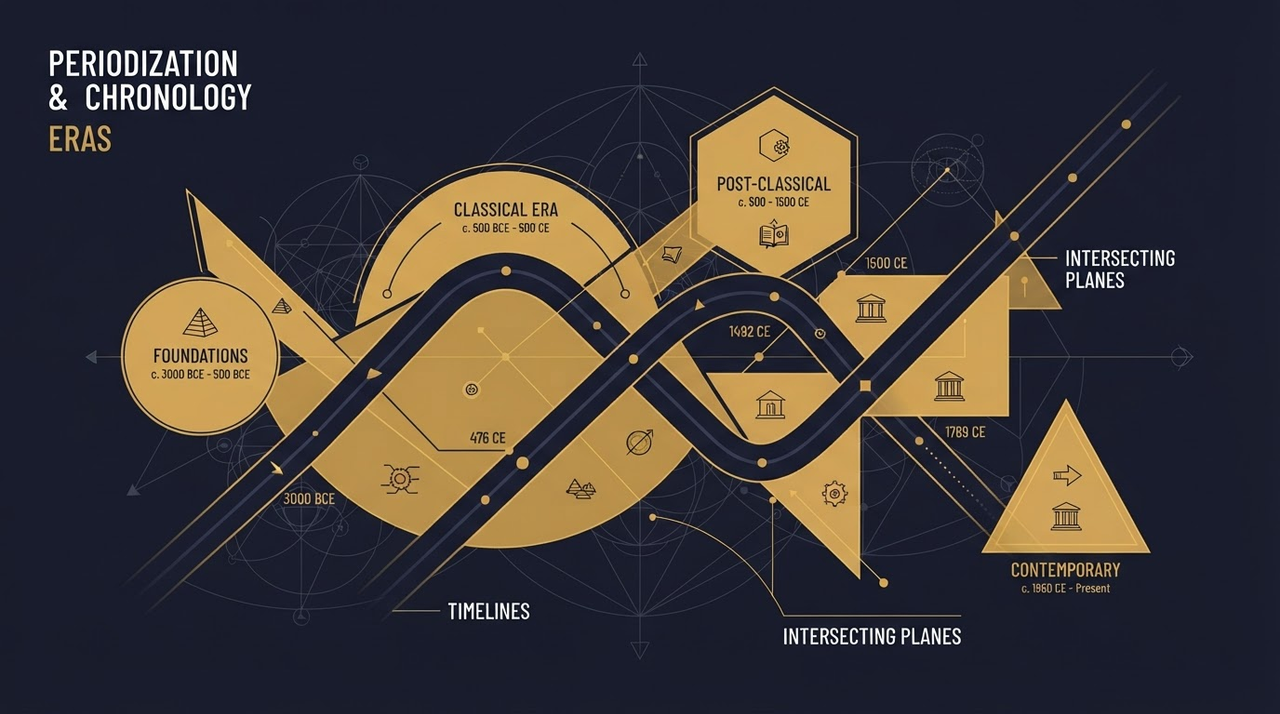
Decoding Historical Time: Chronology, Periodization, Dating Systems & the Calendars That Shaped History
Imagine standing amid the sun-baked ruins of ancient Thebes, where scribes etched king lists into temple walls, their ink defying millennia. Or picture a monk in a candlelit scriptorium, tallying years from a savior's birth. Historical time isn't a straight arrow etched in stone—it's a tapestry woven from fragments, interpretations, and human ambition. This exploration of historical chronology reveals how we divide the past into eras, track dates, and navigate the calendars that shaped civilizations. Far from neutral facts, these tools are lenses, revealing some truths while obscuring others.
In the cosmic library of history, chronology and periodization serve as foundation stones for open inquiry. They help us reconstruct timelines from pottery shards and star alignments, yet they demand we question: What evidence survives? What do we reconstruct? How do we interpret?
The Foundations of Historical Chronology
Historical chronology anchors the past in sequence, piecing together events like a detective with faded clues. Unlike clockwork physics, it's built on layers: primary evidence like inscriptions, cross-referenced with astronomy or dendrochronology. Yet, it's interpretive. Mesopotamian king lists, for instance, blend myth and history, assigning reigns of thousands of years to early rulers—a puzzle scholars still debate.
Periodization, the art of boxing time into eras, emerged later. Labels like Bronze Age or Classical Antiquity weren't proclaimed by ancient peoples but coined by 19th-century historians sifting artifacts. The Bronze Age, tied to metalworking tech around 3000 BCE, spans Europe to the Near East, yet hides vast regional differences: Minoan palaces thriving while others huddled in villages.
How History Divides Time: The Birth of Periods
From Stone to Empire: Prehistoric and Ancient Divides
Dividing historical time starts with tech shifts. The Stone Age fractures into Paleolithic hunts and Neolithic farms, based on tools unearthed in caves. But these bins mask migrations and innovations lost to sea-level rise. Classical Antiquity, peaking with Athens and Rome, spotlights philosophy and conquest, yet sidelines Celtic druids or Nubian kingdoms.
Medieval Shadows and Modern Frames
Medieval—coined by Renaissance humanists scorning the 'middle' era—lumps Dark Ages with Gothic cathedrals, obscuring Islamic Golden Ages or Viking voyages. Transitions like 'Early Modern' reflect Eurocentric views, compressing global tapestries into Western milestones. Each label shapes notice: Bronze Age evokes warriors; Medieval, knights and plagues.
Dating Systems: Tools of Ancient Timekeepers
Ancient societies crafted ingenious dating systems. Egyptian civil calendars tracked 365 days via Nile floods and Sirius rising, fixed at 4241 BCE by modern reckoning—though Early Dynastic dates waver by centuries due to fragmented king lists. Regnal years counted from pharaohs' coronations: 'Year 5 of Ramesses II' pins events without absolute dates.
Mesopotamians used lunar cycles and eponyms—city officials naming years. Greeks innovated Olympiads, quadrennial games from 776 BCE, syncing pan-Hellenic history. These flowed into Roman consular dating, then Christian Anno Domini (AD), devised by Dionysius Exiguus in 525 CE to tally Christ's era. Today, BCE/CE replaces BC/AD, neutral yet rooted in the same pivot.
- Egyptian Sothic Cycle: 1,460-year resets via star-dog.
- Olympiad: Athletic epochs bridging myth to history.
- Regnal: King-centered, echoing divine rule.
Pathways of contact spread these: Alexander's conquests fused Persian lunisolar with Greek solar, birthing hybrids.
Calendars in History: Bridges Across Eras
Calendars in history weren't just time trackers—they wove ritual into rule. Mayan Long Count tallied creation at 3114 BCE, guiding prophecies. Jewish lunisolar calendars sustain festivals amid diaspora. Today, communities like Ethiopian Orthodox cling to their Anno Mundi, diverging from Gregorian norms.
Uncertainties persist: Sumerian King List's antediluvian kings defy radiocarbon, blending flood myths with archaeology. Egyptian chronology hinges on debated synchronisms with Assyrian eclipses.
Evidence yields reconstruction; interpretation births narrative.
Uncertainties, Living Contexts, and Open Inquiry
Distinguish layers: Evidence (stelae), reconstruction (via C14 dating), interpretation (era labels). Living calendars thrive in rituals—Navajo count moons for ceremonies, Hindus align festivals to tithis. They remind us chronology serves communities, not just scholars.
Cross to sacred time, ancient civilizations, or science's dating methods for deeper dives.
Reframing the Past: What Eras Reveal and Conceal
Naming an era—Bronze collapse or Axial flowering—filters history. It spotlights trade networks or overlooks climate woes. As thoughtful explorers, question: Does 'Medieval' dim innovation? How might new labels, like 'Global Holocene,' reshape notice? In this cosmic library, chronology invites endless inquiry, humane and humble.