
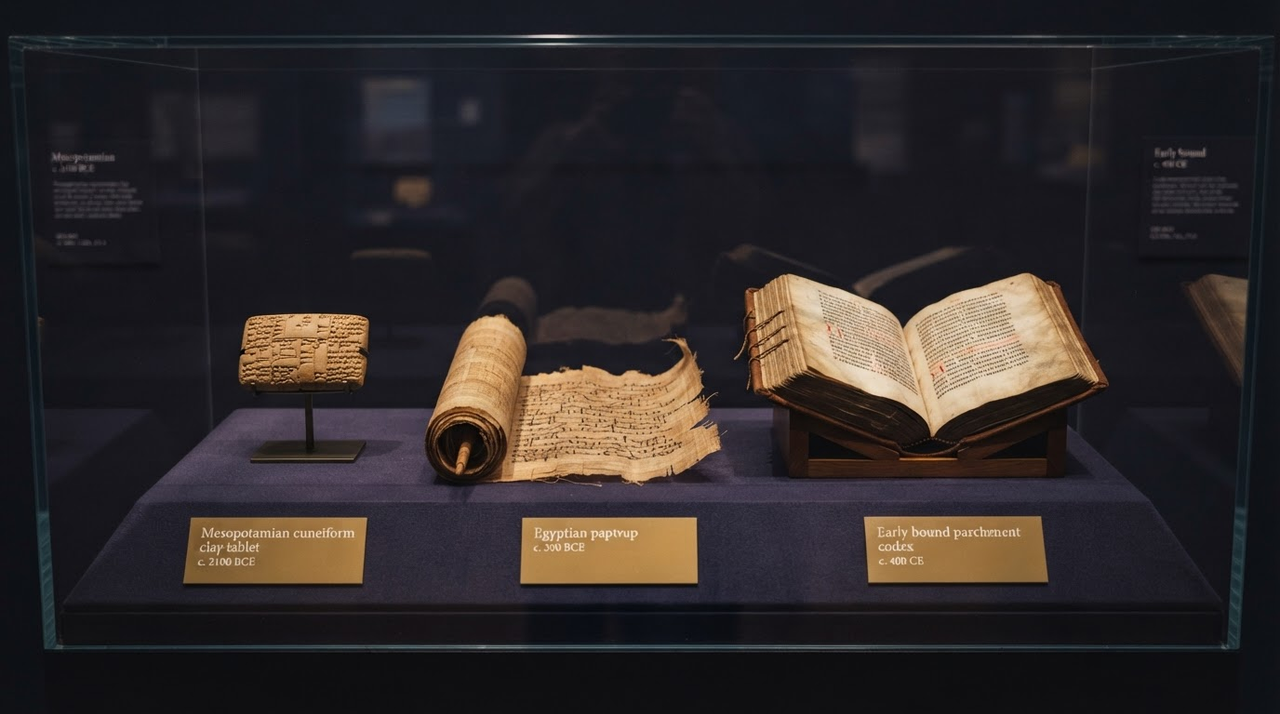
From Cuneiform Tablets to Codex: The Material History of the Book as Evolving Technology
A Book Is Born from Clay and Constraint
Picture this: in the sweltering heat of ancient Mesopotamia, around 3200 BCE, a scribe presses a reed stylus into soft clay. Wedge-shaped impressions form words—accounts of barley rations, tallies of sheep, records of temple offerings. This humble cuneiform tablet isn't just a relic; it's the dawn of the history of the book, a technology forged from the earth's own mud to tame the chaos of human memory.
We often think of books as vessels for stories or ideas, timeless containers of wisdom. But what if the true genius lies in their form? A book is technology—a material intervention in how knowledge flows, persists, and transforms. From the weight of clay to the flutter of vellum pages, each iteration reshapes reading itself. This isn't a linear march to perfection; it's a ragged evolution, marked by accidents of survival, cultural needs, and raw ingenuity. No single "first book" crowns the timeline—many pioneers crumbled to dust. What endures teaches us: form is fate.
Why Form Matters: The Hidden Architecture of Knowledge
Why obsess over clay versus page? Because material text dictates access, authority, and even meaning. An oral epic, recited by firelight, lives in rhythm and repetition, demanding communal performance. A manuscript, copied by trembling hands in a lamplit scriptorium, breathes rarity and reverence—each flaw a fingerprint of its maker. Printed editions multiply truth, or illusion, across continents. Modern critical editions dissect variants, turning the book into a scholarly battlefield.
Form filters survival. Tablets withstand fire but shatter in floods; scrolls rot in damp tombs. Provenance whispers uncertainties: was that Greek scroll truly Homeric, or a later copy? Temples doubled as libraries, guarding clay archives like sacred vaults, yet looting and time erased countless volumes. Recognizing this, we see the writing technology not as neutral, but as a partner in human striving—amplifying voices, burying others.
The book’s body shapes its soul: durable archive or fragile performance, sequential scroll or random-access codex.
The Cuneiform Tablet: An Archive Etched in Earth
Uruk's Bureaucratic Dawn, Late 4th Millennium BCE
In the sprawling city of Uruk, Sumer's beating heart, the cuneiform tablet emerged not for poetry, but pragmatism. By 3100 BCE, proto-cuneiform signs tallied goods: a bull's head for ten oxen, wavy lines for water. These weren't books in our sense—small, palm-sized slabs, often accounting ledgers—but they codified complexity. Temples, those towering ziggurats, hoarded thousands, forming proto-libraries that tracked a burgeoning economy.
Clay's materiality was key: sun-baked for posterity, kiln-fired for eternity. Stackable, erasable when wet, they invited iteration. Imagine scribes in shaded courtyards, stylus flying, as priests audited harvests. Yet limitations loomed: bulkiness curbed long narratives; portability faltered for nomads. Survival biases our view—tablets from dry digs endure, but wooden labels from wetter climes vanished. Were epics inscribed here first? Uncertainties linger; the epic of Gilgamesh, later immortalized, likely began orally, etched later on clay.
Materiality and the Birth of Bureaucracy
This material text birthed bureaucracy, tethering society to records. In Uruk's Eanna precinct, over 5,000 tablets attest to divine accounting—offerings to Inanna, labor rosters. No grand literature dominates early finds; utility ruled. As cuneiform spread to Akkadian, Hittite realms, tablets grew: lexical lists, myths, law codes like Hammurabi's stele. But always, form constrained: linear impressions, no illustrations until seals impressed motifs.
- Durable against flame—ironically, library fires baked them harder.
- Public and private: temple archives versus household tallies.
- Provenance puzzles: many unsigned, origins debated via stratigraphy.
The Scroll: Performance and Unbroken Continuity
Papyrus from the Nile to Hellenistic Libraries
Fast-forward to Egypt's Nile Delta, where papyrus reeds yielded rolls up to 30 meters long. By 2500 BCE, scribes unrolled sheets for manuscript culture: administrative papyri, the Book of the Dead. Lighter than clay, scrolls invited continuity—sewn strips forming a seamless flow, mimicking oral recitation.
Hebrew Torah scrolls preserved this ethos: hand-scribed on kosher parchment, read aloud in synagogues. No page-turns; the scroll unfurled like memory itself. Greeks elevated it for literature: Homer's Iliad on volumina, recited in agoras. Alexandria's Mouseion amassed 700,000 scrolls, a wonder until Caesar's flames. Here, scroll to codex whispers begin—form as performance, demanding voice or sequential gaze.
Echoes of Orality in Written Flow
Scrolls bridged worlds: Egyptian wisdom texts flowed right-to-left, Greek left-to-right. Fragility struck—humidity dissolved papyrus—yet dry tombs gifted treasures like the Nag Hammadi library. Access was elite; slaves copied for patrons. Rhetorical questions arise: Did scrolls' linearity enforce epic wholeness, or hinder reference? Uncertainties abound: many attributed works are copies, provenances fuzzy from trade routes.
The Codex: Revolution in Random Access
Enter the codex, late Roman era's quiet upheaval. Wax tablets, hinged like notebooks, hinted at it; parchment quires, folded and bound, perfected it. By the 2nd century CE, Christians championed vellum codices for scriptures—portable, double-sided, searchable. Flip to John's Gospel amid persecution; no endless unrolling.
Advantages piled up: four times papyrus capacity, indices feasible, marginalia bloomed. Martial praised pocket codices in 85 CE; by 4th century, Christian texts dominated. Was it faith-fueled? Practicality too—missionaries lugged them afar. Survival skewed Christian: pagan scrolls decayed, codices endured in monasteries. The history of the book pivots here—navigation trumps sequence.
- Random access: Jump chapters, unlike scrolls.
- Durability: Animal skin outlasts reeds.
- Cultural shift: From performance to private study.
From Gutenberg's Press to the Critical Edition: Layers of Multiplication
Print Disrupts Manuscript Culture
1455: Gutenberg's Bible rolls off wooden presses, movable type unleashing uniformity. Manuscripts, once unique artworks, yield to editions—thousands identical, cheap, widespread. Yet manuscript culture lingers: illuminations fade, but aura persists in rarities like the Book of Kells.
Modern Layers: Edition, Critique, Access
Printed books standardize, but variants multiply—misprints, revisions. Enter critical editions: scholars collate manuscripts, footnotes dissecting lineages. Oral performance, holographic manuscript, mass-printed tome, digital edition—each a distinct technology. No universal importance; survival spotlights the lucky. Provenance hunts via carbon dating, watermarks yield truths.
Today, writing technology digitizes, but materiality haunts: e-readers lack tactility, algorithms curate access.
Echoes Across Time: Your Turn, Seeker
From Uruk's clay to your screen, the book's body evolves, reshaping minds. Temples as libraries remind us: knowledge nests in places sacred and profane. What form holds your story—a journal page, voice note, blockchain ledger?
Seeker’s Journal Prompt: Trace a text you cherish. What material cradles it? How does its form alter your encounter? Sketch its lineage—what might it become?
In this history of the book, curiosity endures. Dive deeper into Writing & Memory or Sacred Places.