
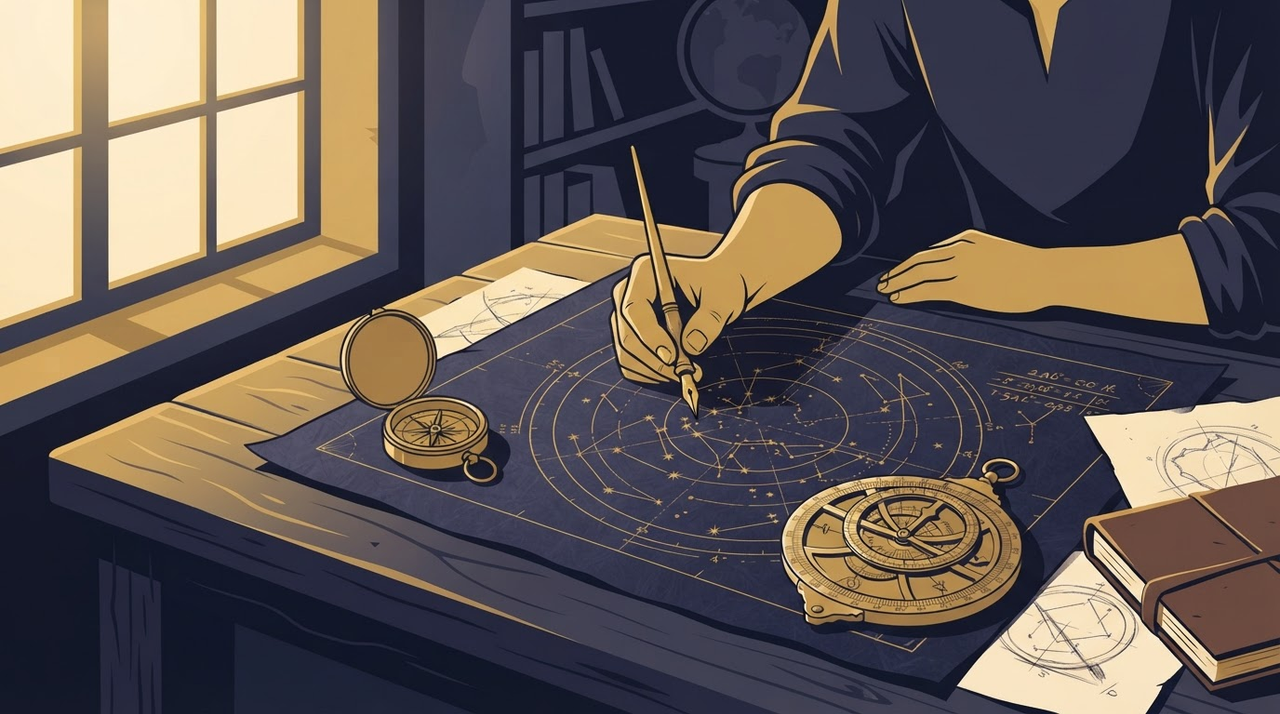
From Naked Eye to Cosmic Detectors: The History of Scientific Observation and Instruments
Imagine a Sumerian scribe in ancient Mesopotamia, eyes fixed on the evening sky, etching cuneiform tallies into wet clay under flickering torchlight. He wasn't just looking—he was observing, training his gaze to track Venus's wanderings across the stars. This is the heart of the history of scientific observation: not passive seeing, but a honed skill, a deliberate act of noticing patterns amid chaos. Welcome to the Science Door of Aetheria, the cosmic library where we protect the seeker's journey through evidence and observation.
From those humble naked-eye records to today's particle detectors piercing the veil of dark matter, scientific instruments have transformed how we gather evidence. Yet throughout, the practice demands discipline: record what is seen, interpret with caution, speculate only on firm foundations. Let's trace this evolution, bridging the ancient and the cutting-edge.
Ancient Eyes: Naked-Eye Records in Mesopotamia and Egypt
Long before lenses or circuits, observation began with the unaided eye. In Mesopotamia around 2000 BCE, priests and scribes cataloged lunar cycles and planetary motions on clay tablets. These weren't myths but meticulous logs—evidence of eclipses, solstices, and floods tied to celestial omens. Egyptian astronomers, meanwhile, aligned pyramids to cardinal points and tracked Sirius's heliacal rising to predict Nile inundations.
Here, the distinction emerged: the record was the raw data—"Sirius rose on day X"—unassailable. Interpretation followed: floods soon after. Speculation ventured further: divine will? These early observers laid the groundwork for scientific instruments by proving sustained noticing yields predictable patterns.
The Islamic Golden Age: Precision Instruments Take Shape
By the 8th century, Islamic scholars elevated observation with ingenious tools. Astrolabes, those brass discs etched with star maps and zodiacs, measured altitudes and times with startling accuracy. Al-Battani refined Ptolemy's models using such devices, compiling tables that European astronomers would later inherit.
From Almagest to Refinement
Ptolemy's Almagest (2nd century CE), a cornerstone of the history of scientific observation, synthesized Babylonian and Greek data into geocentric models. Islamic instrument-makers like al-Zarqali built on this, crafting universal astrolabes portable across latitudes. Their records—planetary positions to within minutes of arc—were evidence incarnate, interpretations tested against skies night after night.
Uncertainty lingered: instruments had limits, like atmospheric distortion. Yet they didn't undermine the evidence; they invited better tools.
Early Modern Revolution: Telescopes, Microscopes, and New Worlds
The 17th century shattered horizons. Galileo's 1609 telescope, grinding his own lenses, revealed Jupiter's moons in Sidereus Nuncius—the starry messenger. No longer confined to naked-eye limits, observers saw craters on the Moon, phases of Venus. Microscopes, perfected by Antonie van Leeuwenhoek, unveiled "animalcules" teeming in pond water.
Instruments amplified evidence: telescopes showed satellites orbiting Jupiter, challenging geocentric dogma. Interpretations shifted—heliocentrism gained traction. Speculation soared: infinite worlds? But Galileo urged fidelity to the record, cautioning against overreach.
Modern Detectors: From Spectrum to Cosmos
Today, scientific instruments detect the invisible. Spectrographs parse starlight into elemental fingerprints; radio telescopes like Arecibo captured pulsar pulses; LIGO's lasers sense gravitational ripples from black hole mergers. The Large Hadron Collider smashes particles, evidencing the Higgs boson.
These tools yield terabytes of data—raw records demanding interpretation. Dark energy accelerates expansion: established. Its nature? Speculative, probed by telescopes like James Webb peering back 13 billion years.
Limits persist: quantum uncertainties, cosmic horizons. Yet well-supported evidence—like cosmic microwave background radiation—stands firm.
Observation's Pillars: Record, Interpretation, Speculation
Across eras, science thrives on clarity. The established record: what instruments unequivocally show. Interpretation: tested meanings. Speculation: frontiers, held lightly. This trinity, rooted in the history of scientific observation, guards against illusion.
In Aetheria, it bridges Doors: Sky for celestial patterns, Sacred Time for cycles observed, Writing & Memory for preserving records.
Noticing Today: A Seeker's Reflection
As seekers in Aetheria's cosmic library, what does the Seeker's Code—observe faithfully, interpret humbly, speculate boldly—mean for your noticing today? Step outside: track a constellation's arc. Or peer through a phone's lens at microbes. The journey from naked eye to cosmic detectors reminds us: true science begins with trained attention. What will you record next?