
From Tallies to Zero: The Human Odyssey of Ancient Counting Systems and Number Invention
Picture a shepherd in the dusty hills of ancient Mesopotamia, fingers trembling as he scratches a notch into a clay tablet for each goat traded at market. Not a symbol on parchment, but a raw tally—a mark born from necessity, from the ache of remembering flocks, harvests, debts. Long before numbers danced as elegant digits, quantity was a human problem: felt in the gut, tallied by hand, wrestled into form by minds hungry for order amid chaos. This is the history of numbers, not a tidy timeline from one genius to another, but a mosaic of parallel inventions across continents, a testament to our shared drive to grasp the world.
In Aetheria's Knowledge Library, we trace this odyssey through the Mathematics Door, honoring the Seeker's Code: question boldly, build foundations stone by stone, protect the journey of discovery. Here, we sift established facts from interpretive debates, rejecting any single-origin myth. Numbers emerged not from a universal blueprint or mystical code, but from diverse human practices—practical tools shaped by environment, trade, and timekeeping.
Ancient Counting Systems: Tallies, Tokens, and the Dawn of Abstraction
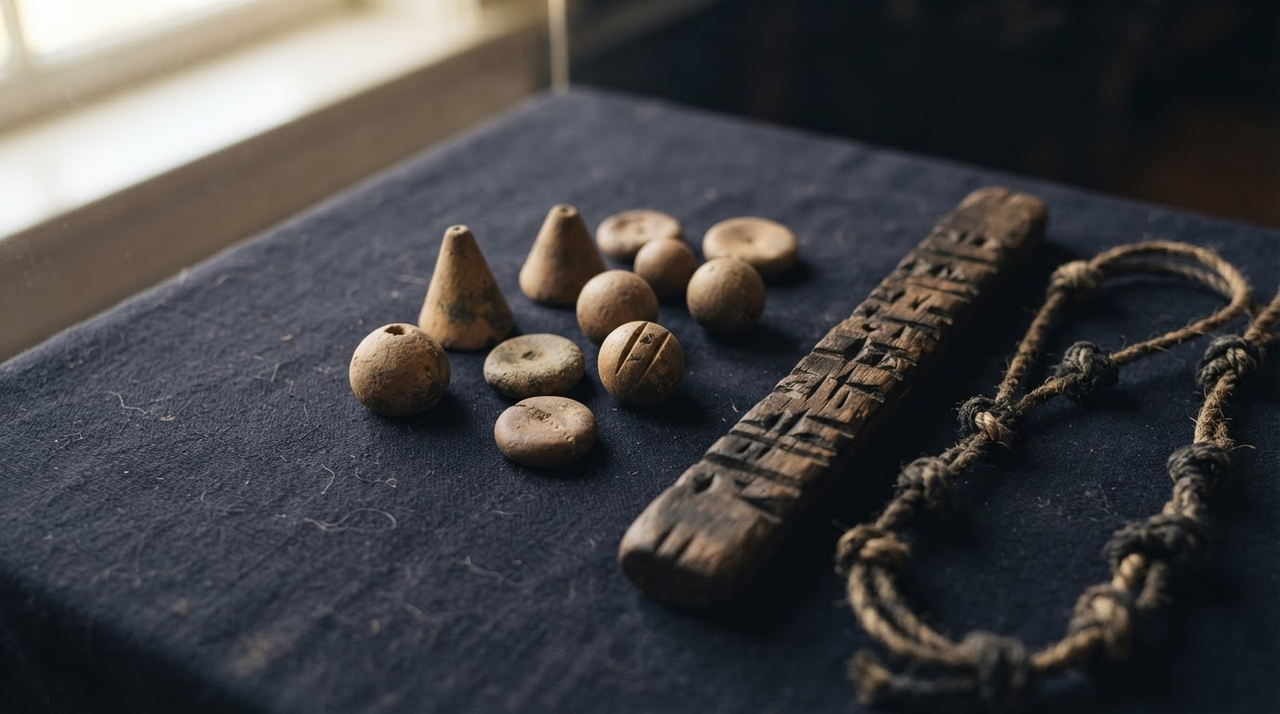
Our story begins not with ink or stylus, but with bone and clay. In the Upper Paleolithic, around 30,000 years ago, artifacts like the Ishango bone from the Congo Basin reveal grouped notches—tallies tracking lunar phases or kills, perhaps. These weren't numerals; they were extensions of the body, fingers splayed into grooves. Fast-forward to the Neolithic era, and ancient counting systems evolve with agriculture. In the Fertile Crescent, around 8000 BCE, small clay tokens appear: spheres for barley, cones for wool, ovoids for oil. Found in sites from Turkey to Iran, these geometric lumps prefigure writing itself, each shape a proxy for goods stored in bulging granaries.
Archaeologists interpret these tokens as accounting aids—drop one in a pouch for each measure of grain withdrawn. By 3500 BCE, they press into clay envelopes, their impressions birthing proto-cuneiform. Evidence is solid: thousands of tokens unearthed, their forms consistent across regions. Yet interpretation varies: Were they purely economic, or tied to ritual tallies? We know they worked; the rest invites curiosity.
Quipu: Knotted Cords and the Limits of Evidence
Across the ocean, in the Andes, the Inca wove numbers into quipu—knotted strings dangling from a main cord, encoding census data, tribute, and yarns of empire. Colors and knot positions signaled categories and quantities, a tactile system thriving without paper. But evidence frustrates: most quipus survive from after Spanish conquest, and their full logic remains partly deciphered. They remind us numbers needn't mimic speech; they can knot, notch, or cluster. For deeper ties between counting and inscription, explore our Writing & Memory Door.
Additive vs. Positional: The Leap to Place Value
Early systems were additive, like Roman numerals: IIII for four, each mark stacking effortfully. Practical for small tallies, disastrous for multiplication. Enter positional notation, where a symbol's worth shifts by placement—ones, tens, hundreds. This place value revolution amplified computation, but it wasn't one eureka moment. It bloomed independently, a human response to scaling empires and astronomy.
Contrast this with tokens or quipu: non-positional, context-bound. Positional systems demand a base and, crucially, zero—a placeholder to distinguish 1 from 10, 100 from 1000. Without it, ambiguity reigns. These innovations parallel across cultures, underscoring no lone inventor, but convergent ingenuity.
Babylonian Mathematics: Sexagesimal Mastery in Cuneiform
Babylonian mathematics exemplifies early positional power. From around 2000 BCE, Mesopotamian scribes etched cuneiform wedges on clay tablets, using a sexagesimal (base-60) system. Why 60? Divisible by 1, 2, 3, 4, 5, 6, 10, 12, 15, 20, 30—ideal for fractions in trade and time. Tablets from Nippur and Sippar show vertical columns for powers of 60, with gaps or double-wedges as proto-zeros by 1800 BCE.
The Plimpton 322 tablet, dated circa 1800 BCE, stands as fact: a Pythagorean triple list, reciprocals computed to six sexagesimal places. No interpretation needed—it's preserved computation, solving quadratics geometrically. Scribes trained in edubba schools manipulated these for irrigation canals, star charts. Yet full place value, with unambiguous zero, lagged; ambiguity persisted until later Assyrian tweaks. This system's legacy? Our 60-second minutes, 360-degree circles—practical echoes in modern life.
Egyptian Fractions: Unit Precision in the Rhind Papyrus
Nile-bound Egyptians shunned positional bases, favoring unit fractions: sums of distinct 1/n. The Rhind Papyrus (circa 1650 BCE, copied from older Hyksos-era texts) brims with problems like dividing 2 by 7 as 1/4 + 1/28. Hieroglyphic numerals—strokes for units, coils for tens—were additive, tallied right-to-left.
Fact: The papyrus lists 87 problems, from loaves to pyramid slopes, solved via duplication tables and fraction expansions. No place value, yet elegant for rationals in pyramid-building and Nile floods. Interpretations debate mysticism—sacred geometry in proportions?—but evidence points to empirical craft, not cosmic code. Human scribes, ink-stained fingers plotting eternal monuments.
To find 2/97: multiply loaves until remainder halves—practical heuristics over abstract zero.
The Invention of Zero: Parallel Triumphs, from Maya to India
Zero arrives late, transformative. Mesopotamia hinted; India crystallized it in positional decimal by 500 CE, transmitted westward. But Maya independently birthed zero centuries earlier—in a vigesimal (base-20) shell glyph, atop Dresden Codex pages from 36 BCE. Positional from the start, it tallied vast calendars, aligning Long Count cycles with Venus risings.
Established: Maya zero as positional placeholder, distinct from Mesopotamian gaps. No diffusion evidence; pure parallel invention. India refined decimal zero around 300 CE in Bakhshali manuscript, full flowering in Brahmagupta's rules (628 CE). These weren't mystical voids but tools for infinity's edge—empty slots enabling boundless scale.
For calendrical roots, venture to our Sacred Time Door, where counting seasons meets cosmic rhythm.
A Mosaic, Not a Monolith: Lessons from Parallel Paths
No single thread weaves this tapestry. Babylonian sexagesimal, Egyptian fractions, Maya vigesimal zero—each ancient counting system solved local puzzles: trade in Sumer, floods in Egypt, stars in Yucatán. Place value emerged where complexity demanded; zero followed. Sacred geometry claims tempt, but artifacts reveal human hands: pragmatic, iterative, diverse.
Philosophy whispers here—Plato's forms? Aristotle's categories?—yet numbers predate, grounding abstraction in clay and cord. History of numbers teaches resilience: from tally's scratch to zero's silence, we invent to endure.
Your Journey Forward: A Seeker's Journal Prompt
Pause. Tally your day: notches for tasks, tokens for joys? What personal system hides in your habits—mental abacus or finger-counted lists? Journal this: How does your counting shape your world? Sketch a new tally for gratitude, a quipu for dreams. In Aetheria, we protect such journeys—one mark at a time.
Word count: 1428