
Gutenberg's Printing Press: Scribes, Displacement, and the Labor History of Technological Change
Picture a scribe in 1450s Mainz, fingers ink-stained from decades of copying manuscripts by hand. Each letter a deliberate stroke, each page a testament to craft honed through guild apprenticeships. Then, whispers spread: Johannes Gutenberg's workshop hums with a strange machine, spitting out identical pages at impossible speed. This wasn't just an invention; it crashed into a living workshop of human labor, reshaping the world of technology and labor history forever.
Gutenberg's movable type printing press, debuting around 1450, didn't arrive in an empty room. It entered scribal communities bound by guilds, patronage, and the slow rhythm of handcraft. Here begins our story of Gutenberg printing press workers, scribes and displacement, and the enduring tension between innovation and the people who wield it.
The Scribal Workshop: A World of Craft and Constraint
Before Gutenberg, Europe's knowledge flowed through scribes. Trained for years in monastic scriptoria or urban guilds, they mastered quill, vellum, and illumination. In Mainz, a hub of scribal activity, workshops buzzed with apprentices grinding pigments, masters correcting texts. Labor was skilled, communal, and precarious—tied to church commissions or noble patrons. A single Bible might take months, commanding high fees that sustained families.
This craft labor technology wasn't primitive; it was refined, adaptive. Scribes adjusted to paper's rise from China, innovated abbreviations for speed. Yet material limits loomed: vellum shortages, ink inconsistencies. Guilds enforced standards, controlling who could work, preserving wages against unskilled labor.
Movable Type Enters the Fray: Artifact, Practice, and People
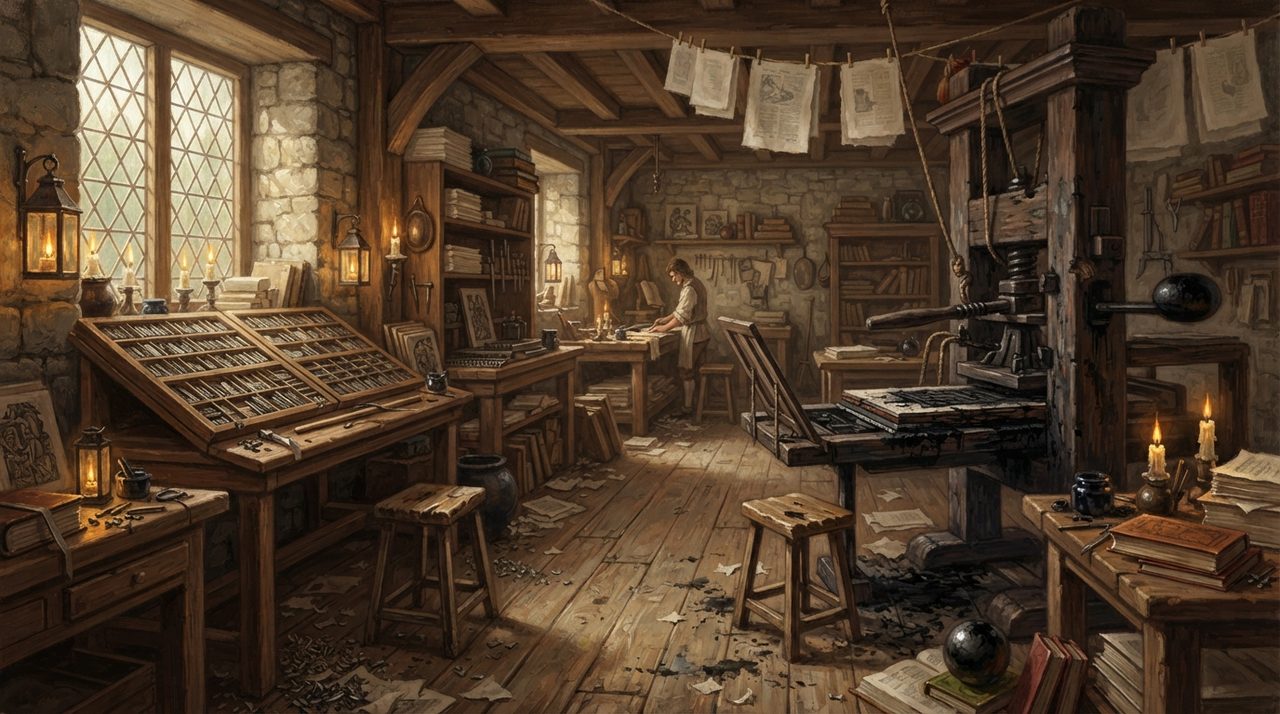
Gutenberg's Workshop in Mainz
Gutenberg, a goldsmith-turned-entrepreneur, built his press from existing tech—screws from wine presses, alloys for type. But success hinged on labor: compositors arranging thousands of metal letters, inked by hand, pressed onto paper. His team? Local craftsmen, including former scribes who grasped letterforms intimately. By 1455, the 42-line Bible emerged, 180 copies produced in a workshop employing perhaps a dozen men.
Ownership mattered: Gutenberg's partners, like Johann Fust, funded via loans, sparking lawsuits that scattered the tech. Print houses sprang up, but always in workshops with people—compositors earning piece rates, apprentices learning the chase.
Scribes and Displacement: Who Builds, Uses, and Adapts?
Did scribes vanish? Not overnight. In Mainz, scribal guilds faltered as print undercut luxury manuscripts' monopoly. Hand-copied books, once 30-50 florins, dropped to 2-3 via press. Displaced workers faced hunger; some pivoted to legal documents or teaching. Yet counterevidence abounds in skill and automation history: many scribes retrained as compositors. Their eye for justification and correction proved invaluable. Peter Schöffer, Fust's son-in-law and a scribe, became a printing pioneer.
- Builders: Goldsmiths and mechanics like Gutenberg.
- Users: Early printers blending scribal skills with type-setting.
- Displaced: Pure copyists in oversaturated markets.
- Retrainers: Scribes flowing into print, carrying craft forward.
Institutional shifts sealed it: guilds reformed to include printers, but power tilted to owners controlling type matrices and presses.
Echoes Across Time: From Weavers to Copy Machines
This pattern recurs. In 19th-century Britain, handloom weavers—skilled artisans—faced power looms, sparking Luddite resistance. Thousands displaced, wages crashed, yet some retrained as machine tenders. Closer to scribes: 20th-century typists and Xerox's rise. Copy tech displaced rote copying, but skilled layout artists adapted to offset printing.
Technology never arrives in an empty room; it enters workshops humming with human endeavor.
Lessons from Craft Labor and Technological Change
Gutenberg's story illuminates scribes and displacement not as doom, but transition. Productivity soared—millions of books by 1500—but at human cost: eroded apprenticeships, new hierarchies. Cross into our Books Door for scribal histories; explore Economy Door labor markets; or Personal Growth Door on skill pivots.
Today, witness compositor ghosts in coders or designers. The press teaches: honor the workshop's people. Next time tech disrupts, ask—who retrains, and how do we ease the shift?