
History of Future Imaginaries: How Cultures Envisioned Utopias, Dystopias, and Tomorrow
Unveiling the Mirror of Tomorrow
Picture a clay tablet from ancient Sumer, etched with lists of kings who reigned for tens of thousands of years, their rule unbroken until a great flood shattered the eternal order. This was no mere record-keeping; it was a glimpse into a future where power endured forever, a reflection of a society's deepest longing for stability amid chaos. Such future imaginaries—visions of what might come—do not predict the unknown. Instead, they reveal the values, fears, and aspirations of the present moment.
In this exploration of future imaginaries history, we trace how cultures imagined the future, from utopian dreams of harmony to dystopian warnings of collapse. Far from fortune-telling, these stories serve as cultural mirrors. This reading invites you to wander through time, distinguishing the threads of historical expectation from speculative fiction, and uncovering comparative future thinking across civilizations. By examining utopia dystopia history, we see not one path to tomorrow, but many past futures—each shaped by its place, era, rulers, and people.
What awaits? A chronological pathway through humanity's forward gaze, distinctions between forms of imagining, cross-cultural contrasts, and reflections on why these echoes matter now. No single destiny emerges; instead, a tapestry of possibilities, urging curiosity about our own unspoken hopes.
Ancient Seeds: Eternal Rules and Cyclic Returns
The story of how cultures imagined future begins in the cradle of cities, Mesopotamia around 2100 BCE. The Sumerian King List, inscribed on prisms and tablets, chronicles rulers like Alulim, who held sway for 28,800 years. Post-flood, reigns shorten, hinting at a degraded age—but the list implies a mythic continuity, a future where kingship persists as divine order. Here, in the shadow of ziggurats and under priestly scribes' hands, future imaginaries served power: affirming the king's sacred role amid floods and invasions.
Egypt's Eternal Horizon
Across the Nile, pharaohs envisioned eternity through pyramid texts and the Book of the Dead. The afterlife was a perfected future Nile valley, where the righteous soul joined Osiris in undying fields. Scale mattered: these were elite visions, commissioned by god-kings for monumental tombs, projecting imperial harmony into infinity. Dystopia lurked in the underworld trials, a warning to maintain ma'at—cosmic balance.
In Mesoamerica, Maya stelae from sites like Palenque tallied k'atun cycles, projecting long counts into centuries ahead. Their future was not linear ascent but rhythmic return, with prophecies of world-ending floods or fires, balanced by renewal. These stone-carved imaginaries, tied to rulers' calendars, functioned as political tools, legitimizing dynasties through cosmic foresight.
Medieval Heavens and Earthly Trials
Augustine's Two Cities
As Rome crumbled in 410 CE, Augustine of Hippo penned City of God, distinguishing the earthly city—frail, doomed to cycles of rise and fall—from the heavenly city, a utopia of eternal peace under divine rule. Written amid Vandal sacks, this was no escape fantasy but a theological reframing: history marches toward judgment, revealing Christian values of transcendence over imperial might. Future imaginaries here shifted from kingly eternity to communal salvation, influencing Western thought for millennia.
Eastern Cycles and Golden Ages
In Tang China (7th-9th centuries), Buddhist and Daoist texts foresaw kalpas—vast eons of decay followed by renewal. The Maitreya sutras promised a future buddha restoring dharma after moral decline, mirroring Tang elites' anxieties over barbarian threats. Islamic scholars in Abbasid Baghdad, like al-Mas'udi, blended Greek inheritance with Quranic eschatology, envisioning a mahdi-led utopia amid golden age optimism fueled by trade and scholarship.
Enlightenment Ascent and Industrial Spectacles
The 18th century brought a pivot: progress as destiny. In France, Marquis de Condorcet’s 1794 Sketch for a Historical Picture of the Progress of the Human Mind outlined ten epochs culminating in indefinite perfection—reason triumphing over superstition, poverty erased by science. This utopia dystopia history reflected revolutionary fervor and salon debates, yet bore the era's blind spots: Eurocentrism, slavery's persistence.
World’s Fairs: Tomorrow on Display
The 19th and 20th centuries materialized these dreams in steel and light. Chicago’s 1893 World’s Columbian Exposition unveiled the White City—a gleaming utopia of neoclassical palaces, electric fountains, and moving sidewalks—promising urban harmony through technology. Organizers like Daniel Burnham channeled American industrial might, yet the fair's midway exoticized colonized peoples, embedding power imbalances.
Paris 1900 outdid it with Eiffel Tower illuminations and metropolis models; New York 1939 previewed radar and television amid Depression recovery. These were state-sponsored scenarios, blending boosterism with warnings—post-WWI fairs hinted at mechanized wars. By mid-century, dystopian undercurrents emerged in literature like Huxley’s Brave New World (1932), critiquing consumer utopias from interwar unease.
Distinctions in the Art of Foreseeing
Not all forward gazes are equal. Historical records, like king lists, blend myth and chronicle to project continuity. Scenarios—World’s Fair pavilions—offer plausible blueprints, tested by engineers for patrons' approval. Speculative fiction, from Lucian’s 2nd-century True History moon voyages to Wells’ Time Machine (1895), probes “what if” through narrative play, unbound by feasibility.
Late imagination—philosophic reverie, as in utopian communes like Fourier’s phalansteries—prioritizes ethical ideals over plot, inviting communal reimagining. Each form functions differently: records stabilize hierarchies, scenarios mobilize investment, fiction provokes debate, imagination inspires reform.
Comparative Future Thinking: Patterns and Divergences
- Cyclical vs. Linear: Indic and Mesoamerican views loop through yugas or baktuns, emphasizing renewal over Western Enlightenment linearity toward apex.
- Elite vs. Communal: Pharaohs’ afterlives served the crown; Augustine’s city invited all believers, democratizing utopia.
- Techno-Utopian vs. Spiritual: World’s Fairs exalted machines; Daoist futures sought harmony with nature’s rhythms.
Functions vary: stabilizing empires (Mesopotamia), consoling the faithful (medieval), fueling revolutions (Enlightenment), or selling progress (fairs). Place imprints all—river valleys foster abundance dreams, steppe empires dread collapse.
Why Multiple Past Futures Echo Today
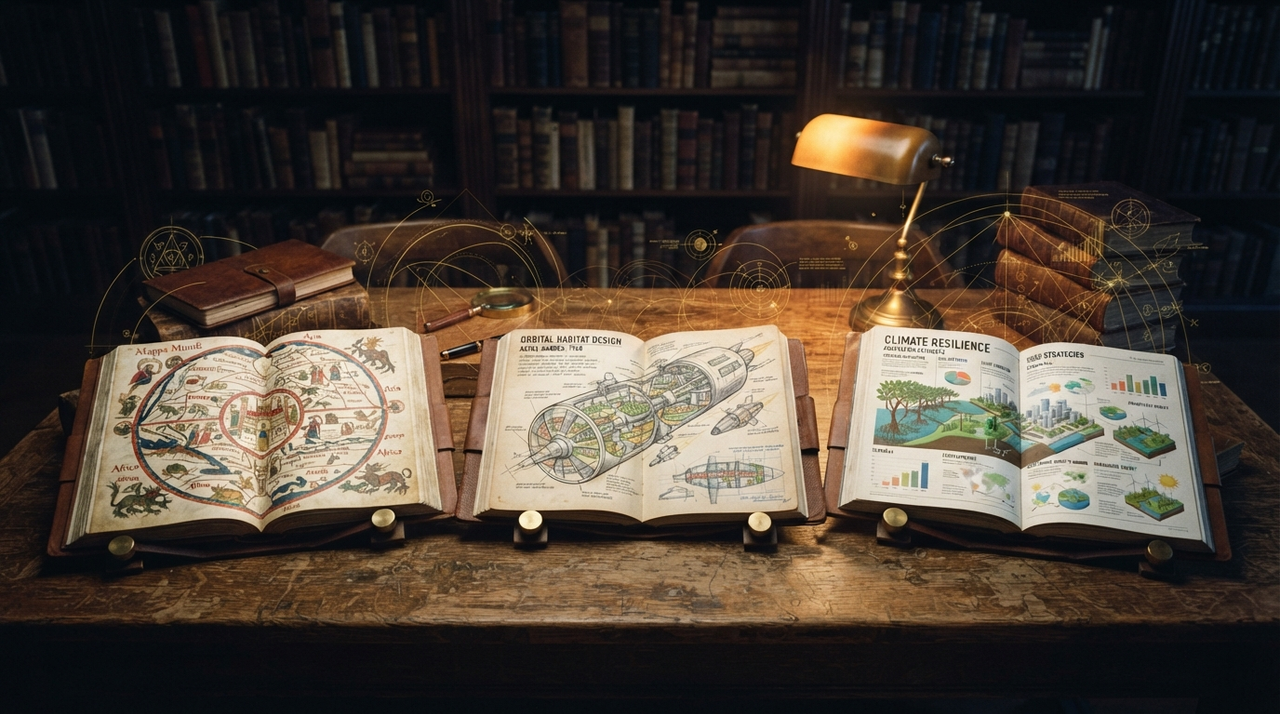
Our era brims with clashing imaginaries: climate scenarios, AI speculations, space colonies. Revisiting these histories reveals contingency—no inevitable arc bends toward utopia or abyss. They remind us that visions encode present power—who narrates? Whose tomorrow? In a globalized world, blending cyclical resilience with linear innovation offers tools for navigating uncertainty, honoring diverse scales from local communities to planetary stakes.
Cross-Door Threads in Aetheria’s Library
This door to the Future of Humanity connects richly. In Writing & Memory, see how cuneiform lists preserved mythic futures, shaping collective recall. Sacred Kingship echoes in eternal reigns, questioning if divine rulers ever yield to time. Technology mirrors fair pavilions—tools as utopia-makers or dystopian traps, always human-wielded.
Toward Your Own Horizon
These past futures, neither prophecy nor warning, invite us to craft anew. What values does your tomorrow reflect? In Aetheria’s spirit of inquiry, pause here.
Seeker’s Journal Prompt: Sketch one future imaginary from your daily life—what hopes or fears does it reveal? How might it shift if narrated from another place, era, or hand?
Step through, curious one. The universe unfolds in questions.