
History of Uncertainty: Ancient Chance, Divination, Lots & the Dawn of Statistics
Imagine a Mesopotamian farmer in 2000 BCE, staring at the Tigris River's muddy swell. Will the floods nourish his fields or sweep them away? No spreadsheets, no Monte Carlo simulations—just the raw pulse of unpredictability. Ancient peoples didn't have the history of statistics we know today, yet they wrestled with uncertainty daily. From casting lots to charting stars, they forged tools to navigate the unknown. This is the history of uncertainty: not a tale of primitive guesswork, but a humane saga of pattern-seeking amid chaos. How did ancient chance and divination and lots shape early human decisions? And where do we glimpse the first flickers of early probability and measurement uncertainty?
In this final companion to the Mathematics Door, we trace uncertainty's ancient roots—not as failure, but as the spark of inquiry. Without modern stats, our ancestors turned to rituals, records, and reckonings that honored life's inherent fog. Join us on this journey through clay tablets and temple oracles, where human curiosity first quantified the unquantifiable.
Casting Lots: Bounded Decisions in an Unpredictable World
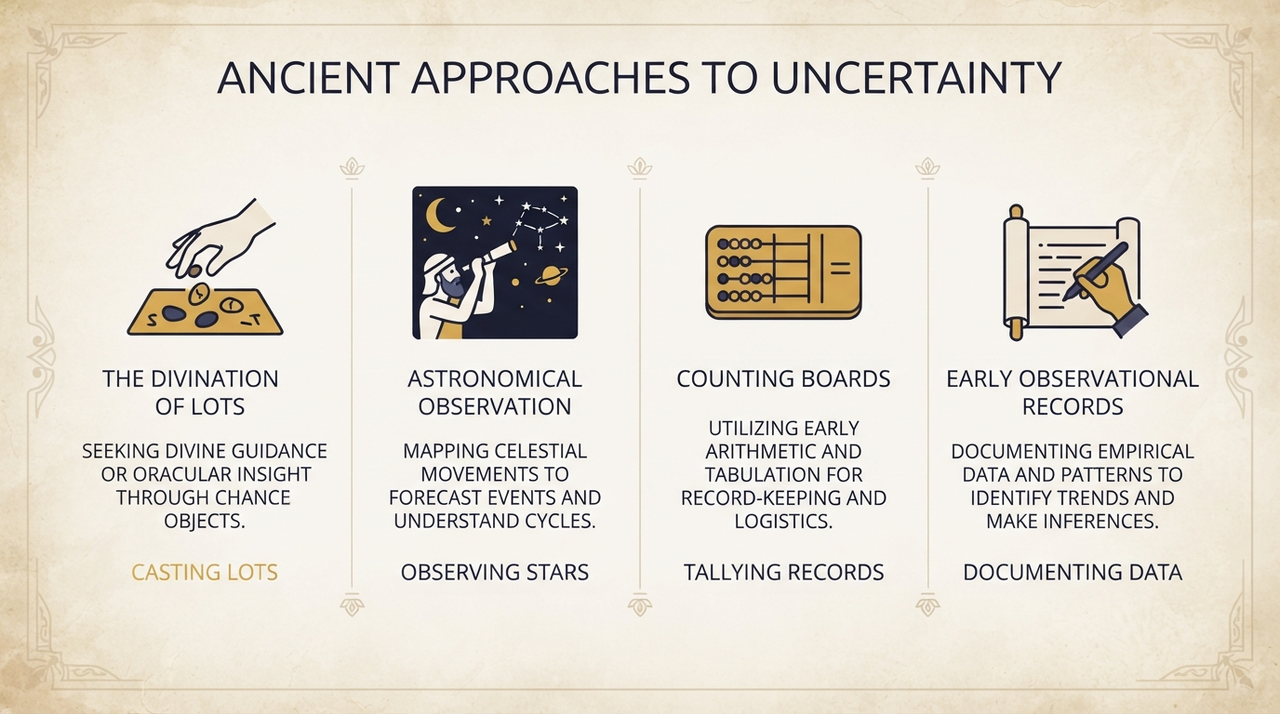
Long before dice rolled in Roman taverns, lots served as ancient decision engines. Picture a Levantine elder in the 10th century BCE, facing a tribal dispute. Stones drawn from a pouch—smooth for yes, rough for no—settle inheritance claims. These weren't gambles in our sense; they were divination and lots, sacred procedures to pierce divine intent. Texts from Ugarit describe priests shaking puḥru (lots) for kingly choices, framing uncertainty as a dialogue with gods, not random noise.
In Mesopotamia, the šubtu lots appear on cuneiform tablets from the Old Babylonian period. A merchant queries: Ship goods now, or wait? Lots provide a binary oracle, bounding infinite possibilities into yes-or-no. Greek parallels emerge in Herodotus, recounting Persian lots for battle omens, while the Hebrew Bible's Proverbs 16:33 declares, "The lot is cast into the lap, but its every decision is from the Lord." Here, ancient chance isn't probabilistic; it's a conduit for higher order. No one tallied frequencies to predict outcomes—these were one-shot rituals, not repeatable experiments.
From Mesopotamia to Greece: Lots as Social Glue
Mesopotamian lots extended to law: Eshnunna codes reference them for oaths in uncertain cases, like stolen livestock. Greek klēros (lots) allotted land post-war, as in Athens' democratic sortition—random yet ritualized, ensuring fairness amid envy. Levantine traditions, seen in Numbers 26's tribal divisions, used lots for equitable shares. These practices tamed history of uncertainty socially: by externalizing choice to lots, communities sidestepped endless debate.
Critically, ancients distinguished coincidence from pattern. Frequent rain after lot-cast prayers? A sign, perhaps—but not tested like modern stats. They sensed early probability intuitively, yet resisted retrofitting randomness onto the sacred. Uncertainty remained human: a reminder of limits, not a math problem to solve.
Stars, Scribbles, and the Sting of Error: Measurement Uncertainty Awakens
Shift to the night sky over Babylon, 700 BCE. Scribes in the Esagila temple log lunar positions in meticulous diaries—over 1,000 clay tablets spanning centuries. These aren't horoscopes; they're raw data: "Moonrise 1/30 cubit behind Mul.Mul." Yet errors creep in. Observations vary by observer, weather, instrument—a naked-eye awareness of measurement uncertainty.
Babylonian astronomers noted discrepancies, adjusting predictions. Tablet BM 34572 records a lunar eclipse off by "5 cubits," prompting recalibrations. This birthed qualitative error-handling: not standard deviations, but scribal notes like "cloudy, unreliable." Egyptian counterparts faced calendar drift. The Nile's inundation tied to Sirius' heliacal rising, but their 365-day civil calendar slipped a quarter-day yearly. By 1400 BCE, priests inserted intercalary months, confronting history of uncertainty in time's flow. Ramesside decans—star clocks—acknowledged observational fuzz, with texts warning of "dimmed" risings.
Scribal Corrections: The Quiet Dawn of Reliability
Clay tablets reveal double-counts and cross-checks. A Neo-Assyrian inventory tallies sheep twice, reconciling tallies to flag shortfalls. Egyptian ḥsb (reckonings) in tomb papyri show scribes erasing and rewriting grain measures, annotating variances. These weren't stats; they were pragmatic hedges against error, fostering trust in records.
- Double verification: Mesopotamian tax lists compare surveyor reports, noting "discrepancy of 2 gur."
- Qualitative scales: Greek metrologists like Hero of Alexandria graded weights as "trustworthy" or "suspect."
- Pattern vs. anomaly: Babylonian omens cataloged celestial repeats, but outliers signaled portents—not noise.
Such practices sowed history of statistics' seeds. Uncertainty sharpened scrutiny, turning vague dread into bounded risk.
Threads Across Traditions: Uncertainty in Law, Time, and the Beyond
This history of uncertainty weaves through Aetheria's Doors. In the First Laws Door, legal codes grapple testimony's fog—Hammurabi's ey witnesses weighed against lots, echoing bounded decisions. Time and Sacred Time Doors mirror calendrical corrections: Egyptian Sothic cycles realigned profane and holy years, much like Babylonian diaries tuned lunar-solar mismatches.
Even Death & Afterlife motifs reflect it. Egyptian ka judgments balanced scales amid heart-weighing uncertainties; Greek oracles at Delphi parsed ambiguous prophecies. Lots and divination bridged mortal haze to eternal verdicts, humanizing the divine.
Uncertainty, then, unites traditions—not as flaw, but forge for wisdom.
From Ancient Intuitions to Statistical Dawn: A Humane Legacy
By Hellenistic times, these threads converge. Ptolemy's Almagest quantifies stellar errors in parallax degrees, nodding to Babylonian legacies. Indian Sulbasutras adjust rope geometries for measurement slack. Yet true history of statistics awaits Pascal and Fermat's 17th-century letters—probability as math, not ritual.
Ancients didn't pioneer early probability; they embodied it humanly. Divination bounded choices; observations flagged errors; scribes built reliability. Patterns emerged from lived repetition—rain lots succeeding often enough to persist—not chi-squared tests. We mustn't project Bernoulli onto Babylon; instead, honor their clarity: uncertainty demands attention, not erasure.
For cross-Door seekers, explore Time and Sacred Time for drift's rituals, First Laws for evidentiary lots, or Death & Afterlife for judgment's haze.
Sharpening Your Inquiry: Uncertainty as Ally
Today, as you chase big questions—cosmic origins, ethical frontiers—pause. Where does uncertainty in your research hone focus? A dataset's variance? An ancient text's ambiguity? Like that Mesopotamian farmer, embrace it. Not as foe, but teacher. In Aetheria's spirit, let ancient chance remind: the universe unfolds through our patient gaze.
What lot will you cast next?