
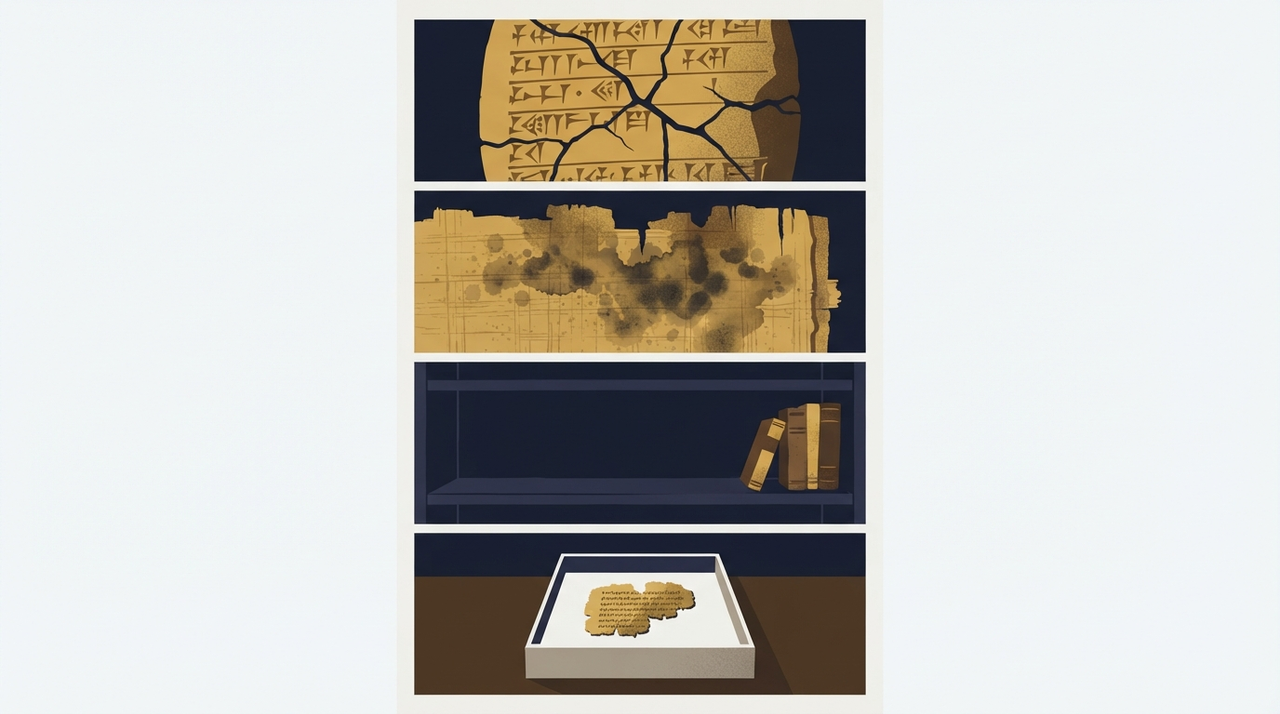
Manuscript Survival: The Quiet Causes of Textual Loss Beyond the Myths
Picture a quiet scriptorium in medieval Europe. A scribe, quill in hand, labors over a sheet of vellum. But the parchment beneath his fresh ink once held words from centuries past, scraped away to make room for the new. This everyday act of palimpsest reuse erased far more texts than any blaze. While tales of grand library fires grip the imagination, the real story of textual loss unfolds in shadows: damp cellars, hungry insects, selective copying, and human neglect. For readers weary of the Library of Alexandria's dramatic end, this is the wider, quieter account of how knowledge slips away.
The Limits of Legendary Fires: Alexandria Myth Limits
The burning of Alexandria has become shorthand for cultural catastrophe. Yet evidence for its scale remains thin, woven more from later legends than firm records. Real manuscript survival faced threats far less cinematic. Libraries never held all knowledge; they mirrored elite tastes, monastic priorities, or royal whims. What perished often did so not in spectacle, but in the grind of time and circumstance.
Consider the stacks of forgotten rolls in provincial archives or private collections. Survival hinged on utility, not inherent value. Texts on agriculture, medicine, or local lore rarely drew copyists' eyes when scripture or classics beckoned. This bias shaped canons across History and Archaeology Doors at Aetheria.
Palimpsest Reuse: Scraping Away the Past
Parchment was precious, a labor of animal hides stretched, limed, and scraped. When demand outstripped supply, scribes turned old manuscripts into palimpsests, washing or scraping off ink to reuse the surface. Ultraviolet light now reveals ghosts of erased works: Euclid's lost treatises, medical tracts, even plays by Sophocles.
In monasteries from Ireland to Byzantium, this practice was routine. A single sheet might cycle through three lives, each erasure dimming the prior voice. Thousands of such interventions contributed to textual loss, not malice, but economics.
Climate and Archives: The Slow Erosion of Damp and Heat
Humidity's Relentless Toll
Manuscripts crave dry, cool havens. In tropical climates or poorly ventilated vaults, humidity swells fibers, inviting mold. Pages blacken, text dissolves into pulp. European collections in damp abbeys lost volumes to rot; Islamic libraries in Baghdad battled similar foes before their own declines.
Heat and Fragility
Arid deserts preserve scrolls, as in Qumran caves. Yet extreme swings crack bindings, brittle leaves. Across the Environment Door at Aetheria, we see how climate and archives entwine: modern warming accelerates decay in underfunded repositories worldwide.
Insects, Rodents, and Organic Decay
Bookworms are no myth. Silverfish, booklice, and beetles feast on glue, leather, and paper alike. In tropical Asia, termites devoured temple libraries; rodents nested in European stacks, shredding folios for bedding. Decay followed: ink flaked, parchment powdered.
These pests thrived in neglect. A flooded archive or unattended warehouse amplified the damage, turning treasures to dust without fanfare.
Fires as Local Disasters, Not Apocalypses
Fires struck often, but piecemeal. A candle topples in a Strasbourg bindery, 1770: 20,000 volumes gone. Monastic blazes in Ireland, 11th century; colonial warehouses in India. Each a local grief, not global void. Neglect preceded many: crumbling roofs invited sparks.
Politics enters here. Wars scattered collections; colonial powers extracted texts as trophies, leaving gaps in origin lands.
The Bias of Copying and Extraction
Scribes copied what patrons valued: theology over trade manuals, epics over ephemera. School curricula favored Virgil, sidelining practical verse. Colonial eras worsened this: British ships hauled Sanskrit works to London, fragmenting archives.
- Women's writings, often personal or devotional, copied least.
- Folk traditions, oral by nature, rarely inscribed.
- Scientific outliers dismissed as heresy or fad.
Manuscript survival thus skews toward the orthodox, the copied, the relocated.
Every Survivor a Reminder
Approach each ancient book as remainder, not pinnacle. What voices rarely endure? The farmer's ledger, the healer's notes, the poet's unpublished draft. Through Aetheria's Books Door, explore these quiet losses across History, Archaeology, Environment, and Politics. In understanding textual loss, we cherish the fragile threads that persist, and ponder the silences they leave.
Manuscripts teach humility. Not all worth vanishes in flames; much fades in forgotten corners, waiting for curious eyes.