
Origins of Writing Unveiled: From Mesopotamian Clay Tokens to Cuneiform, Egyptian Hieroglyphs, and Andean Quipu
Imagine a world without words etched on stone or papyrus—where the pulse of civilization beats through humble lumps of clay. The origins of writing didn't burst forth like a divine spark but evolved quietly from the drudgery of accounting, in the shadowy ledgers of ancient administrators. Far from a single eureka moment, writing emerged across continents in response to the same human imperatives: tracking grain, livestock, and labor in burgeoning cities. This deep dive into the Ancient Civilizations Door uncovers three parallel traditions—Mesopotamian clay tokens blossoming into cuneiform, Egyptian hieroglyphs, and Andean quipu—revealing how these systems encoded memory, power, and ritual.
The Humble Seeds: Mesopotamian Clay Tokens and the Birth of Cuneiform
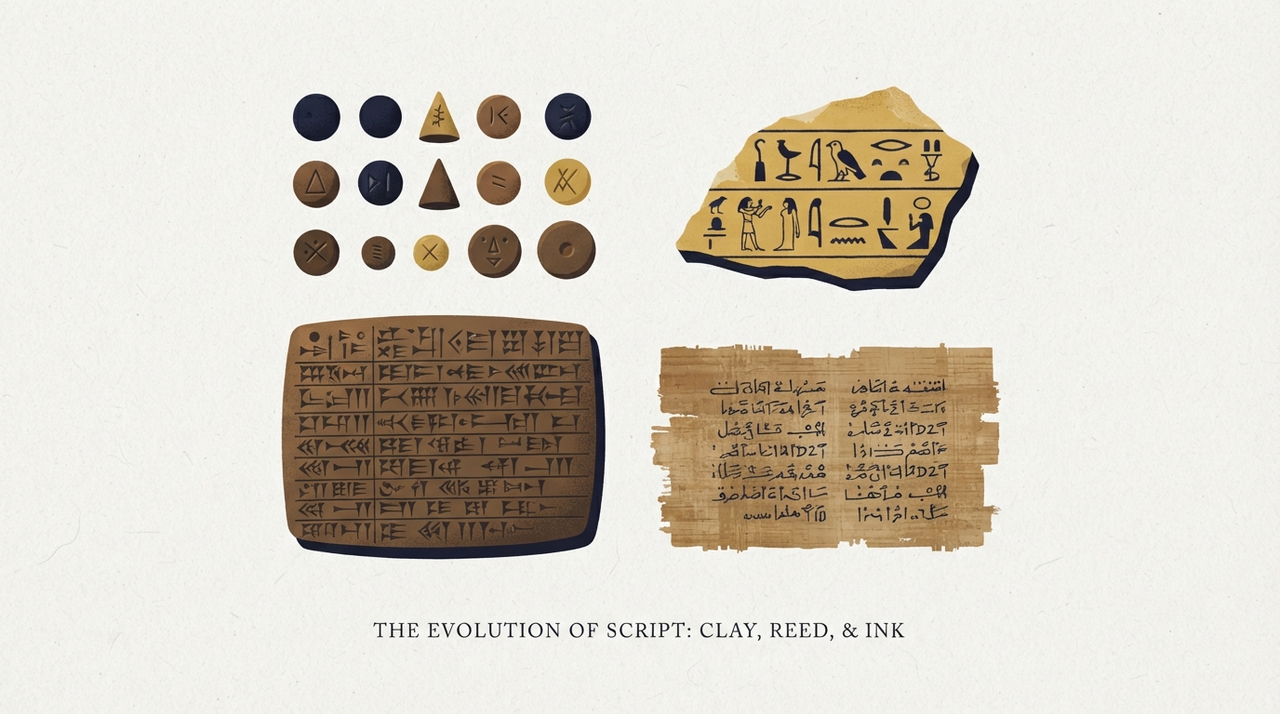
In the fertile floodplains of southern Mesopotamia, around 8000 BCE, small clay tokens appeared—plain nodules, cones, and spheres impressed with simple marks. These weren't art or poetry; they were bureaucratic tools for accounting commodities in early farming villages. Archaeologists unearthed thousands at sites like Tepe Gawra and Susa, each token representing a unit: a sphere for a measure of barley, a cylinder for an animal.
By Uruk IV (ca. 3400–3100 BCE), in the towering precincts of Uruk—home to the world's first true city—these tokens evolved. Enclosed in clay envelopes called bullae, impressions on the exterior matched the tokens inside, allowing verification without breaking them open. Soon, scribes incised pictographs directly onto clay tablets, birthing proto-cuneiform. Over 5,000 tablets from Uruk's Eanna temple archive detail accounting: barley allocations, sheep tallies, labor rosters. Pictographs like a reed stylus-marked head for "ration" or a fish-like sign for "beer" were read logographically, not phonetically at first.
Who wielded the stylus? Likely temple scribes—trained elites in administrative complexes—for priestly overseers and rulers. Everyday speech? Unrecorded. Literacy remained elite; debates rage over how widely proto-cuneiform was understood, with signs standardized yet enigmatic. Humility tempers our reading: full decipherment eludes us, reconstructions pieced from later Sumerian texts.
Egypt's Ritual Dawn: Early Hieroglyphs in Abydos Tomb U-j
Just decades later, around 3250 BCE, across the desert in Abydos, Egypt's tomb U-j yielded a stunning cache: ivory labels inscribed with the earliest hieroglyphs. Discovered in a predynastic royal grave amid exotic imports—oil jars, resins, ebony—these tiny bone and ivory tags strung on cords cataloged grave goods. Signs depict boats, mountains, falcons, reeds: a serekh-like frame hints at king Scorpion I, alongside emblems for linen or power.
Administrative or Ritual? The Abydos Puzzle
Unlike Uruk's voluminous ledgers, these sparse labels blend accounting with ritual. Scholars reconstruct readings as labels like "Horus Narmer brings 400 jars of oil," though phonetic values are speculative. Findspot matters: a high-status tomb, not a temple archive, suggests elite funerary use. Scribes? Probably court functionaries etching for pharaohs and gods. Literacy's extent? Minimal, confined to ritual contexts; no mass records yet. This contemporaneous bloom challenges Mesopotamia-first narratives, highlighting independent paths in the origins of writing.
Knots of Knowledge: Andean Quipu as Non-Phonetic Records
Leaping millennia and oceans, the Inca Empire (ca. 1400–1530 CE) mastered quipu: knotted cords in colors and hierarchies encoding vast data. Cotton or llama wool strings, with primary cords dangling pendants tied in loops denoting numbers—seven half-loops for 70 sheep. Unearthed at sites like Puruchuco-Huaquerones, quipus tallied censuses, tribute, even narratives via knot patterns.
- Content: Purely numeric and categorical accounting, no phonetic script.
- Who: Khipukamayocs, specialist "knotters," for emperors and officials.
- For whom: Imperial bureaucracy, audits memorized via quipu alongside oral recitation.
Quipu remind us: true record-keeping needn't mimic words. Debates swirl on narrative quipus—did they encode myths? Decipherment stalls without full keys, echoing ancient limits on literacy.
Threads Across Time: What Writing Captured—and Ignored
These traditions—cuneiform on clay for temples, hieroglyphs on labels for tombs, quipu in cords for empires—arose in administrative-ritual crucibles. Common: elite accounting, absent: folklore, emotions, the illiterate majority's voices. Chronology differentiates: Uruk edges Abydos slightly, quipu millennia later yet purely iconic.
Link to the Writing and Memory Door: these systems outsourced cognition, birthing history. Peek into the Science Door for cognitive archaeology probing scribal brains. Yet caution: our reconstructions falter at edges, literacy's true spread a scholarly mirage.
Echoes in Eternity
From clay tokens to knotted cords, the origins of writing whisper of humanity's drive to tally the tangible, leaving intangibles to breath and song. In Aetheria AI's Ancient Civilizations Door, these artifacts invite seekers to question: what memories do we etch today, and which fade unheard?