
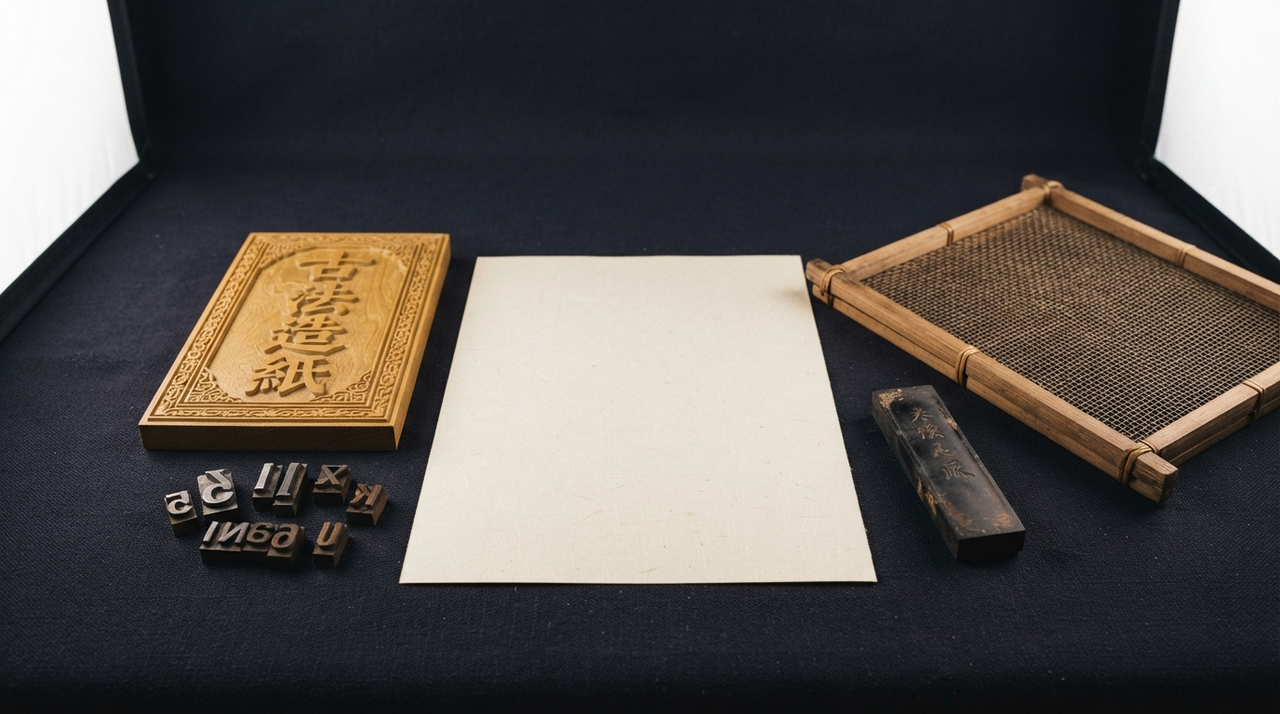
Paper's Global Journey: Woodblock Printing, Movable Type, and Who Could Read the Multiplied Books
Picture a quiet workshop in ancient China. A craftsman carves intricate characters into a polished wooden block, inks it carefully, and presses it against a sheet of freshly made paper. The result? A page that can be reproduced endlessly, carrying words across generations. This scene, from over a millennium ago, marks the start of the history of paper intertwining with printing techniques that reshaped how knowledge traveled the world. Yet the story unfolds far beyond one place or moment, weaving through Asia, the Islamic world, and Europe, challenging tidy tales of singular breakthroughs.
Paper itself emerged in China around 105 CE, credited to Cai Lun, though fragments suggest earlier experiments dating back two centuries. Crafted from mulberry bark, rags, and hemp, it was lightweight, affordable, and perfect for ink. By the 8th century, this innovation crossed into the Islamic world after the Battle of Talas in 751 CE, where captured Chinese papermakers shared their craft. Paper mills sprang up in Baghdad, Damascus, and Cordoba, fueling a golden age of scholarship. Europe lagged, relying on parchment until the 12th century, when paper from Islamic Spain began to transform monastic scriptoria.
Woodblock Printing: Carving Knowledge into Multiples
Woodblock printing appeared in China by the 7th century, initially for Buddhist charms and talismans. Texts followed suit. The Diamond Sutra, dated 868 CE and discovered in a Dunhuang cave, stands as the oldest dated printed book: a 16-foot scroll extolling enlightenment. Entire books, calendars, and playing cards emerged from these blocks, each laboriously carved in mirror image. Simple yet revolutionary, woodblock allowed mass production of religious tracts and imperial edicts.
This technique rippled outward. By the 8th century, Japan adopted it for exquisite woodblock-printed scrolls. In the Islamic world, paper met block printing for amulets and early texts, though hand-copying dominated for Quran production. Europe glimpsed similar methods via Byzantine and Islamic trade, printing textiles and images by the 14th century. Woodblock democratized visuals first, images of saints or dragons leaping onto paper in vibrant inks.
Movable Type: Rearranging the Building Blocks of Text
China's Wooden Pioneers and Korea's Metal Leap
Bi Sheng, a Song dynasty artisan, experimented with movable type around 1040 CE, firing clay characters and arranging them in a glued frame. Wood followed, suited to Chinese script's thousands of characters. These allowed reuse, speeding production over carving whole blocks anew. Yet complexity limited widespread use; woodblock persisted for its fidelity to illustrations.
Korea refined this in the 13th century with metal type. The Jikji, printed in 1377 at Heungdeok Temple, survives as the oldest extant movable-type book. Crafted from bronze, these characters endured, producing Confucian classics and Buddhist sutras. Goryeo and Joseon scholars printed state exams and histories, multiplying official knowledge.
Echoes in Europe
Europe's adoption came later, around 1450, with Johannes Gutenberg's press using movable metal type in Mainz. Building on wine presses and prior Asian echoes via trade routes, it printed the Gutenberg Bible. But this was adaptation, not isolation; paper from Islamic mills and block-printing precedents paved the way.
Print and Readers: Multiplication Meets Barriers
More copies did not mean more readers. Print and readers remained gated. In China, imperial censorship banned unapproved texts; printers needed licenses. Prices dropped, but a Song dynasty book still cost weeks of wages for common folk. Literacy hovered among elites fluent in classical Chinese, a language far from spoken dialects. Women, often barred from formal education, accessed books via family or oral retellings.
Korea printed for scholar-officials; metal type served bureaucracy. Islamic centers valued printed paper for notes, but sacred texts stayed manuscript to honor scribes. In Europe, Latin bound print to clergy and universities. Vernacular works grew slowly; incunabula were luxury items. Censorship by church and crown burned books as readily as multiplied them.
Access varied: buy for the wealthy, borrow from libraries like Cordoba's vast collection, hear via public readings in markets or mosques. Manuscripts endured alongside print, prized for artistry. Oral cultures thrived, passing epics and folklore unbound by pages.
Echoes Through Aetheria Books Door
This history of paper, woodblock printing, and movable type reveals a shared human quest to multiply minds on the page. At Aetheria Books Door, we trace these threads without myths of lone inventors. Who bought, borrowed, or heard these multiplied books? Who still could not, shaped by class, gender, tongue, and taboo?
Step through to our Education Door for literacy's uneven spread, History Door for timelines unspooled, or Politics Door to see power's grip on pages. Paper's journey invites us to question: in our era of digital floods, who truly reads?