
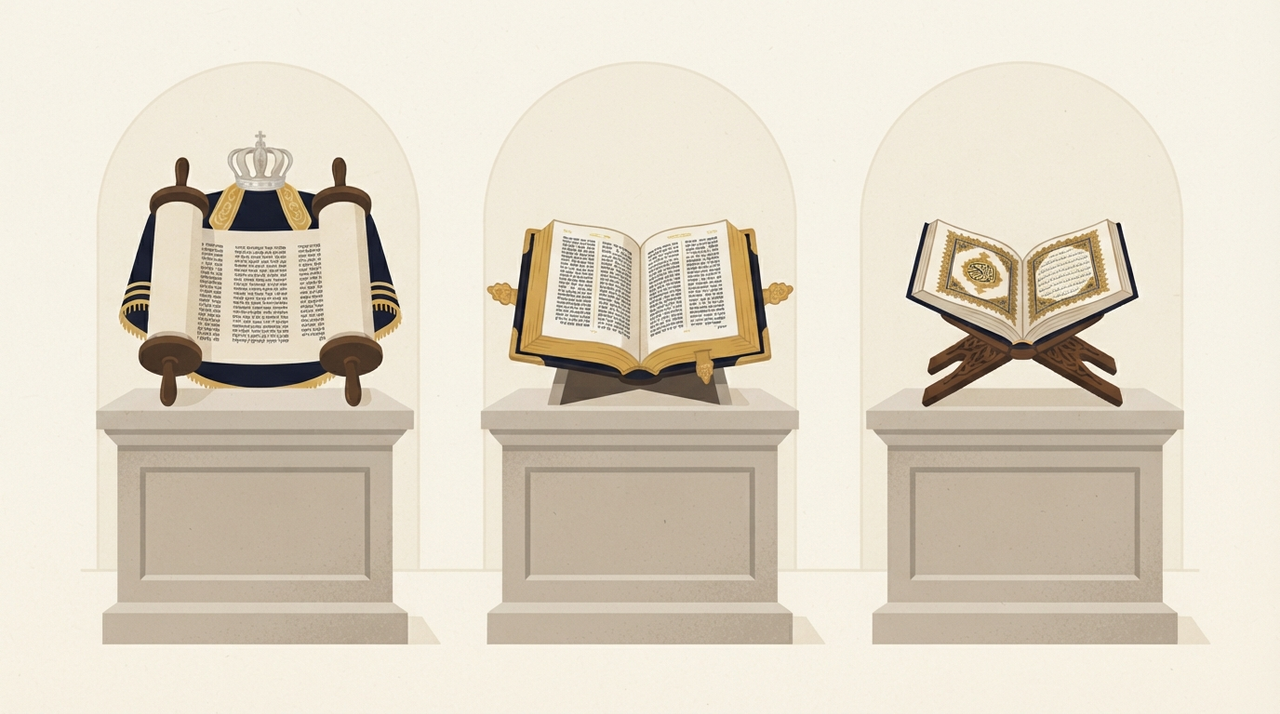
Sacred Forms Endure: Torah Scrolls, Christian Codices, Qur'an Mushafs and Community Traditions
Imagine standing in a dimly lit synagogue as the Torah ark opens. A sofer, trained for years in sacred calligraphy, lifts a massive scroll wrapped in velvet and silver. This is no ordinary book. Its form demands unrolling from right to left, verse by verse, in a ritual that has shaped Jewish life for millennia. Why does this community cling to the scroll amid digital plenty? The answer lies not in technology alone, but in the intimate bonds between material form, liturgy, and law.
In the Aetheria Books Door, we explore the book as material form, tracing scroll and codex history through the lens of enduring community practices. Readers here grasp that books evolved beyond mere convenience. They carry authority, dictate reading rhythms, and enforce communal memory. Today, we delve into three traditions—Jewish, Christian, and Islamic—where specific formats persist, not as relics, but as vital threads in living fabrics of faith.
The Torah Scroll: A Form Dictated by Divine Command
Jewish law mandates the Torah scroll for public reading. Written on kosher parchment from a single animal skin, columns of text in precise Ashkenazi or Sephardic scripts fill its panels. No pagination disrupts the seamless flow; readers chant sequentially during Shabbat services, haftarot on holidays. This Torah scroll form echoes ancient practices, yet thrives today in every synagogue worldwide.
Primary evidence abounds: surviving medieval scrolls match descriptions in the Talmud, which details production rules. A scribe tests each quill, ink, and stitch. Errors invalidate the scroll, demanding ritual burial. Liturgy reinforces this: congregants rise as it appears, touching it with prayer shawls for blessing. Random access suits study texts, but the scroll enforces disciplined, performative recitation, binding community in shared voice.
Scholars interpret this persistence as resistance to fixity. Scrolls allow interpretation in the moment, aligning with rabbinic debate. Community authority upholds it; printed books serve homes, but only scrolls confer sanctity in prayer.
Christian Codices: Binding the Word for Worship and Witness
From Late Antiquity to Liturgical Standard
In scroll and codex history, Christians embraced the bound codex by the fourth century. Parchment leaves, sewn quires, formed Gospels and Psalters for Eucharist and monastic chant. The Codex Sinaiticus, a fourth-century survivor, exemplifies this shift, its pages annotated for preaching.
Why codex over scroll? Liturgical demands favored quick reference: turning to Passion readings or flipping Psalms mid-office. Portable for missionaries, durable for libraries. Yet form tied to law; councils like Nicaea referenced codex Bibles as authoritative witnesses. Medieval illuminations—gold leaf, rubricated initials—elevated them as icons, blurring book and sacrament.
Today, Orthodox lectionaries and Catholic missals retain codex traits: sequential yet navigable, fostering communal reading cycles. Protestant traditions echo this in bound Bibles, where marginalia invites personal encounter within church bounds.
The Qur'an Mushaf: Recitation Bound in Reverence
The Qur'an mushaf—from sahifa, a sheet, but denoting the bound volume—crystallized under Caliph Uthman. Standardized script on vellum ensured uniform recitation across empires. Early examples like the Birmingham folios show Kufic angularity, suiting oral performance.
Islamic practice distinguishes it sharply. Mushafs lack illustrations, facing Mecca in placement. Reciters memorize fully, yet consult during tarawih prayers, their pages guiding tarteel rhythm. Law governs form: specific proportions, diacritics for tajwid rules. Ottoman masters crafted jewel-encased giants for mosques; today, mass-produced yet ritually pure.
This book as material form embodies the Qur'an's dual nature: recited word, compiled text. Communities insist on mushafs for salah, preserving Uthman's rasm while allowing qira'at variants in voice.
Enduring Forms: Liturgy, Law, and Community Memory
Compare these without hierarchy: scrolls demand procession and chant; codices enable layered devotion; mushafs harmonize heart and page. Each form shapes practice—Torah scrolls forbid private handling, codices invite glossing, mushafs prioritize purity. Not nostalgia, but necessity: liturgy embeds form in muscle memory, law inscribes it in halakha, canon, sharia.
- Torah: Sequential sanctity over searchability.
- Codex Bibles: Accessibility for assembly and alone.
- Mushaf: Visual aid to indelible recitation.
Living authority trumps speculation. Synagogues commission new scrolls; monasteries bind fresh lectionaries; mosques commission calligraphers. In the Aetheria Books Door, notice these insistences. They reveal how the book as material form sustains worlds.
What form does your community cherish? Unroll the question.