
Samarkand's Islamic Paper Mills: 8th-Century Revolution in Paper History and Information Survival via Cairo Geniza
Picture the dusty plains of the Talas River in 751 CE, where Tang Chinese forces clashed with Abbasid armies in a battle that reshaped the flow of knowledge across Eurasia. Amid the chaos, Chinese prisoners revealed not just military secrets, but the arcane art of papermaking. Transported to Samarkand, these captives ignited the Islamic paper mills Samarkand would become famous for—an 8th-century revolution in the history of paper that democratized writing and preserved information like never before.
This wasn't mere craftsmanship. It marked a pivot in information history, shifting from scarce papyrus and costly parchment to abundant, affordable paper. As mills sprang up along the Silk Road, they fueled an explosion of scholarship, administration, and trade. Yet, the true genius of this era lies in what survived: fragments unearthed from the Cairo Geniza, whispering tales of medieval life through their very fibers.
The Birth of Islamic Paper Mills in Samarkand
Samarkand, a glittering crossroads under Abbasid rule, hosted the first Islamic paper mills around 751 CE. Chinese techniques—pulping rags, mulberry bark, and hemp into sheets—were adapted locally. No longer dependent on fragile Egyptian reeds or animal skins, Islamic scholars could copy texts en masse. By the late 8th century, production scaled up, with water-powered mills grinding rags into pulp under the watchful eyes of engineers like those chronicled in early Arabic sources.
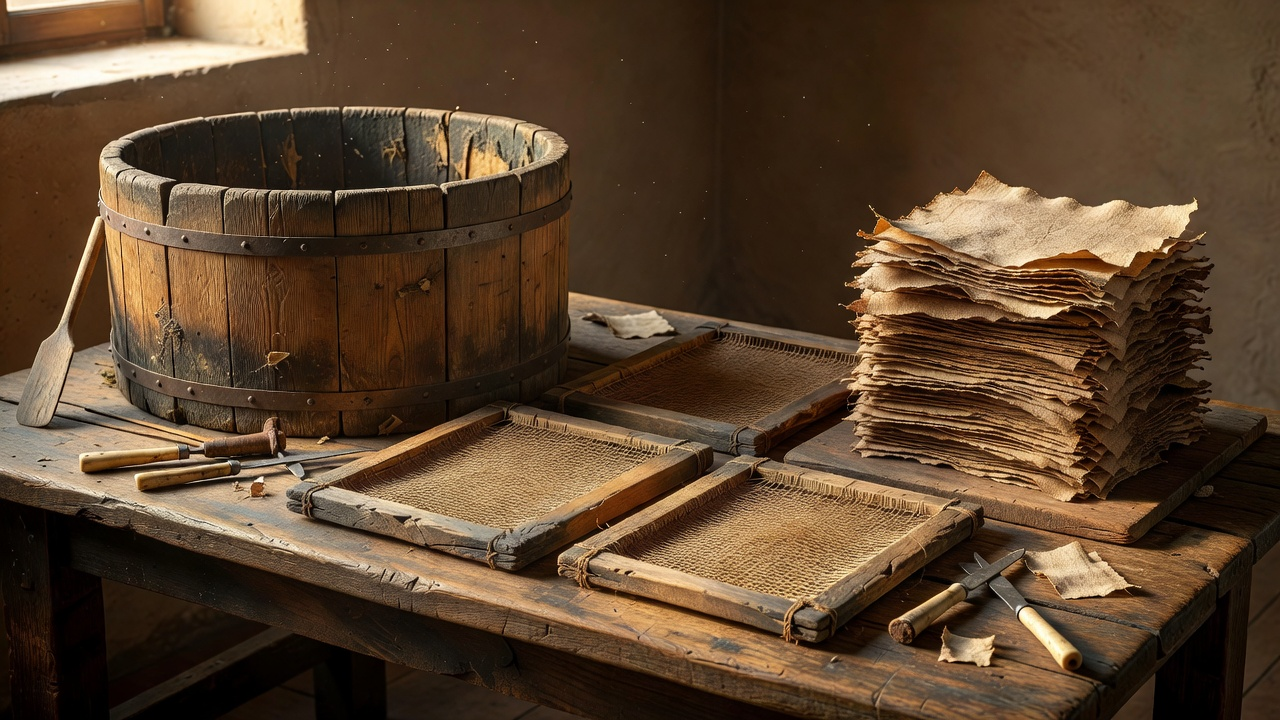
Concrete details emerge from the process: workers soaked linen and cotton rags—abundant in the Islamic world—for days, then beat them into a watery mash. Spread on screens and pressed dry, the sheets bore the faint imprints of their origins. This rag-based paper, tougher than China's tree-derived version, endured the rigors of travel and time, transforming Samarkand into the epicenter of the history of paper in the Islamic world.
From Samarkand to Baghdad and Damascus: A Paper Empire Expands
The innovation rippled outward. By 794 CE, Baghdad's mills under Caliph Harun al-Rashid churned out paper for the House of Wisdom, that legendary library where Greek, Persian, and Indian texts mingled. Damascus followed, its workshops supplying courts and mosques. Arab chronicler al-Tha'alibi, in his 11th-century Latā'if al-maʿārif, marveled at these operations, describing how paper's rise eclipsed parchment's dominance.
Imagine caravans laden with crisp quires snaking from Samarkand's bazaars to the Tigris. This network didn't just spread sheets; it amplified voices. Legal deeds, poetry, scientific treatises—all proliferated on paper's cheap canvas, embedding information history with a new resilience.
Unveiling Evidence: Arab Chronicles, Cairo Geniza, and Scientific Sleuthing
Chronicles and Geniza Fragments
Al-Tha'alibi's accounts provide textual proof, but the Cairo Geniza offers tangible relics. This trove, hidden in a Fustat synagogue attic from the 9th to 19th centuries, holds over 300,000 Arabic paper fragments. Many bear watermarks—maker's marks pressed into the sheet—linking them directly to 9th-12th century Islamic paper mills Samarkand helped pioneer.
Watermarks and Rag Analysis
Modern forensics seals the case. Watermarks, studied by scholars like Janirah Adلفang, match designs from Samarkand and Baghdad mills. Chemical analysis reveals rag contents: high linen percentages in early Geniza papers, shifting to cotton later, mirroring Islamic textile booms. These aren't abstractions; they're molecular echoes of medieval labor.
How Material Shapes Survival: Paper's Enduring Legacy
Papyrus crumbled in humid climates; parchment, though durable, was elite and finite. Paper? Versatile, recyclable, it invited everyday use—bills of sale, love letters, spells—now preserved in the Geniza. This biases our information history toward the mundane, revealing not just kings, but merchants haggling over figs or rabbis debating Talmud.
Broad theories posit media as survival filters: paper's abundance favored volume over permanence. Yet critique tempers this—survival is situated, not law-like. Geniza papers endured due to sacred disposal taboos, not inherent superiority. Theories must grapple with context: accidents of storage, cultural reverence.
Echoes in Information History and the Writing Memory Door
Samarkand's mills remind us: information history hinges on material affordances. As we digitize today, what survives? Cairo Geniza fragments challenge us to question biases in our archives. This revolution connects to the Writing Memory Door, where scripts and substrates entwine, urging us to decode not just words, but the worlds that bore them.
In Samarkand's shadow, paper whispered eternity. What medium will echo our own secrets through time?