
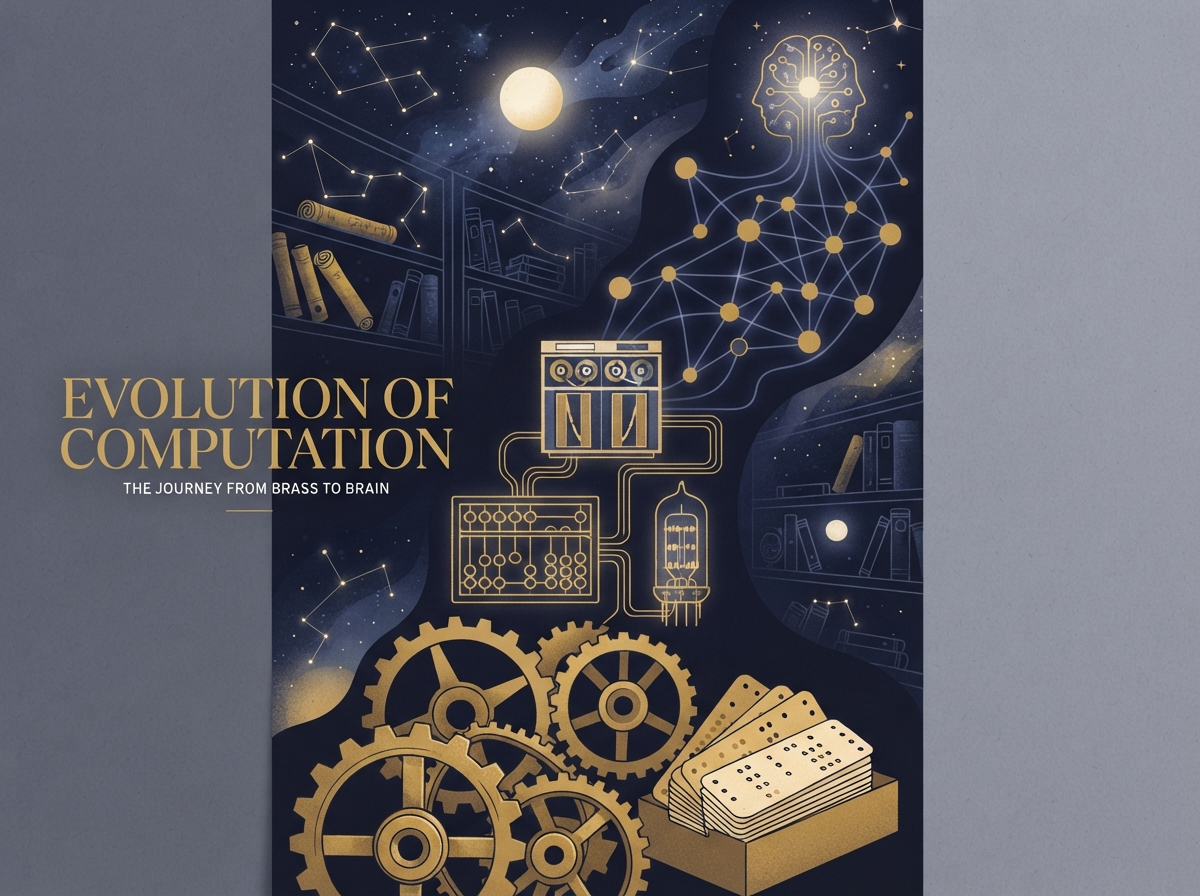
The 200-Year Human Odyssey of AI: From Babbage and Lovelace to Deep Learning's Dawn
Imagine a Victorian-era workshop humming with gears and punch cards, where the seeds of artificial intelligence were sown not in silicon chips, but in brass and ambition. The history of artificial intelligence stretches back over two centuries, a winding path of human ingenuity, setbacks, and quiet persistence. Far from a Silicon Valley flashpoint, AI's origins trace to dreamers who dared to mechanize thought itself. This odyssey reveals not just technical triumphs, but our enduring quest to mirror the mind.
The Analytical Engine: Babbage, Lovelace, and the Birth of Programmable Machines
In the 1830s and 1840s, Charles Babbage envisioned the Analytical Engine, a mechanical behemoth capable of performing any calculation through programmable instructions. Funded by the British government yet never fully built due to funding woes, it laid the groundwork for modern computing. Enter Ada Lovelace, daughter of Lord Byron, who in 1843 translated and expanded Luigi Menabrea's article on the engine. Her extensive notes—over three times longer than the original—prophesied machines weaving algebraic patterns "like the Jacquard loom," and composing intricate pieces akin to music.
Lovelace's insight into the engine's potential for creativity, beyond mere number-crunching, marks the AI origins in programmable generality. She grappled with limits: could machines originate new content, or merely recombine? These questions echo through the history of artificial intelligence, blending math, philosophy, and imagination.
Turing's Gambit: Can Machines Think?
From Computable Numbers to the Imitation Game
Fast-forward to 1936: Alan Turing's paper "On Computable Numbers" introduced the Turing Machine, a theoretical device proving what functions computers could—and couldn't—solve. Amid World War II codebreaking, Turing pondered deeper: In his 1950 Mind journal article "Computing Machinery and Intelligence," he posed the famous question, "Can machines think?" Sidestepping metaphysics, he proposed the Imitation Game—now the Turing Test—as a practical benchmark.
Here, Babbage Lovelace Turing converge: mechanical engines evolve into universal computors, challenging us to define intelligence not by souls, but by behavior. This foundation fueled cybernetics, Norbert Wiener's 1948 feedback-loop framework for control in animals and machines.
Dartmouth's Declaration: Naming AI and the Symbolic Era
The summer of 1956 crystallized it all at Dartmouth College. John McCarthy, Marvin Minsky, Nathaniel Rochester, and Claude Shannon convened, coining "artificial intelligence" in their proposal. Optimism reigned: machines would simulate every human intellect facet within a generation. Symbolic AI dominated—expert systems like Dendral (1965) diagnosing molecules via rule-based logic, or MYCIN (1970s) advising antibiotics.
Early wins dazzled, but hype outpaced reality. Established history shows these systems brittle outside narrow domains, igniting the first AI winter by the 1970s as funding froze.
Winters, Revival, and the Deep Learning Surge
Connectionism Rises with Backpropagation
A second winter hit the 1980s amid expert system flops, yet connectionism—neural nets mimicking brain neurons—stirred. Backpropagation, refined in 1986 by Rumelhart, Hinton, and Williams, enabled multi-layer training. Still, compute limits stalled progress.
The deep learning history pivots at ImageNet 2012. AlexNet, from Krizhevsky, Sutskever, and Hinton, crushed image recognition benchmarks using GPUs and vast data. This watershed separated hype from scalable reality, powering today's vision systems.
Why This Computational Chronicle Matters Today
Grasping AI's 200-year arc distinguishes fact from frenzy. Symbolic logic yielded to statistical learning, yet both stem from human hands—Babbage's designs, Lovelace's visions, Turing's proofs. For seekers at Aetheria, this history illuminates philosophy (mind's nature), mathematics (computability), and writing & memory (how we encode thought).
- Symbolic AI: Precision's promise and peril.
- Cybernetics: Feedback's timeless loop.
- Deep learning: Data's democratic force.
It humbles us: AI emerges from collective striving, not solitary genius or overnight miracles.
Charting the Next Horizon
As Aetheria's Guide navigates these Doors—distinct from AI's bold claims—pause. What echoes of Lovelace's loom do you see in neural webs? Explore onward: Philosophy probes essence, Mathematics rigor, Writing & Memory the human archive. This odyssey endures, inviting your step into the weave.