
Vizier History: Scribes, Palace Clerks, and Bureaucracy Before the Modern State
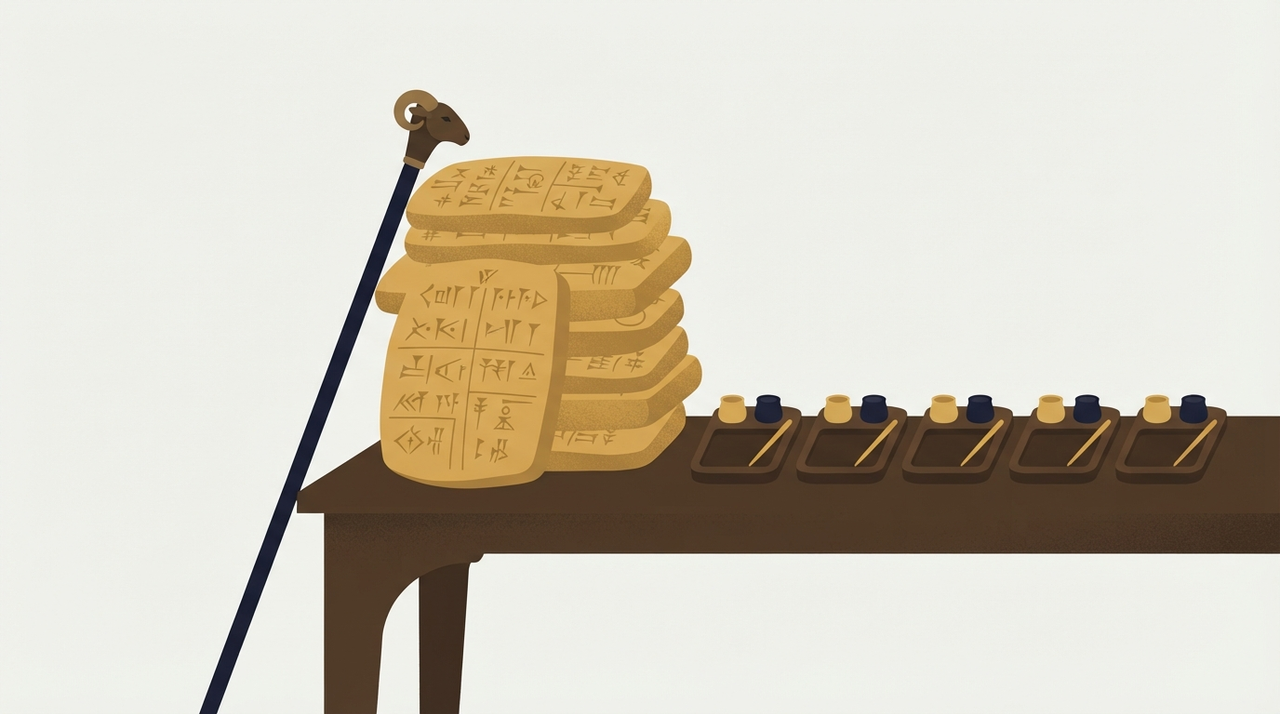
Clay tablets stack high in the dim palace storeroom, their edges sharp against the flickering lamplight. Each one bears cuneiform scratches, records of grain allotments, labor drafts, temple offerings. Nearby, wooden shelves groan under rolls of papyrus, tied with linen strings, ink still faintly legible after centuries. Rows of identical scribe palettes line the walls, palettes of limestone or wood, each with wells for red ochre and black soot inks, brushes tucked into slots. No royal throne commands this space. No scepter gleams. The king remains offstage, his decrees filtered through these silent accumulations. Here lies the labor of administration, the work of scribes and palace clerks who turned spoken will into enduring form.
These unnamed staff of office shaped empires long before modern bureaucracies emerged. They copied orders, tallied tribute, archived judgments. Their palettes wore smooth from use, their fingers callused from pressing reeds into clay. Vizier history unfolds not in grand battles or divine mandates, but in the quiet grind of scribes and administration, where power hid in the angle of a stylus stroke.
Varieties of Administrative Labor: Beyond the Single Title
Palace clerks came in many guises, each role carved by circumstance, culture, and control. Not every hand that held the stylus wielded equal authority. Some served as personal favorites, trusted confidants who whispered advice and drafted private missives. Others inherited their posts through family lines, hereditary vizierates binding administration to bloodlines.
Salaried clerks appeared in more structured systems, paid from state coffers for their tallying and filing. Enslaved secretaries, captured in war or born into service, managed correspondences under watchful eyes. Colonial interpreters bridged languages in conquered lands, translating decrees while navigating loyalties. These distinctions mattered. A personal favorite might alter a phrase to favor allies. A hereditary vizier could hoard records to protect kin. An enslaved secretary learned to survive by perfecting delay.
Consider the scribe's world. Training began young, boys memorizing signs under masters' rods. In Egypt, they copied the Book of the Dead alongside tax rolls. In Mesopotamia, they mastered Sumerian logs even as Akkadian dominated speech. Tools stayed simple: a reed stylus for wedges, a damp cloth to smooth errors. Yet roles diverged sharply. The runner dashed between chambers with wet tablets, racing against drying clay. The archivist dusted shelves, deciding what to keep. Palace clerks formed a spectrum, from lowliest copyist to high vizier, all threads in the web of bureaucracy before the modern state.
Vizier History in Ancient Egypt: Evolving Titles and Duties
Old Kingdom: Multiple Viziers and Granary Oversight
In the Old Kingdom, around 2686 to 2181 BCE, the title tjaty, later rendered vizier, denoted overseers of the king's works. Not one eternal job, but several men bore it simultaneously, each tied to a nome or department. Tomb inscriptions from Saqqara reveal their loads: supervising Nile inundations, measuring fields post-flood, auditing granaries. One vizier, Mereruka, boasted of hearing lawsuits daily, his stelae listing clerks under him.
Scribes and administration hummed in pyramid towns. Teams of 40,000 laborers needed rosters, bread rations, tool inventories. Palettes found in workmen's villages match those in royal tombs, underscoring the uniformity. These palace clerks ensured stone blocks arrived on time, their tallies preventing famine or revolt.
Middle and New Kingdoms: Consolidation and Justice
By the Middle Kingdom, 2055 to 1650 BCE, viziers consolidated power. Titles multiplied: overseer of the double house of silver and gold, chief of the six courts of justice. The vizier Rekhmire, from the 18th Dynasty New Kingdom, inscribed his wall at Thebes with duties. He inspected craftsmen's work, tallied southern oases tribute, judged nobles and commoners alike.
Enslaved secretaries appear in records, Nubians or Asiatics copying foreign tallies. Hereditary lines strengthened; fathers trained sons in hieratic script. Bureaucracy before the modern state peaked here, with viziers reviewing daily reports from provincial clerks. A single delayed shipment of emmer wheat could spell unrest.
Scribes and Administration in Mesopotamia: Šukkallu and Vast Archive Rooms
Mesopotamia's palaces brimmed with clay. At Ebla, around 2500 BCE, 17,000 tablets filled rooms, cataloged by genre: lexical lists, offering rosters, diplomatic notes. Scribes, dubbed dub-sar, worked in schools attached to temples, graduating to palace service. Their šukkallu, vizier-like figures in later kingdoms like Mittani (1500 BCE), coordinated envoys and tribute.
Archive rooms at Mari on the Euphrates held letters from distant rulers, sealed with cylinder imprints. Palace clerks sorted by sender, piercing tablets for strings to bind batches. Runners carried empties to writers, returning with fresh impressions before sun baked them permanent. One letter from Zimri-Lim's time details a scribe delaying a grain order, citing flood-damaged roads. Such acts reveal the leverage of unnamed staff of office.
In Assyria's Neo period, 911 to 612 BCE, scribes managed provincial governors' reports. Libraries at Nineveh stored 30,000 items, but administrative cores focused on taxes, corvee. Hereditary families dominated, sons apprenticed in cuneiform houses. Personal favorites advised kings on omen texts, blending divination with policy.
A Distinct Path: Chinese Examination Officials and Merit Selection
Imperial China diverged, emphasizing exams over heredity. From the Han Dynasty, 206 BCE to 220 CE, officials passed tests in classics, calligraphy, arithmetic. Standardized by Tang in 605 CE, the system produced palace clerks versed in memorials and edicts. Unlike Egyptian viziers, these men rotated posts, preventing entrenched power.
Grand Secretaries in the Ming era oversaw the Hanlin Academy, drafting imperial rescripts on silk or paper. Provincial runners relayed bamboo slips, heavy bundles testing endurance. Archives in the Forbidden City housed millions of documents, sorted by reign. A lowly clerk might alter a character, shifting tax burdens subtly. Bureaucracy before the modern state here meant Confucian scholars wielding brushes as swords of state.
Women rarely entered, but eunuchs filled gaps as enslaved secretaries, managing inner palace records. Their literacy sparked tensions, eunuch cliques rivaling outer officials.
The Medieval Chancery: European Palace Clerks in Transition
In medieval Europe, chanceries evolved from Carolingian scriptoria. By the 12th century, English kings employed salaried clerks in the Exchequer, tallying sheriffs' accounts on pipe rolls. Papal chancery in Avignon processed indulgences, bulls sealed with lead. Scribes used quills on parchment, abbreviating Latin to save space.
Italian notaries, trained in universities, served as colonial interpreters in Crusader states, drafting treaties in Arabic and Latin. Hereditary chancellors like Becket rose, but most remained unnamed staff of office. A 13th-century Westminster roll lists dozens of anonymous hands, their scripts betraying fatigue in flourishes.
Runners navigated castle stairs, dodging courtiers. Delays in charters sparked lawsuits, clerks blamed for lost wax seals. Vizier history in this era bridges antiquity and state, with clerks professionalizing amid feudal ties.
The Power of the Copy: Who Writes, Delays, or Loses the Order
Every decree began as voice, ended as artifact. Who held the stylus decided fates. In Egypt, viziers reviewed drafts, but junior scribes copied finals, slipping omissions. A Rekhmire stele notes floggings for errors, yet perfect copies concealed intent.
Mesopotamian wet clay allowed erasures, but fired tablets fixed words. Delay meant holding in shade, claiming more review needed. Archives buried inconvenient records under newer stacks. Chinese memorials piled in pendings, clerks shuffling to bury rivals' pleas.
Losing proved potent. Egyptian papyri from the village of Deir el-Medina show clerks "misplacing" complaints against foremen. Medieval rolls cite fires or floods, convenient for crown. Runners feigned drops in mud, buying time. This power, subtle and deniable, defined scribes and administration. Bureaucracy before the modern state thrived on such frictions, clerks as gatekeepers of action.
- The writer chooses phrasing, ambiguity a shield.
- The delayer cites procedure, endless verification.
- The loser points to chaos, archives as black holes.
Cross-Doors: Threads to Aetheria's Broader Corpus
Business Door: Administration as Core Labor
Echoes in coordination studies, where distributed tasks mirror palace divisions. Scribes model flows without central heroes.
Technology Door: The Act of Writing
From cuneiform to quill, tools shaped control. Explore memory tech in Writing & Memory Room.
History Door: Temporal Layers
Vizier history layers atop general chronicles, focusing labor over crowns.
Writing & Memory Room: Archives as Power
Tablets and rolls preserved selectively, ethics of forgetting intertwined.
Ethics Door: Duty and Subversion
Clerks balanced loyalty against survival. Who names the nameless?
Invitation: Seek the Unnamed Hand
Next time a document crosses your path, a contract or charter, pause. Whose script shaped it? Whose delay spared or doomed? In Aetheria's Community, share: whose name hides in your archive? Vizier history lives in these traces, bureaucracy before the modern state a testament to labor unseen. The palettes wait, stacks eternal.