
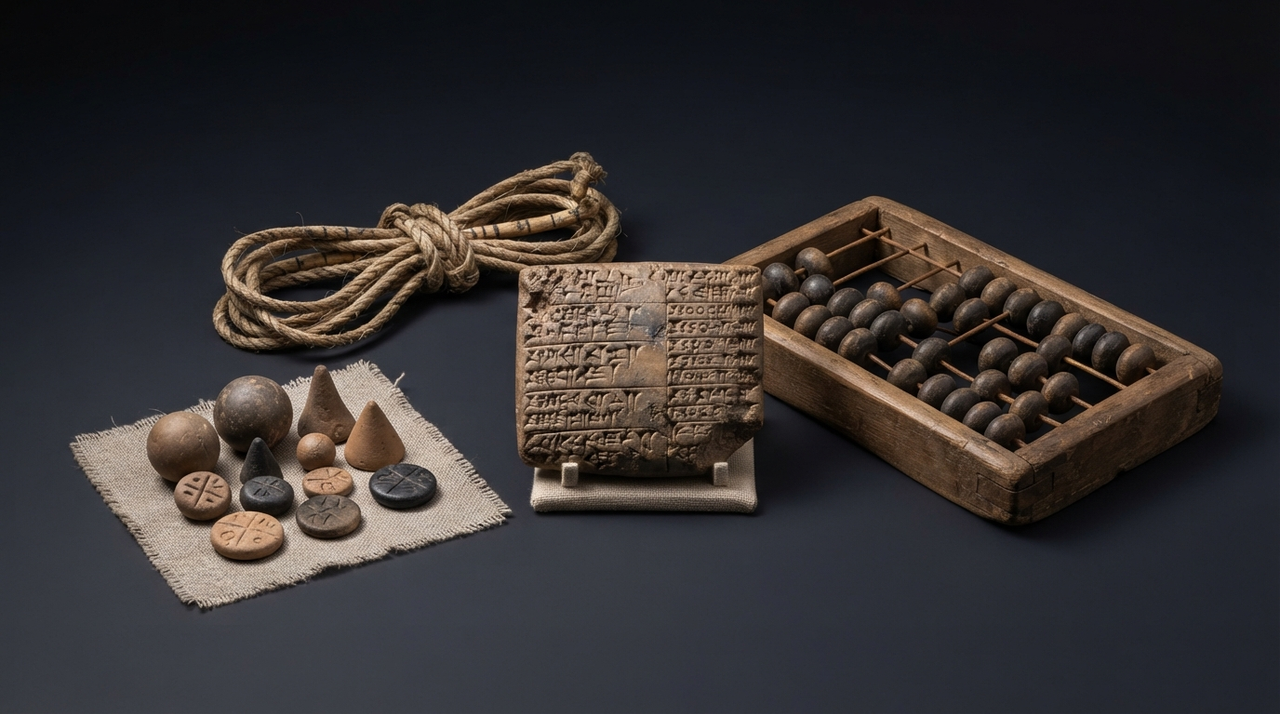
Ancient Computation: Clay Tokens, Abacus Precursors, Babylonian Base-60 & Quipu Knots
Picture a bustling Mesopotamian marketplace around 8000 BCE. A merchant tallies sacks of barley not with scratches on a tablet, but by dropping small, molded clay tokens into a clay envelope—each shape representing grain, sheep, or oil jars. This tactile system of ancient computation wasn't a primitive quirk; it was the world's first step toward abstract accounting, laying groundwork for writing itself. For students of ancient mathematics and measuring practices, these artifacts reveal how early societies wrestled with numbers long before silicon chips or algorithms.
In this exploration, we delve into clay tokens, abacus precursors, Babylonian base-60 innovations, Egyptian measuring ropes, timepieces like sundials and water clocks, and Inca quipu knots. Far from mythical supercomputers, these were practical tools for scribes in temples and palaces—limited by material fragility and cultural specifics, yet profoundly influential. We'll distinguish these counting aids from modern programmable machines and highlight reconstruction challenges, connecting back to core doors in mathematics and science.
Clay Tokens: The Birth of Ancient Computation in Mesopotamia
Archaeologists unearthed thousands of these unassuming lumps—spheres for barley, cones for wool—from sites like Tepe Gawra in Iraq, dating to the Neolithic Ubaid period. Sumerian administrators used clay tokens for inventory in emerging urban centers, where temples managed vast agricultural surpluses. A 1-gram ovoid might signify one measure of oil; clusters tracked hundreds.
Tokens evolved: impressed onto the envelope's exterior for verification, they morphed into proto-cuneiform script by 3500 BCE. This transition underscores ancient computation's roots in concrete representation, not abstract symbols. Limits abound—many tokens dissolved in soil, and shapes varied regionally, complicating full reconstructions. Yet, they prefigure accounting ledgers, reminding us how math doors opened through institutional needs.
From Tokens to Tallies: Abacus History Unfolds
As tokens gave way to writing, pebble boards and tally sticks emerged as abacus history precursors. In ancient Egypt and Greece, merchants slid stones (calculi) along lines in sand or grooves—manual sorters for addition and multiplication. The Roman handheld abacus, with beads on wires, refined this by 200 BCE, used by tax collectors in forums. These weren't Turing-complete devices but speed-ups for rote arithmetic, bounded by human dexterity and error-prone resets.
Babylonian Mathematics: The Legacy of Base-60
By the Old Babylonian era (2000–1600 BCE), scribes in cities like Nippur etched clay tablets with cuneiform numerals in sexagesimal (base-60). Why 60? Its divisors (1,2,3,4,5,6,10,12,15,20,30,60) eased fractions for trade and astronomy. Tablets like Plimpton 322 showcase Pythagorean triples, solved via geometric algorithms, not proof—evidence of practical Babylonian mathematics.
Palace schools trained ummânu (experts) for lunar predictions and land surveys. Base-60 endures in our 360-degree circles and 60-minute hours. Reconstructions falter without full context—place-value ambiguity (no zero until later) led to interpretive debates, highlighting science doors' fragility.
Measuring Rope and Timepieces: Practical Geometry and Chronometry
Egyptian Rope Stretchers: Harnessing Triangles
Pharaohs' builders, the harpedonaptai, knotted measuring ropes into 3-4-5 Pythagorean triangles for right angles at Giza pyramids (c. 2600 BCE). Palm fibers stretched taut amid Nile floods, aligning foundations with stellar precision—but only for known ratios, not arbitrary lengths. Temple guilds institutionalized this, blending math with ritual.
Sundials and Water Clocks: Shadow and Flow
Egyptian obelisks cast shadows for daytime hours by 1500 BCE; Babylonians refined portable versions. Water clocks (clepsydrae) dripped steady flows for nights or speeches, used in courts. Inaccurate in wind or evaporation, they measured intervals, not absolute time—key limits in ancient science.
Quipu Knots: Inca Information in Strings
High in Andean peaks, Inca khipukamayuq (quipu keepers) twisted cotton cords with knots encoding census data, taxes, and storehouses by the 1400s CE. Main cords dangled clusters: single knots for 1–9, long for 10s, colors for commodities. Up to 1,500 cords per quipu tracked empire-wide herds.
Quipu excelled in aggregation, not narrative—undeciphered beyond basics due to oral keys lost to conquest. Institutionalized in Cusco's bureaucracy, they exemplify non-numeric computation's power and peril.
Bridging Eras: Lessons from Ancient Tools
These artifacts—clay tokens, abacus precursors, Babylonian base-60, measuring ropes, sundials, water clocks, quipu—weren't ancient super-tech but human extensions for trade, stars, and statecraft. Temples and empires drove them, yet perishability and context gaps limit revival. For mathematics and science students, they unlock doors: computation as embodied practice, not disembodied code. Next time you glance at a clock's 60 minutes, nod to those clay-handed pioneers.